A second-year student team from Panjab University’s UILS clinched the 9th GNLU Moot on Securities and Investment Law 2026, impressing judges with strong arguments on investor protection, regulatory disclosure, and U.S. law risks to emerge overall champions.
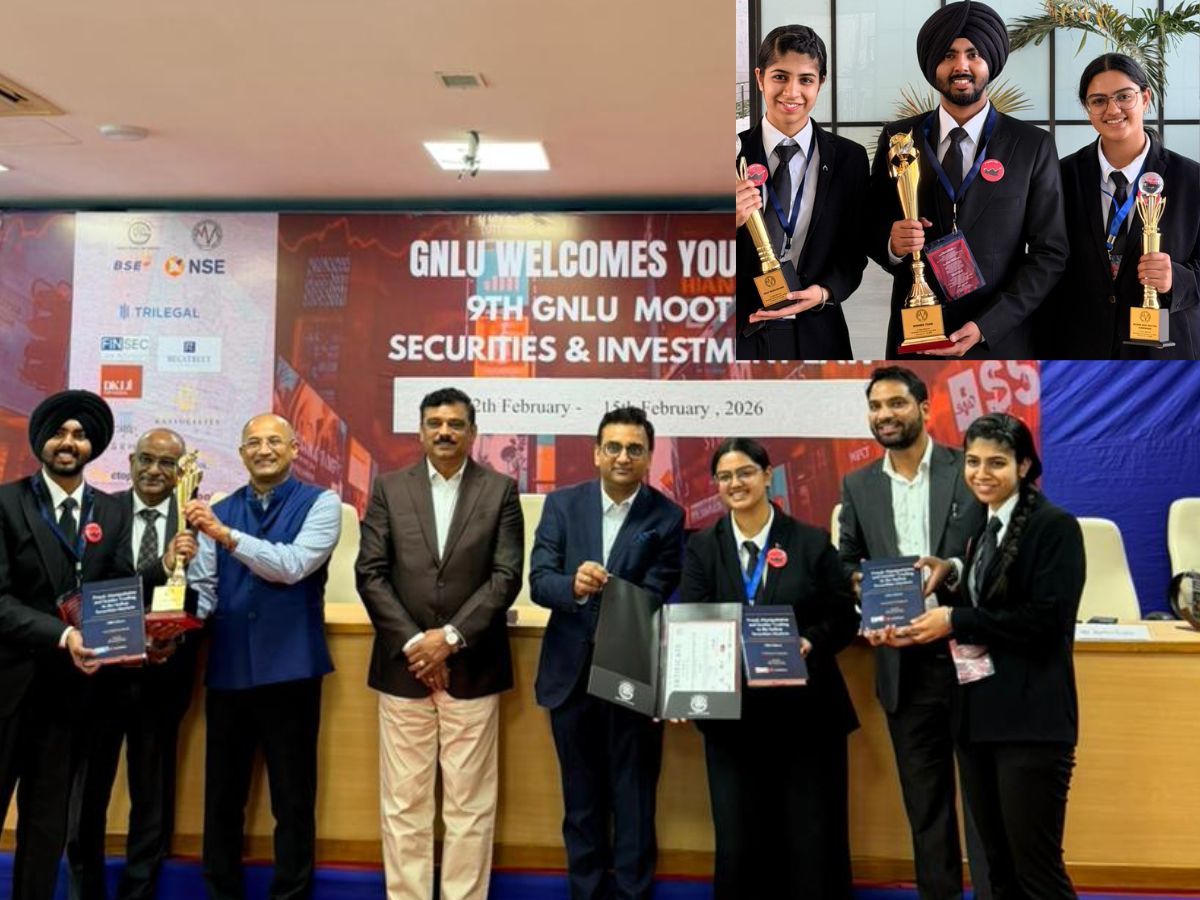
A three-member team from the University Institute of Legal Studies (UILS), Panjab University, has won the prestigious 9th GNLU Moot on Securities and Investment Law, 2026
Gandhinagar / Chandigarh – 12th - 15th February 2026: A three-member team from the University Institute of Legal Studies (UILS), Panjab University, has won the prestigious 9th GNLU Moot on Securities and Investment Law, 2026. The team composed entirely of second-year law students Manraj Singh Chandpuri (Oralist 1), Navnoor Rana (Oralist 2) and Harliv Kaur Mundi (Researcher), not only emerged champions but also took home the second-best written submission award and the best researcher award.
The competition, hosted by Gujarat National Law University in February 2026, is one of India’s leading commercial-law moots and is in collaboration with leading partners such as Bombay Stock Exchange India Investor Protection Fund, Trilegal, Finsec Law Advisors, Regstreet Law Advisors, Joby Matthew & Associates, National Stock Exchange, DKL Advocates, etc. The 2025-26 edition featured a problem centred on a proposed initial public offering (IPO) and raised questions about regulatory disclosure. During preparation, the Bombay High Court on 1st Dec. 2025 delivered its judgment in Hemant Kulshreshtha v. SEBI– a case bearing striking similarity to the moot problem, meaning the students had to adjust their strategy mid-way. The problem also contained two unique twists that were not covered in the real case such as a license agreement governed by U.S. law with anti-bribery obligations and silence on the eligibility route under Regulation 6(2) of the ICDR Regulations, 2018. These additional facts became the focus of UILS’s submissions.
The Finals were between UILS as Petitioners and Maharashtra National Law University, Aurangabad as Respondents.
“At least ninety-eight per cent of the facts were identical to the real dispute before the Bombay High Court. We argued that the ratio of Hemant should be expanded to account for the two extra facts that materially changed investor risk,” said the team. As Petitioners they contended that although Hemant favoured the Respondent in the real case, the presence of a U.S. law operations and management agreement (subject to the Foreign Corrupt Practices Act) and the lack of clarity about the issuer’s eligibility route made the case in the moot different. The team emphasised that American anti-bribery rules treat suspicions of corruption as an existential threat, meaning the foreign licensor could terminate the contract even before a conviction, a risk that needed to be disclosed to investors. They also argued that SEBI’s 2024 Guidelines for returning of draft offer document and its resubmission, required regulators to state clearly which eligibility route under Regulation 6 applied, failure to do so meant the offer could not proceed to the final prospectus stage.
Throughout the rounds, the UILS team maintained that the regulator had a duty to protect investors by ensuring disclosure of all material risks. They used the Bombay High Court’s own guidance in Hemant which requires “intelligible” and integrated disclosure of risk factors and sought to distinguish the case by showing how the additional U.S. law complications warranted greater regulatory scrutiny. Their submissions highlighted how Indian institutional investors could be at a disadvantage compared with U.S. investors who better understood the foreign legal obligations.
For UILS, the victory is significant as it marks the first time the Chandigarh‑based institution has won this particular national competition. The team credits their success to rigorous preparation, support from faculty, and a willingness to take on a problem that was heavily skewed towards the respondent. “We approached the case as underdogs,” the team noted. The law appeared to favour the other side, but by focusing on investor protection and the unaddressed U.S. law risk, we attempted to convince the judges that a more expansive view of the precedent was necessary.”
The achievement underscores UILS’s growing reputation in mooting circles and highlights the quality of legal research and advocacy training at the university.
