
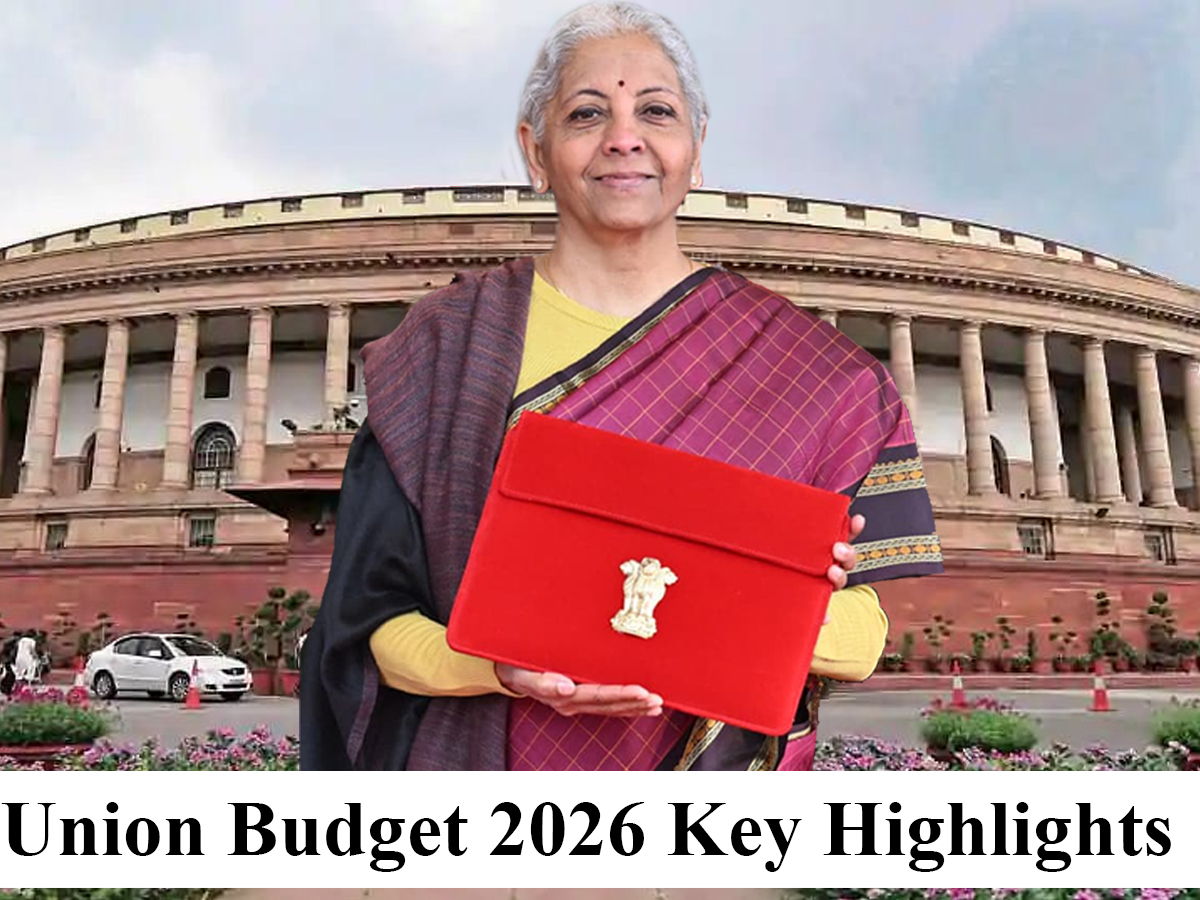
Finance Minister Nirmala Sitharaman presented the Union Budget 2026–27 in the Lok Sabha, marking a first-ever Sunday Budget in independent India and her ninth consecutive fiscal address. The Budget blends ambitious infrastructure plans, tax reforms, industry support and social measures, reflecting the government’s push for sustainable and inclusive economic growth driven by youth energy and deep reforms.
Here are the 10 key highlights that will shape India’s economic direction in the coming year.
1. Strong Push for Semiconductor Manufacturing
Sitharaman unveiled India Semiconductor Mission 2.0, with a ₹40,000 crore outlay to accelerate chip production, industry-led research and training, and strengthen global technology partnerships — a major step towards tech self-reliance.
2. Record Capital Expenditure to Boost Infrastructure
The government raised its capital expenditure allocation to ₹12.2 lakh crore for FY27, nearly 9% higher than before. This reflects continued focus on infrastructure to support jobs, connectivity, and economic resilience.
3. Seven High-Speed Rail Corridors Announced
Budget 2026 includes plans for seven new high-speed rail corridors connecting major cities such as Mumbai-Pune, Pune-Hyderabad, Hyderabad-Bengaluru, and Delhi-Varanasi, aimed at reducing travel time and promoting greener transport.
4. New Freight and Rare Earth Corridors
In addition to passenger rail, the Budget outlines a dedicated east-west freight corridor and rare earth mineral corridors in Odisha, Kerala, Andhra Pradesh, and Tamil Nadu to bolster raw material supply for high-tech industries.
5. Big Support for MSMEs and SMEs
A ₹10,000 crore SME Growth Fund will nurture smaller firms, help create jobs, and bolster competitiveness. This comes alongside policy, credit, and technology support to strengthen the MSME backbone.
6. Tax Reforms and Compliance Ease
The Budget proposes simplified income tax rules, an updated Income Tax Act, and extended timelines for filing revised returns, offering more flexibility to taxpayers, including individuals and trusts.
7. Reducing TCS and Tax Ease for Travel and Education
Sitharaman reduced TCS on overseas tour packages and foreign education remittances to 2% under the liberalised remittance scheme, benefiting middle-class families and boosting travel and learning mobility.
8. Fiscal Discipline With Lower Deficit
The government estimates a fiscal deficit of 4.3% of GDP for 2026-27, slightly lower than the current year, signalling a continued focus on fiscal consolidation even while expanding spending.
9. Enhancing Digital and Global IT Services
To attract global technology firms, Budget 2026 proposes a tax holiday until 2047 for foreign companies offering cloud services through India-based data centres, reinforcing the country’s digital economy ambitions.
10. Citizen-Centric Social and Economic Measures
The Budget outlines plans such as girls’ hostels in every district, veterinary health support schemes, enhanced healthcare facilities, and support for university townships near industrial logistics hubs, aiming to improve the quality of life across regions.




