Union Budget 2026 places education, skills, AI and youth employment at the core of India’s growth strategy with major reforms across healthcare and innovation.
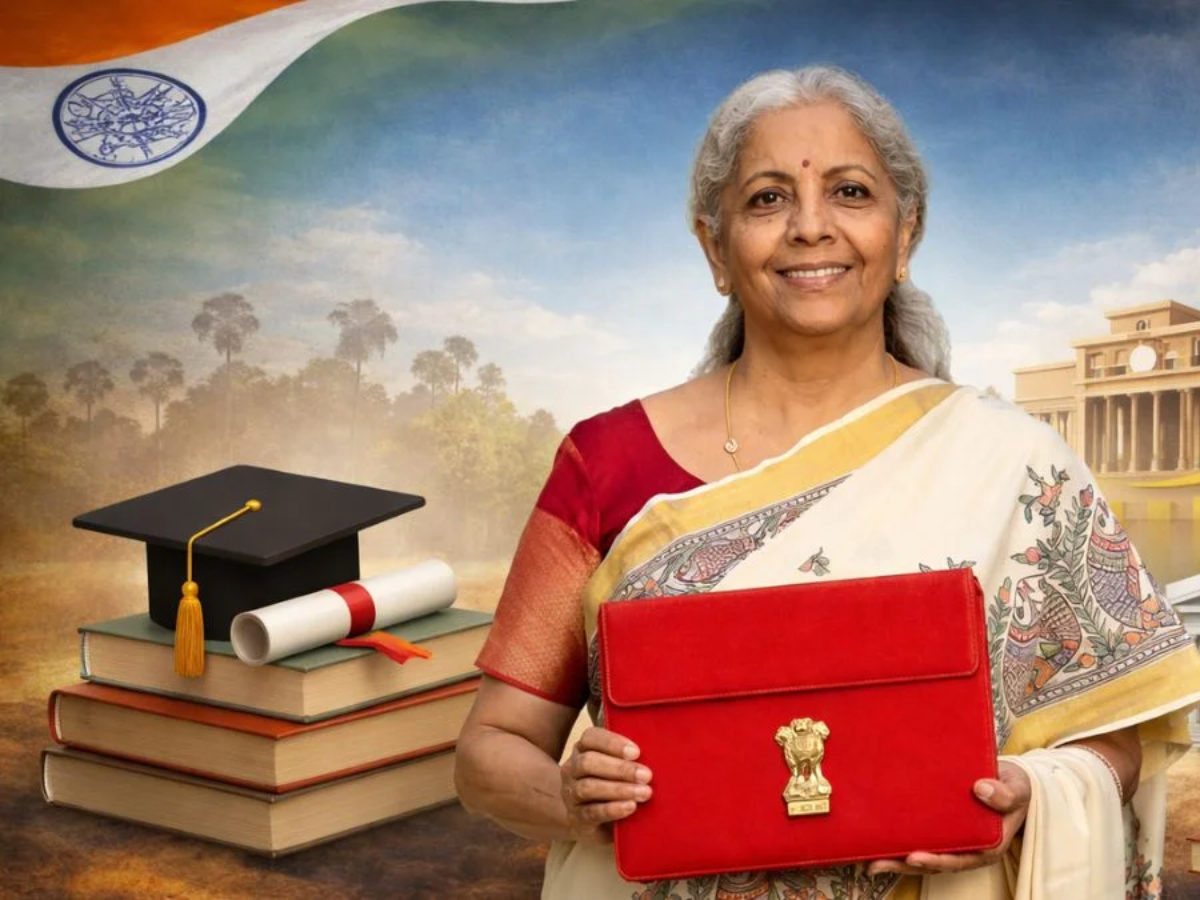
Finance Minister Nirmala Sitharaman presents Union Budget 2026, outlining major reforms in education, skills and youth-focused growth initiatives (Photo: File)
Union Budget 2026: The budget 2026 was a historic year since Finance Minister Nirmala Sitharaman was making the first Budget presentation on a Sunday. In addition to the symbolism, the Budget was an unequivocal message that education and skills are now a core part of the India economic strategy in the long-term with youth employment, innovation and human capital taking the centre-stage the government announced reforms to create an employment-ready workforce in the future.
The Budget places education firmly at the heart of national development where public spending on education rose to Rs 1.28 lakh crore, a 6.65% increase over the previous year. The Economic Survey 2026 notes that India’s higher education institutions expanded from 51,534 in 2014–15 to 70,018 by June 2025, reflecting steady capacity building across universities and colleges.
Healthcare education received a significant push with the government proposed three new National Institutes of Pharmaceutical Education and Research, upgrades to seven existing institutes and a network of 1,000 accredited clinical trial centres. Selected institutions will also train one lakh allied health professionals, strengthening India’s healthcare talent pipeline.
To bridge the education-employment gap, an Education to Employment and Entrepreneurship Committee has been proposed. ICAI and ICSI will roll out short-term, modern courses and expand the Corporate Mitra programme, particularly in Tier-2 and Tier-3 cities with a pilot project with IIMs will train 10,000 tourist guides across 20 iconic destinations, linking skills with services-led growth.
The Budget deepened its technology push through a national AI Mission, backed by the National Research Fund and Innovation Fund. These initiatives aim to support students, encourage women in STEM and promote applied research. The Content creator labs in schools and a new design institute in eastern India further underline the shift toward creative and digital skills.
Social inclusion remains a key theme. The government announced one girls hostel in every district, national mental health institutes, upgraded AYUSH pharmacies and capital support for veterinary colleges and diagnostics. TCS on overseas education remittances under LRS has been reduced from 5% to 2%, easing the burden on students pursuing education abroad.
