Supreme Court bans NCERT Class 8 textbook over judiciary corruption content. Here’s the full controversy, court orders, and what happens next.
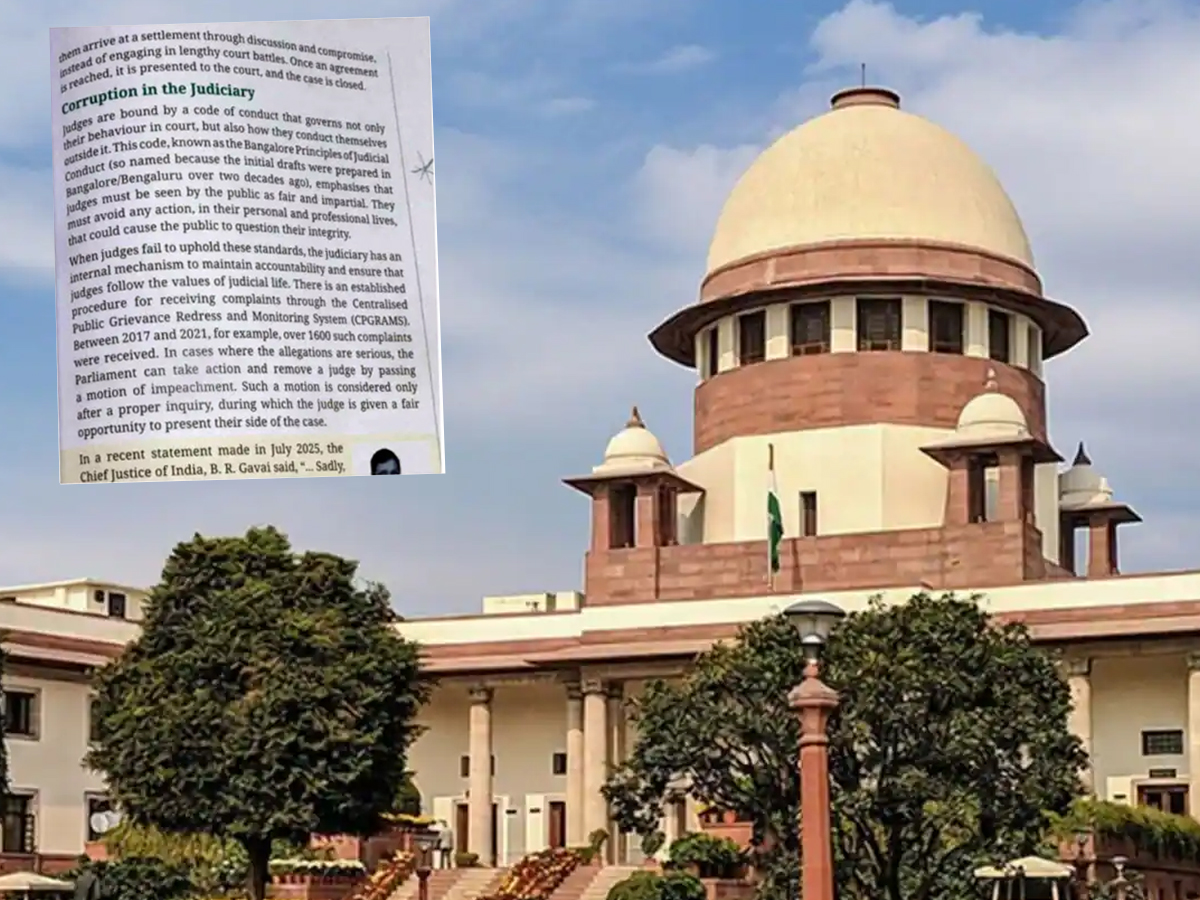
According to the court, introducing these issues to 13–14-year-old students in this manner paints the judicial institution in a damaging light and crosses the line from education into defamation. (File Photo)
A storm has erupted over a chapter in a newly released Class 8 Social Sciences textbook by NCERT, after the Supreme Court of India stepped in with unprecedented urgency. What began as an academic discussion on the role of courts has now turned into a major institutional confrontation, with the top court banning the book entirely and warning of strict action.
The controversy centres on how the judiciary was described to young students under the new National Education Policy (NEP) framework. The Supreme Court has made it clear that it will not tolerate what it sees as an attempt to undermine public faith in the judicial system.
The dispute arises from a chapter titled ‘The Role of the Judiciary in Our Society’, included in the new Class 8 NCERT Social Sciences textbook released on February 24. The chapter referred to corruption within the judiciary, a huge backlog of cases, and a shortage of judges.
According to the court, introducing these issues to 13–14-year-old students in this manner paints the judicial institution in a damaging light and crosses the line from education into defamation.
The matter was brought to the court’s attention by senior advocate Kapil Sibal. Chief Justice Surya Kant responded immediately, initiating a suo motu case and expressing strong displeasure.
The Chief Justice asserted that the court would not allow anyone to “defame the institution”, describing the textbook content as part of what appeared to be a “deep-rooted conspiracy” rather than a neutral academic exercise.
The Supreme Court went far beyond criticism and issued sweeping directions:
“Ensure that all copies of the book, hard copy or soft copy, whether held in retail outlets or schools is removed from public access,” the CJI said.
Following the court’s sharp observations, NCERT moved quickly. It withdrew the textbook and began recalling copies. Of the 2.25 lakh copies printed, only 38 had been sold before the withdrawal.
NCERT later issued an apology, stating that the “error” was “unintentional” and that the controversial portion would be “rewritten”. However, the Supreme Court was unconvinced.
The court remarked that the wording did not appear to be a “bona fide error”, adding, “It seems to us that there is a calculated move to undermine institutional authority and demean the dignity of the judiciary.”
At the outset, Solicitor General Tushar Mehta, appearing for the Centre, apologised and assured the court that the officials responsible for drafting the chapter would not be associated with future work of the UGC or any ministry.
The Supreme Court sought full details of the National Syllabi Board members involved in drafting the chapter and signalled that a deeper probe may be ordered.
“We would like to have a deeper probe. We need to find who is responsible... Heads must roll! We will not close the case,” CJI Kant said.
The court also issued a show-cause notice under the Contempt of Courts Act to the Secretary of School Education and NCERT Director Dr. Dinesh Prasad Saklani, while clarifying that it does not intend to stifle legitimate criticism of the judiciary.
Senior advocates weighed in with differing views. Abhishek Manu Singhvi suggested that the move appeared selective. “The selectivity, my lord. Corruption is there in other areas also,” he said.
Kapil Sibal echoed the concern, asking, “What about politicians and leaders?” The court noted these arguments but maintained that the age of the students and the language used made the content unacceptable.
The matter will come up for hearing again after four weeks. Until then, the textbook remains banned, and the controversy has sparked a wider debate on academic freedom, institutional respect, and how sensitive topics should be taught in schools.
