
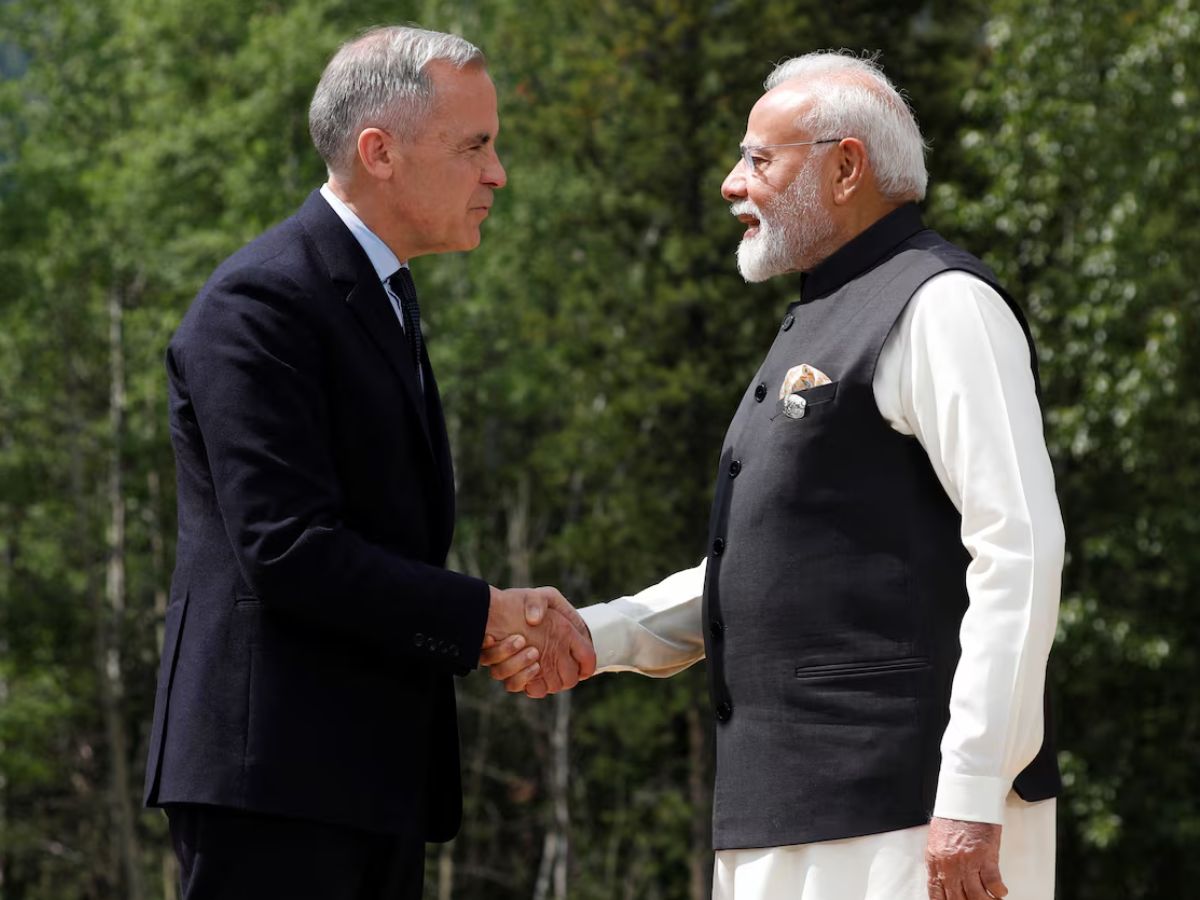
Canada is clearly moving to reset its relationship with India as Prime Minister Mark Carney prepares for his first major international tour. The visit places New Delhi at the heart of Canada’s wider Indo-Pacific strategy, which aims to diversify trade, draw foreign investment, and build strong long-term partnerships at a time of global economic uncertainty.
Announcing his travel plans to India, Australia, and Japan from February 26 to March 7, Carney said Canada’s new government is concentrating on “what we can control” in an increasingly divided world. He explained that this approach means strengthening Canada’s economy at home while expanding and rebalancing global ties abroad.
Mark Carney’s India Visit
India will be the first and most important stop on Carney’s tour. This highlights Ottawa’s intention to upgrade ties with the world’s fastest-growing major economy after a phase marked by tensions and missed opportunities.
During his visit to Mumbai and New Delhi, Carney is scheduled to meet Prime Minister Narendra Modi. Officials say the talks will help shape an ambitious new chapter in Canada–India relations.
Discussions are expected to focus on cooperation in trade, energy, technology, artificial intelligence, defence, talent mobility, and culture. Carney will also meet Indian business leaders and promote Canada as a stable and investment-friendly destination, especially in areas such as clean energy, critical minerals, advanced manufacturing, and digital technology.
Growing India–Canada Trade Links
India is already Canada’s seventh-largest trading partner, with total goods and services trade valued at $30.8 billion in 2024. Both countries have set a bigger target of more than doubling trade to $70 billion by 2030 under a proposed Comprehensive Economic Partnership Agreement.
Negotiations for the deal began after last year’s G20 Leaders’ Summit, and Carney’s visit is expected to give fresh political push to the talks.
Officials say India’s importance goes beyond trade figures alone. With global supply chains changing and geopolitical competition rising, Canada sees India as a key partner in building a more resilient and diversified economy. India’s growing role in technology, manufacturing, and global trade fits well with Canada’s efforts to reduce dependence on a limited number of markets.
“India is a powerhouse economy and a central actor in the Indo-Pacific,” a senior government source said. “Deepening this partnership is essential for Canada’s long-term prosperity and security.”
Plans After India
After India, Carney will visit Australia, where he will meet Prime Minister Anthony Albanese in Sydney and Canberra. Talks will cover defence, maritime security, critical minerals, trade, and advanced technologies, including artificial intelligence. In a rare gesture, Carney will address both houses of Australia’s Parliament — the first Canadian prime minister to do so in nearly 20 years.
The final stop will be Japan, where Carney will hold talks with the Japanese prime minister on clean energy, advanced manufacturing, food security, and defence. Japan remains one of Canada’s key partners in Asia, with annual bilateral trade worth $36.4 billion.
Canada’s Renewed Indo-Pacific Focus
Together, the visits to India, Australia, and Japan form the core of Canada’s renewed Indo-Pacific strategy, which the government says is based on economic realism and shared interests. Carney has highlighted Canada’s strengths, including abundant energy resources, critical minerals, advanced technology, and skilled talent.
“In a more uncertain world, Canada is focused on what we can control,” Carney said in a statement. “We are diversifying our trade and attracting massive new investment to create new opportunities for our workers and businesses. We are forging new partnerships abroad to create greater certainty, security and prosperity at home.”
For India, the visit sends a strong message that Canada is ready to move past earlier tensions and invest both politically and economically in rebuilding trust. As Canada looks to secure future growth through the Indo-Pacific region, New Delhi now appears firmly back at the top of Ottawa’s diplomatic and economic priorities




