Panipat refinery workers protested over 12-hour shifts, unpaid overtime, and poor facilities, triggering clashes with police and CISF at the IOCL plant.
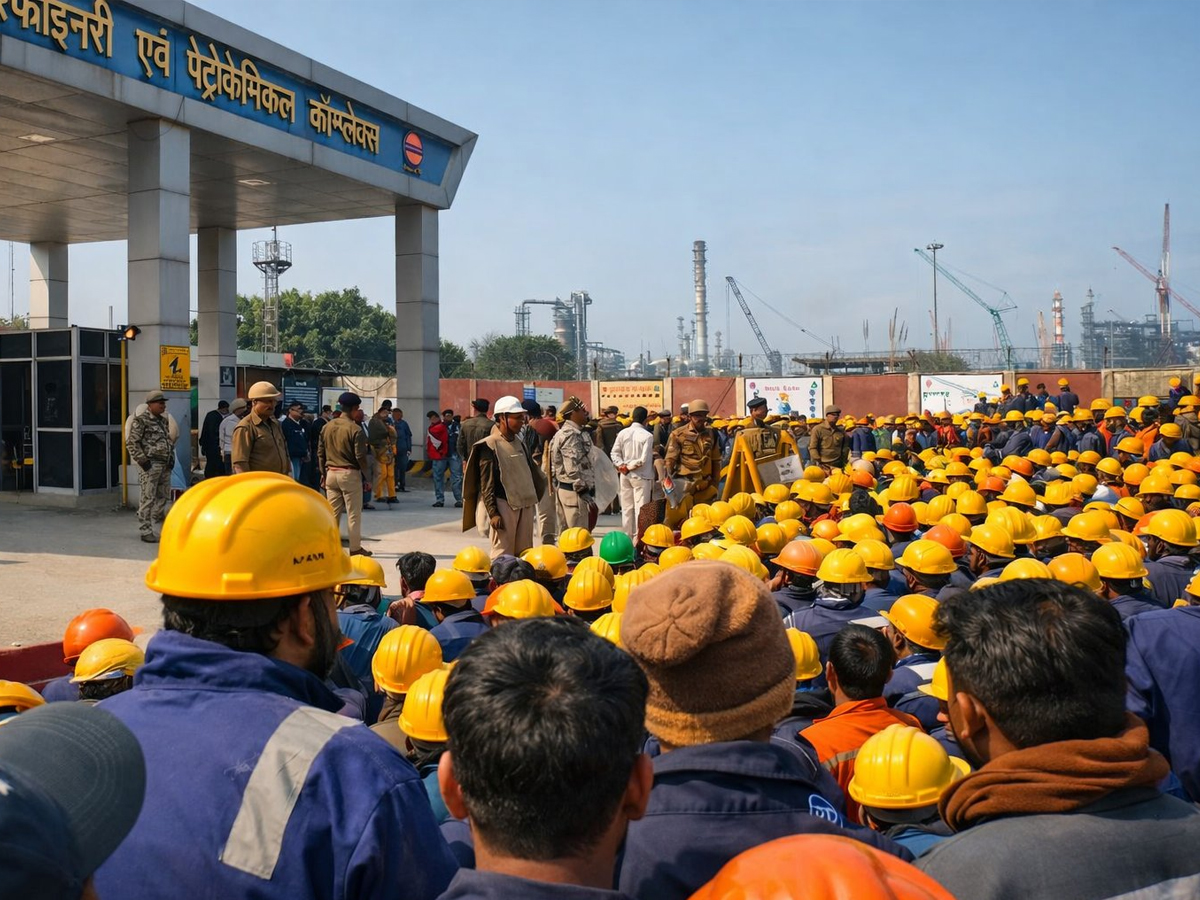
Workers say long working hours, delayed salary payments, and poor on-site facilities have become routine, pushing them to the streets. (Photo: X/ActionAidIndia)
Hundreds of contract workers at the Indian Oil Corporation Limited (IOCL) refinery in Panipat, Haryana, launched a large protest demanding better working conditions, fair wages, and basic facilities. What began as a planned demonstration escalated into chaos on Monday, leaving two security personnel injured and forcing authorities to fire warning shots to restore order.
The agitation has once again drawn attention to the working conditions of contract labourers at one of India’s most critical energy installations.
At the heart of the protest lies a growing sense of exploitation among contract workers employed at the Panipat Refinery and Petrochemical Complex. Labourers allege that they routinely work 12-hour shifts but receive wages for only eight hours, without overtime compensation.
This is the situation at the refinery of Indian Oil Corporation Limited in Panipat.
Workers are protesting with a simple demand: reduce duty hours from 12 to 8 and ensure salaries are paid between the 1st and 5th of every month. If employees are working 12-hour shifts, it raises… pic.twitter.com/k2Vx1HkfAx— The Nalanda Index (@Nalanda_index) February 24, 2026
Workers say long working hours, delayed salary payments, and poor on-site facilities have become routine, pushing them to the streets.
Their demands reflect long-standing grievances rather than sudden discontent.
The protesting workers have raised several demands, which they say are essential for dignified and safe working conditions:
Labourers claim that despite contributing to refinery operations, they lack even basic amenities at the worksite.
The protest took a violent turn at the refinery’s main gate in Baholi, around 100 km from Delhi, when workers allegedly blocked roads leading to the facility. Police asked the demonstrators to shift their protest to a designated area to prevent disruption of refinery operations.
Tensions escalated when some protesters allegedly began stone-throwing and damaging security vehicles. Police responded with a lathi charge to disperse the crowd.
During the clash, two personnel from the Central Industrial Security Force (CISF) were injured. Security forces fired two warning shots in the air as a precautionary measure after the crowd reportedly outnumbered deployed personnel.
The unrest began around 11 am and continued until police reinforcements reached the site.
Senior officers, including the Panipat City Deputy Superintendent of Police, reached the location to manage the situation. Police, along with CISF personnel, eventually brought the protest under control.
Authorities later facilitated a dialogue between workers’ representatives and refinery management to defuse tensions and prevent further escalation.
Officials maintained that the warning shots were fired strictly to restore order and ensure the safety of personnel and infrastructure.
The Panipat incident highlights a broader issue across industrial hubs in India, where contract workers form the backbone of daily operations but often lack the protections enjoyed by permanent staff.
Experts note that extended shifts without overtime pay, wage delays, and lack of facilities are common complaints among contract labourers, particularly in large public-sector units.
The refinery’s strategic importance adds pressure on authorities to balance uninterrupted operations with workers’ rights.
While normalcy has been restored at the refinery, worker unions insist their protest will continue if their demands remain unaddressed. Talks between labour representatives and management are expected to continue in the coming days.
The episode serves as a reminder that unresolved labour grievances can quickly spiral into law-and-order situations, even at high-security industrial installations like the IOCL Panipat Refinery.
