
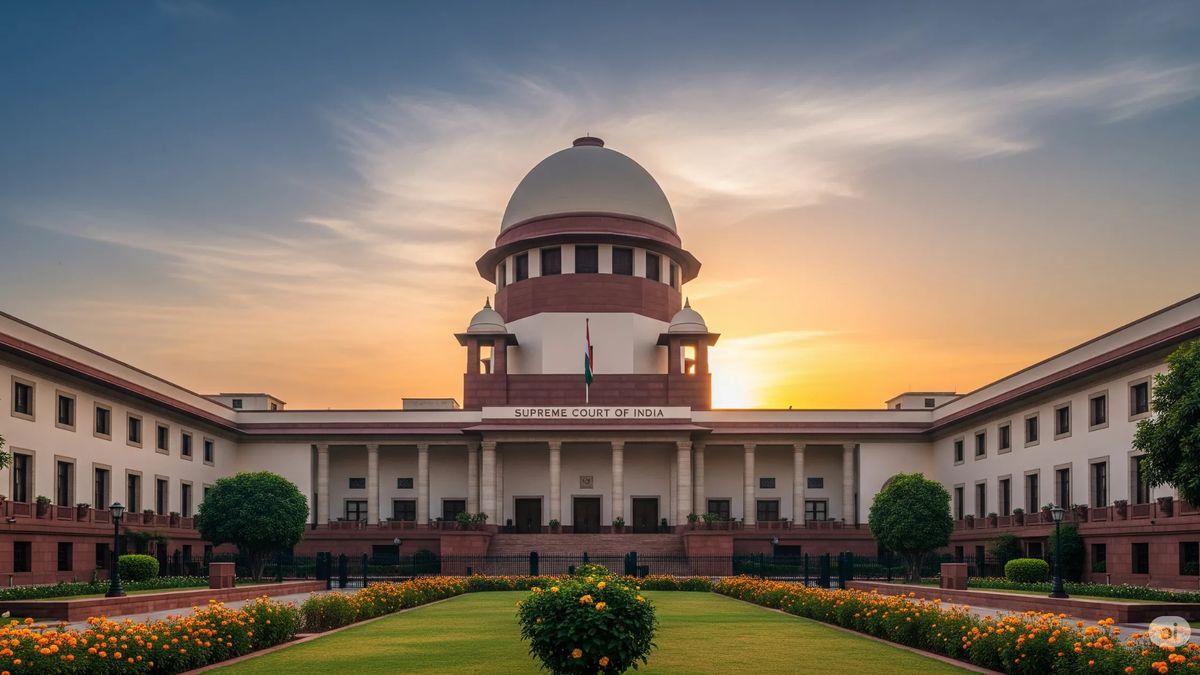
NEW DELHI: Landmark verdicts on the powers of governors and the president on bills, staying few provisions of the Waqf law and a series of pathbreaking judgements defined 2025 for the Supreme Court, a year which saw an unprecedented shoe attack on CJI BR Gavai and the discovery of huge cash at high court judge Yashwant Varma’s bungalow here. The apex judiciary saw a rare transition through three Chief Justices of India (CJIs) within a single year—Sanjiv Khanna, Gavai, and the incumbent, Surya Kant. In a move aimed at bolstering judicial independence, justices Khanna and Gavai publicly announced their decisions to not to take any post-retiral assignments, an issue which has been keenly debated.
This set the stage for further institutional transparency, as the court finally began uploading the asset statements of its judges to the public domain and introduced a first-of-its-kind reservation policy for SC/ST categories in its administrative staffing.
The judiciary was rocked after burnt wads of huge currency notes were found at the official residence of Justice Varma, the then sitting Delhi High Court judge, on March 14. This led to a series of decisions including administrative ones by the then CJI Khanna. After an in-house inquiry panel indicted Justice Varma, he refused to resign even after being nudged by CJI Khanna, who was then compelled to write to President Droupadi Murmu and Prime Minister Narendra Modi for his impeachment. Currently, a parliamentary panel is conducting its inquiry against Varma, a condition precedent before the impeachment.
On October 6, advocate Rakesh Kishore, now suspended, hurled a shoe towards then CJI Gavai during proceedings. He was apparently miffed over Gavai’s alleged remarks on Hindu gods in an earlier proceeding. As the incident sparked widespread condemnation, Modi spoke to the then CJI and said the attack was “reprehensible and angered every Indian”.
The year saw many pathbreaking judgements on a range of issues related to public interest, politics, environment, business, crime and complex civil disputes, especially the challenges to the new Waqf (Amendment) Act, 2025 and the presidential reference. In a boost to the Centre, the apex court said its deletion of the “waqf by user” provision in the waqf law was prima facie not arbitrary and the argument that waqf lands would be grabbed by governments held “no water”. It, however, put on hold a few provisions, including a clause that only those practising Islam for the last five years could create waqf.
The tug of war between governors and opposition ruled states over delayed or non-grant of assent to bills passed by state assemblies culminated when President Murmu moved the SC seeking its opinion on a range of issues including whether a timeline of three months, as envisaged by a verdict penned by Justice B Pardiwala, can be fixed for governors and the president. Answering the reference, a five-judge bench on November 20 delivered unanimous opinion holding that the court cannot impose any timelines on governors and the president to grant assent to bills. It, however, said governors do not have “unfettered” powers to sit on the bills for “perpetuity”.
The stray dogs menace caught the apex court’s attention as its two-judge bench took suo motu cognisance of a media report on canine bites leading to rabies, particularly among children, in Delhi. A slew of directions, including permanent relocation of stray dogs from streets to shelters, created an uproar with several animal rights activists and organisations hitting the streets in protest leading to setting up of a three-judge bench to deal it afresh. The larger bench modified on August 22 the direction prohibiting the release of vaccinated stray dogs from pounds in Delhi-NCR, calling it “too harsh” and ordered the canines to be released post sterilisation and de-worming.
The spurt of cyber crime cases came under the top court’s scanner as it took cognisance of the matter on December 5 and asked the CBI to carry out a pan-India probe into digital arrest scam cases, especially where elderly people are duped of their hard earned monies. The poll panel’s decision to conduct special intensive revision (SIR) of electoral rolls in various states beginning from Bihar also came up for judicial scrutiny.
The issue relating to the horrific Air India Dreamliner crash in Ahmedabad that claimed 260 lives also came to the SC which said no one blamed the chief pilot of the flight for the incident.
Amid growing debate over apex court setting aside its own verdicts post retirement of the author judges, the top court on November 18 reversed its own judgement and paved the way for retrospective environmental clearance (EC) by the Centre and other authorities to projects found violating environmental norms on payment of heavy penalties. Earlier on May 16, a Justice AS Oka-led bench had barred the Ministry of Environment, Forests and Climate Change and the authorities concerned from granting retrospective ECs to projects which are found in violation of green norms.




