
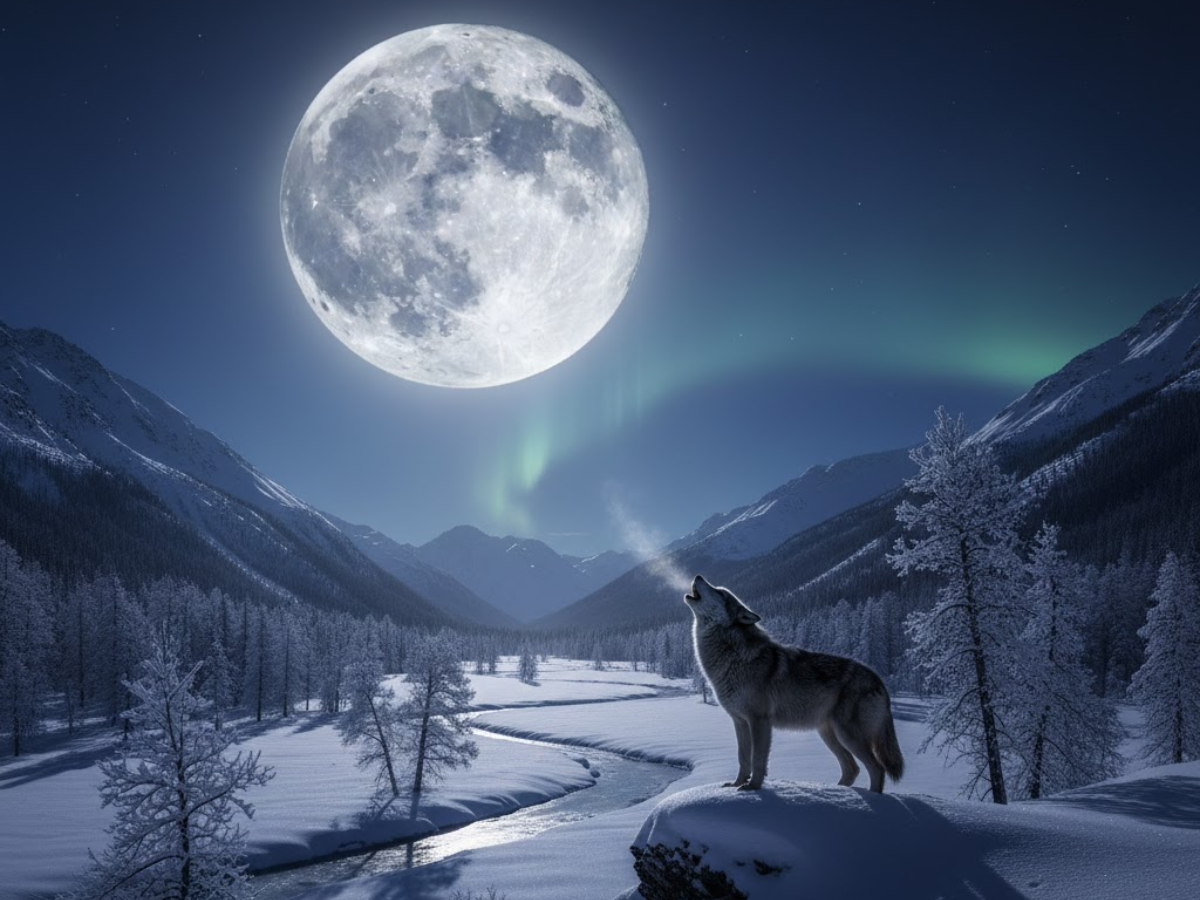
The 2026 begins with a simple striking gift from the sky with the first weekend of January, the Moon appears larger, brighter and closer than normal, drawing attention from rooftops, roadsides and open fields around the world and known as the Wolf Moon. Celestial event connects science with tradition and echoing a time when human rhythms were guided by steady pull of the lunar cycle.
What is a Supermoon?
A supermoon is not a rare or striking anomaly in space because of the way Moon orbits the Earth, this Lunar event is predictable. The Moon travels along an oval path rather than a perfect circle which causes its distance from Earth to fluctuate continuously. The Moon is approximately 360,000 kilometres away at its closest point and 400,000 kilometres away at its furthest.
The Moon appears noticeably larger and brighter in the sky when a full Moon occurs near this closest point known as perigee. A Supermoon can appear up to 14% larger and nearly 30% brighter than a full moon which occurs at apogee, its furthest orbital point.
Origin of the Term Supermoon
Astrologer Richard Nolle coined the term ‘Supermoon’ in 1979 because of its simplicity, the term spread beyond astrology and into popular astronomical discourse where it is frequently used by both scientists and skywatchers. The exact alignment of the Sun, Earth and Moon produces this remarkable visual effect is referred to in scientific terminology as a perigee.
ALSO READ: What Is a Supermoon 2025? The Science Behind the Moon’s Close Approach to Earth
What is Wolf Moon
The full moon in January’ is traditionally referred to as the Wolf Moon because it coincides with a supermoon event in 2026. This occurs when the Moon reaches full phase close to perigee which is the point in its orbit where it is closest to Earth. The result is a Moon that appears slightly larger and noticeably brighter than an average full Moon, even to an untrained eye.
When to Watch Wolf Moon
On January 3, 2026, at around 10:03 GMT, the Wold Supermoon reaches its maximum illumination. Nevertheless, the most striking views will occur earlier, during moonrise on the evenings of January 2 and January 3. As the Moon lifts itself above the eastern horizon at dusk, its size can feel dramatic due to natural visual effects created by the landscape.
Why the Wolf Moon?
Long before the advent of the printed calendars, the phases of the full Moons had named that were associated with the seasons and the habits of survival related to them. The first moon of the year is known as the Wolf Moon and its association is with the middle of the winter season when the availability of foods was limited and the wolves were known to howl more frequently around the human habitations due to proximity of the cold weather.
ALSO READ: NASA’s James Webb Telescope Discovers Bizarre Lemon-Shaped Exoplanet With Mysterious
How to View a Supermoon
- The location of choice must be open with a clear view of the eastern horizon such as a rooftop, park or open field
- Start viewing the resulting effect around sunset when the Moon will be rising and appears largest due to natural visual illusion
- There is no need to use telescope or binoculars, since a supermoon is bright and visible to the naked eye
- Urban areas are suitable, but lower light pollution better for contrast and surface detail
- Allow your eyes a few minutes to adjust to the darkness for a clearer vision
- Photographers can use foreground objects like trees or buildings to highlight the Moon’s size
- Check local weather forecasts to avoid cloud cover during moonrise
How Many Supermoons in 2026
- 3 January, 2026: Wolf Supermoon is the first full Moon of the year and closest to the winter solstice
- 24 November, 2026: Second Beaver supermoon appearing larger and brighter than a regular full Moon
- 24 December, 2026: Cold Supermoon is the closest and brightest supermoon of the year
Other Astronomical Highlights in January
January has more to offer than just the Wolf Supermoon on January 3, Jupiter appears close to Moon while Orion shines brightly in the winter sky and Saturn is visible low in the southwest at moonrise. This month also brings the Quadrantid meteor shower peaking on January 2 and 3, active for just a few hours and known for producing bright fireballs. Moonlight will obscure some of the fainter streaks but this showers strongest meteors can still be seen from midnight to dawn.
ALSO READ: Astronomy Calendar 2026: When to See Supermoons, Meteor Showers Solar & Lunar Eclipses
Disclaimer: Astronomical details may vary slightly by location. Viewing conditions depend on weather, horizon visibility and local light levels.




