
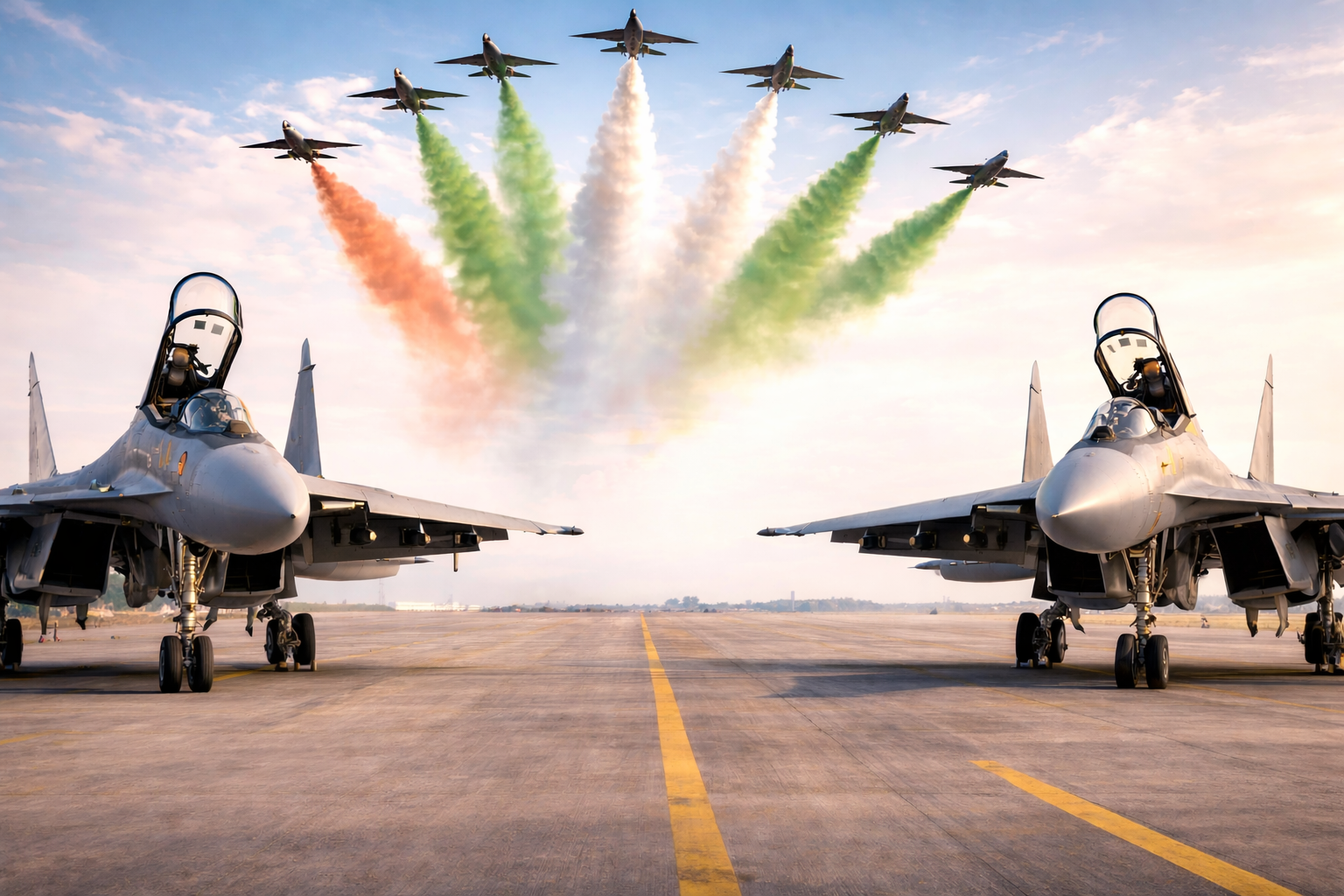
A compelling narrative in modern military discourse suggests that the era of the fighter pilot is ending, replaced by autonomous drone swarms promising risk-free, algorithm-driven warfare. Although such a future is quite appealing from a technological point of view, it is strategically very shortsighted, especially for a country like India. India, which has to deal with nuclear-armed opponents, border disputes that are ongoing, and civilian populations that are complicated, giving up human judgment to autonomous systems is not a step forward, but a very risky step backwards. This paper argues that because of the spread of drones, Indian air power will largely depend on manned combat aircraft. The pilotless future is not pilotless; it is, by far, human-led.
The Irreplaceable Sentinel- Human Judgment in the Crucible of Limited War-Contemporary conflicts, particularly the ones along India’s unstable borders, are characterized by political restraint. These operations are carried out under the most severe scrutiny and extremely tight Rules of Engagement (ROE), where a single mistake can lead to escalation beyond control. In such an atmosphere, the act of using weapons is quite straightforward; however, figuring out whether, when, and where to use them is the real challenge.
Robotic agents, following the logic of their programming, are incapable of understanding the political aspects, moral ambiguity, or cultural context. A pilot sitting in the cockpit merges data from sensors with mission goals, orders from command, and his/her own understanding of the repercussions. The human ability to make contextual decisions is India’s crucial safety net against errors in judgment. In addition, the concept of retaining “meaningful human control” over the use of lethal force is the cornerstone of ethical conduct and international legality. The flight deck is the ultimate safety device—a human conscience just a few seconds away from the impact, able to identify the target visually, notice unexpected civilians, and stop the operation. This last-moment decision, which is indispensable for the exercise of restraint, is structurally not present in remote or autonomous systems, as global drone attacks that have led to innocent victims due to wrong target identification have, unfortunately, demonstrated.
The Currency of Deterrence- Risk, Resolve, and Political Signaling-Air power serves as one of the most effective means of political communication. The use of a Su-30MKI or Rafale is an extremely strong message of national determination and readiness to bear losses. Strategically, this “costly signaling” gains its trustworthiness from the risk that it is accompanied with. Unmanned systems, however, eliminate that risk, thus, the corresponding signal is muffled. The adversary may think that the political cost of intercepting a drone is low, but that of shooting down a manned aircraft is very high, leading to escalation.
India needs to deter grey-zone attacks and “salami-slicing” tactics by showing it through well-planned acts. The employment of manned fighters gives politicians a potent weapon—more powerful than diplomacy, yet more controlled than ground combat, that conveys their unwavering commitment. The fact that pilots are airborne over the disputed areas is a real demonstration of will that a silent drone can never match. This idea is supported everywhere; for example, while drones serve as asymmetric tools in the war like the one in Ukraine, large powers such as the United States still put more emphasis on the development of next-generation manned platforms like the F/A-XX for long-range power projection and deterrence of peer adversaries.
The Unyielding Physics of War- Payload, Survivability, and the Swarm Myth-An all-drone force would be the strongest argument of the swarm advocates, where they can overcome individual platform limitations one after another. This reasoning fails when it is taken into account the unchangeable laws of physics, logistics, and intensity of the battle. For example, one heavy fighter can carry a wide, large payload to a distant place, force its way into a heavily-guarded airspace, and come back. The same might be done by several large drones or hundreds of smaller ones, but as a result, there will be insurmountable problems with air traffic congestion, bandwidth overload, and logistic disorder.
Moreover, the lessons from the recent conflicts are very loud and clear. While drones might be very destructive in places with no restrictions, they quickly become targets of heavy losses in those areas that have integrated air defense systems as it has been shown in the later phases of the Ukraine conflict. Opponents that adapt will turn slow, medium-altitude drones into easy targets. The manned fighters with superior speed, payload, and electronic warfare suites still have to play the role of enemy air defense destroyers and to help create the temporary “windows” in which unmanned systems can be efficiently used. They are the spearhead; drones are the follow-on force.
The Evolved Warrior- The Pilot as Aerial Battle Manager-The future is a combination of both, not one instead of the other. The role of the pilot is no longer that of a simple platform operator, but that of a mission commander who coordinates the activities of a Manned-Unmanned Team (MUM-T) from the air. This is the main idea shaping the future air forces in the world, like the U.S. Next-Generation Air Dominance (NGAD) program or the UK/Japan/Italy Global Combat Air Programme (GCAP).
Here, the pilot of a cutting-edge fighter (e.g., a future two-seat TEDBF or a modernized Su-30MKI) is a survivable command node. They guide a bunch of “loyal wingman” drones that get to see further, serve as additional missile magazines, and take in, or “absorb,” the threats. The human being keeps the final say for the most complicated decision-making, target discrimination, and weapons release. This example of the “Collaborative Combat Aircraft” program in the USAF is an innovation model that uses the idea of drones being expendable and can be there for as long as they want, while still keeping the cognitive abilities, moral responsibility, and leadership qualities of the human. It is a clear refutation to the autonomous hype- technology as a tool to enhance human judgment.
The Centaur Doctrine-Why the Human Must Remain in the Kill Chain-The most compelling vision for the future of air combat is not a fully automated drone swarm, but a synthesis of human and machine intelligence—a “Centaur” model. This doctrine, named for the mythical hybrid creature, posits that the optimal warfighter combines the cognitive strengths of a human with the processing power of artificial intelligence. The alternative, a fully autonomous “killer robot,” represents not just a technological risk but a profound moral and strategic hazard.
Real-world testing is validating this collaborative approach. In mid-2025, Europe achieved a milestone when the AI agent “Centaur” was entrusted with control of a Saab Gripen E fighter jet during live flight tests over the Baltic Sea. In simulated beyond-visual-range combat, Centaur autonomously executed complex maneuvers, processed sensor data, and cued the human pilot on when to fire. Crucially, a safety pilot remained in the cockpit, able to instantly override the AI at any moment. This is the Centaur model in action: the AI acts as a supremely capable tactical co-pilot, managing geometry and calculations, which “open’s up a lot of free brain power” for the human commander to focus on higher-level strategy and context.
This human oversight is non-negotiable for ethical and legal warfare. Organizations like Human Rights Watch warn that weapons systems which select and engage targets without meaningful human control are a “hazard to human rights”. They violate core principles of human dignity and create an unbridgeable “accountability gap,” as a machine cannot be held responsible for unlawful actions. The European Union firmly states that “humans must make the decisions with regard to the use of lethal force” and must “remain accountable for decisions over life and death”. An AI, no matter how advanced, lacks the innate human capacity for compassion, moral reasoning, and understanding the political nuance of a dynamic battlefield.
For India, the Centaur Doctrine is a strategic imperative. It offers a path to harness the game-changing speed and precision of AI—exemplified by systems that can accumulate “decades of virtual air combat experience in as little as 24 hours”—without surrendering the judgment that defines responsible power. In the complex, escalation-prone environment of India’s frontiers, every kinetic decision carries strategic weight. The pilot in the cockpit provides the irreplaceable qualities of intentionality, discernment, and ultimate accountability. By investing in this hybrid model, India can ensure its air power remains not only technologically formidable but also ethically sound and strategically wise, keeping the nation’s conscience and command firmly in the hands of its warriors.
Final Words-The idea of pilotless air power is based on a mistaken perception of war as a purely technical competition. For India, air power is a strategic weapon that is used under very strict political, ethical, and physical limitations. Along with the destructive effect, the weapon must also provide discernment, credible signaling, and absolute control.
World view, starting from legal disputes concerning the accountability of drone strikes and through to tough lessons learned from high-intensity combat, arrives at the same point- air power’s future is human-led. India’s strategic plan should be just as obvious. The country should be very active in its unmanned aerial vehicles and artificial intelligence development and integration efforts on the one hand, and on the other hand, it should be committing itself to the modernization of its manned fighter fleet as the essential core of combat power, deterrence, and giving account to ethics. By supporting the pilot as the evolved battle manager, India will be able to ensure a decisive advantage in the battlespaces of the future, where the human intellect will be the ultimate weapon.




