
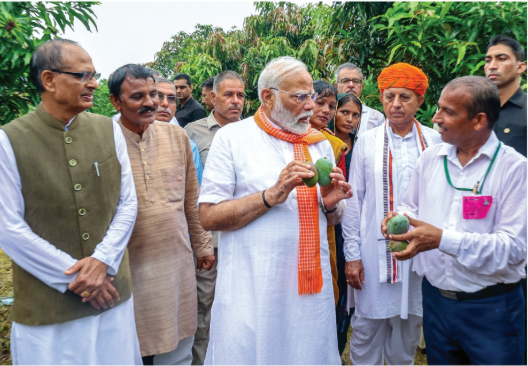
On 15th August 2025, Prime Minister Narendra Modi, addressing the nation on the 75th anniversary of Independence, presented the “Paanch-Pran,” or five pledges for India’s future. Among these, one stood out for its long-term vision: the rediscovery of how India’s ancestors coexisted with nature. This emphasis was not rhetorical but rooted in a civilizational tradition where human progress was balanced with ecological harmony. At a time when the modern world struggles to reconcile its relentless pursuit of growth with the imperatives of environmental sustainability, India’s ancient wisdom offers alternative pathways. Global warming, biodiversity loss, deforestation, land degradation, and resource exhaustion are often treated as intractable modern crises, yet centuries ago, Indian society had devised ways of preventing such problems or at least mitigating their worst effects.
Modi’s articulation of “One Sun, One World, One Grid” and “One Earth, One Family, One Future” on international platforms is an extension of this ethos. His framing situates sustainability not as a narrow national pursuit but as a global responsibility. India, with its historical depth, cultural resilience, and ecological diversity, has the potential to guide the world toward models of inclusive growth. It is in this light that the concepts of implicit knowledge, local skills, and inherent knowledge acquire both contemporary relevance and global resonance.
India’s claim to such civilizational leadership stems from multiple sources. The first is the vast repository of ancient practices rooted in ecological balance, ranging from architecture to agriculture, from water management to disaster resilience. These practices reflect tacit skills transmitted across generations. The second is a renewed cultural confidence, whereby Indians are reclaiming pride in their indigenous traditions rather than dismissing them as outdated. Third, there is the leadership’s global vision of positioning India as a Vishwa Guru, a teacher to the world, by demonstrating how sustainable living can coexist with modern progress. Finally, India’s evolving geopolitical role ensures that such ideas are not confined within borders but presented with assertiveness in international negotiations. The interplay of these elements positions India as a natural hub for applying inherent knowledge, local wisdom and tacit skills to global problems.
The Indian civilizational perspective on nature is distinct from many modern traditions. Ancient Bharat never perceived the environment as inert or inanimate. Rivers, forests, and trees were revered as living deities. The act of worshipping rivers or treating trees as sacred reflected not mere ritualism but an understanding of interdependence. Natural disasters were not interpreted as random acts of cruelty but as corrective forces that reminded human beings of their limits. Resource management was largely decentralized, ensuring that communities respected the ecosystems they depended upon. Reverence for nature guided usage, embedding restraint within everyday practices.
This worldview is particularly evident in India’s water management traditions, which remain among the most remarkable legacies of civilizational wisdom. Floods were never considered an unmitigated disaster; they were converted into opportunities for irrigation and navigation through systems such as inundation canals. Across regions, communities developed localized, cost-effective, and community-driven water management techniques. In the South, anicuts diverted river water for irrigation. In Himachal Pradesh, Khuls channeled glacial waters into fields. In Maharashtra and Karnataka, Bandharas ensured storage and distribution. In Bihar, Ahars and Pynes provided drought-proof solutions. In Assam, Thingal and Doong integrated water flow with paddy cultivation. Johads in Rajasthan stored rainwater in percolation ponds, while the Zabo system in Nagaland combined water harvesting with natural fertilization. The Eris of Tamil Nadu controlled soil erosion, recharged groundwater, and prevented floods, ensuring stable agricultural cycles. These systems were so effective that India historically did not suffer either floods or droughts in the way the term is now understood. Droughts are largely manmade phenomena, created by mismanagement rather than nature’s scarcity.
India’s ecosystems also played a pivotal role in natural carbon sequestration long before climate change became a political concern. The Himalayas, through the sediment-trapping activity of the Ganges and Brahmaputra, sequestered billions of tons of carbon. Forests absorbed vast quantities, while traditional farming enriched soils with organic matter, adding another layer of storage. Although much of this balance has been eroded by deforestation and chemical agriculture, the underlying principle remains powerful. Future sustainability can be achieved by reviving similar approaches—enhancing basalt weathering to trap carbon, rehabilitating mangroves and seagrass for “blue carbon,” and encouraging farmers to adopt no-till practices, biochar, and organic composting. These measures draw from both inherent knowledge and modern science, offering hybrid models of mitigation.
Sustainability was also embedded in everyday life. Ancient Indians adopted minimalism not as austerity but as practicality. Daily-use items were environmentally friendly—combs made from neem or bamboo with natural antibacterial qualities, skincare based on herbs like turmeric and amla, and cleansers such as soap nuts. Utensils crafted from copper, clay, and iron were not only energy-efficient but also beneficial to health. Water stored in copper vessels had antibacterial properties long before “plastic pollution” became a global concern. Similarly, clothing was made of cotton and silk, biodegradable materials reused across generations. Architecture too reflected eco-sensitivity: the Ajanta caves demonstrate how passive solar design reduced energy consumption by using natural lighting and ventilation. All these reflect how the principle of “reduce, reuse, recycle” was an organic part of Indian life centuries before it became a slogan.
A deeper civilizational insight lies in how Indians differentiated between natural phenomena and disasters. Cyclones, earthquakes, tsunamis, floods, and droughts are phenomena that have shaped mankind and its culture, but hubris, selfishness, and greed guided by linear thinking can convert them into man-made disasters if not adapted. Earthquakes, floods, or volcanic eruptions were recognized as part of Earth’s evolutionary process, shaping landscapes and ecosystems. They became “disasters” only when human beings built poorly, settled unwisely, or failed to adapt. Earthquakes, for instance, do not kill by themselves; it is fragile human structures that collapse. Recognizing this, Indian architecture incorporated seismic resilience. Bamboo houses in the Northeast, timber-laced stone masonry in Ladakh, and designs like Pherols of Uttarkashi or Dhajji-Diwari of Kashmir are examples of structures built with earthquake resistance in mind. The Bhungas of Gujarat’s Kutch region are circular, low-rise dwellings that withstand tremors effectively. Temples built under the Kakatiya rulers still stand as earthquake-proof marvels. Such architectural ingenuity was the product of inherent knowledge enshrined in lateral and design thinking refined over centuries.
This accumulated experience over 15,000 years has shaped a distinctive Indian approach to development, one that is nature-centric rather than resource-extractive. The model emphasizes decentralized, self-reliant units based on agro-climatic conditions. Rural India historically functioned like a partially closed ecosystem, where the energy captured by plants through photosynthesis circulated through human and animal systems in an endless cycle. This can be adapted today by integrating modern technologies such as satellite monitoring or drip irrigation. Zero-emission systems, minimalistic living, and resource-congruent models can be drawn from India’s traditions, refined with contemporary science, and exported as scalable solutions.
Globally, there is a growing recognition of the value of indigenous knowledge systems. Institutions like Barefoot College in Tilonia, Rajasthan, demonstrate how local wisdom can be institutionalized to address modern challenges such as renewable energy, education, and women’s empowerment. India’s role, therefore, extends beyond preserving its traditions; it lies in reviving and globalizing them. By building universities and knowledge networks centered on indigenous practices, India can contribute to global efforts in climate adaptation, disaster resilience, and sustainable technology.
In Modi’s articulation of India as a Vishwa Guru, there is no assertion of dominance but rather an offer of guidance. The revival of implicit skills, inherent knowledge, and local wisdom is central to this vision. India’s experience demonstrates that sustainability is not an external imposition but an internalized cultural value. From water systems to clothing, from farming to architecture, the country holds centuries of ecological intelligence that the modern world desperately needs. The challenge is to reinterpret and scale these practices in contemporary contexts.
India’s civilizational journey shows that sustainable living is not a new concept but an embedded cultural reality and a technological marvel. Modi’s call on the 75th Independence anniversary and in different global forums is a reminder that the world, facing existential crises, can look to India for models of survival and progress. The extension of PM Modi’s concept of the One Sun One World One Grid (OSOWOG) initiative organized along with the Chhatth festival (the only festival that worships the Sun) aims to raise awareness about various ways to harness energy from the Sun. It aims to build a transnational grid that would allow countries to source solar power from regions where it is daytime to meet their green energy needs when their own installed solar capacity is not generating energy. By combining ancient wisdom with modern science, India can provide inclusive solutions that balance development with ecology. The reliance on inherent knowledge, local wisdom, and implicit skills is an asset for mankind and a necessity in a fast-degrading world guiding the planet toward a future in harmony with nature.
K. Siddhartha is one of the rare breed of polymaths having wide scale, in-depth knowledge and command over many subjects. His range includes astrophysics, space science, the entire of earth sciences, experiential economics, civilizational & Sanatan economics, nature-centric development approach, geography, perception management, and cultural heritage. He is a strategic thinker, knowledge and perception management consultant, and advisor to several international and state governments. As an earth scientist and polymath, he has authored 52 books and 116 research articles. Apart from that, he has been mentor to 1600 civil servants, film personalities, entrepreneurs, and policymakers.
India’s claim to civilizational leadership stems from multiple sources. The first is the vast repository of ancient practices rooted in ecological balance, ranging from architecture to agriculture, from water management to disaster resilience. These practices reflect tacit skills transmitted across generations.
Inherent Knowledge, Local Wisdom, Tacit Skills for a Sustainable Future
K. Siddhartha
Modi’s mantra: Future sustainability can be achieved by reviving similar approaches—enhancing basalt weathering to trap carbon, rehabilitating mangroves and seagrass for ‘blue carbon,’ and encouraging farmers to adopt no-till practices, biochar, and organic composting.




