
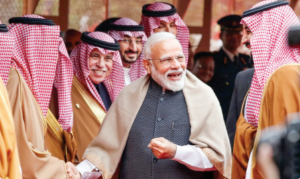
The relationship between India and the Arab world is a testament to the enduring bonds forged over centuries. It is characterised by multifaceted engagement across diplomatic, economic, cultural and strategic dimensions. Rooted in shared historical ties and mutual respect, this relationship has evolved into one of the most robust and dynamic partnerships in the international arena. It is not merely a product of geographical proximity, but of the deep connections between the peoples of India and the Arab world since time immemorial.
The relations between India and the Arab world are marked by civilisational and cultural communication throughout the ages. These ties date back to the first millennium BCE, when India and the Arab world were centres of trade and civilisation. Archaeological ruins in cities such as Harappa and Mohenjo-daro, and other sites in the Indus basin, attest to longstanding trade and cultural relations between India and Arab regions. The relics indicate the existence of trade in incense, aromatic herbs, food and clothing between the two sides. Over the centuries, these relations deepened and contributed to the exchange of knowledge, literature and science, a legacy that remains visible today.
This cultural communication was not limited to kings and rulers; it flourished among peoples as well. Numerous works by Arab travellers and scholars—such as Abu Rayhan al-Biruni, Abu Zayd al-Sirafi, al-Jahiz, Sulayman al-Tajir, Ibn Battuta, al-Mas‘udi, Ibn al-Faqih and al-Tabari—describe India in rich detail. Many Indian manuscripts and books were translated into Arabic from as early as the reign of al-Mansur in AD 772.
In the twentieth century, relations strengthened further as India and several Arab countries gained independence. India emerged as one of the nations closest to the Arab world, consistently supporting just Arab causes. This enhanced the appreciation of the Arab public and their governments for India’s positions in international forums on the Arab–Israeli conflict in general and the Palestinian issue in particular. The Indian government was among the first to recognise the State of Palestine and opened an embassy in the Indian capital, Delhi.
The southern coastal shore of Kerala stands as a living embodiment of the deep-rooted connections between Arabs and India. Centuries of maritime trade and cultural exchange led to Arab settlements along this coast, which served both commercial and cultural roles. Through interactions with local communities, Arab traders brought diverse customs, traditions and religious beliefs that gradually integrated with the rich tapestry of Indian culture.
Kerala’s cultural landscape bears witness to this cross-cultural exchange—in its cuisine, language, architecture and religious practices. The influence of Arab merchants is evident in traditional Malabar cuisine, which blends Indian spices with Arabic flavours, and in the architectural styles of mosques and other structures along the coast. The enduring legacy of these interactions is also reflected in Kerala’s social fabric, where Arab influences have seamlessly woven themselves into the region’s cultural identity. This fusion has enriched Kerala’s diversity and fostered a spirit of tolerance and mutual respect among its inhabitants.
The world has seen three of the oldest civilisations preserve their legacies across the ages: the illustrious Indian civilisation, the pioneering Sumerians and the enduring civilisation of Egypt. These ancient cultures left remarkable tangible artefacts and laid foundations for human progress through their principles and innovations. It is natural to recognise the interconnectedness among these civilisations, which shared ideas, technologies and cultural practices, influencing each other in profound ways.
Similarly, across the Arab lands, civilisations such as Babylon, Assyria, Syria, Palestine, Arabia, Egypt, Sumer and Elam flourished, serving as hubs of trade, culture and learning. The people of the Indus Valley Civilisation had close relations with Sumer and traded extensively with Egypt and Crete, demonstrating the early roots of India’s engagement with the Arab world. These historical ties formed the basis for enduring cultural exchanges, economic partnerships and diplomatic relations between India and Arab countries, shaping their relationship over millennia.
Dr Waiel Awwad is a senior journalist and West Asia strategist. For more details, visit www.waielawwad.com.
This article is extracted from the essay “India and the Arab World under Modi,” published in the book Indian Renaissance: The Age of PM Modi, edited by Aishwarya Pandit.




