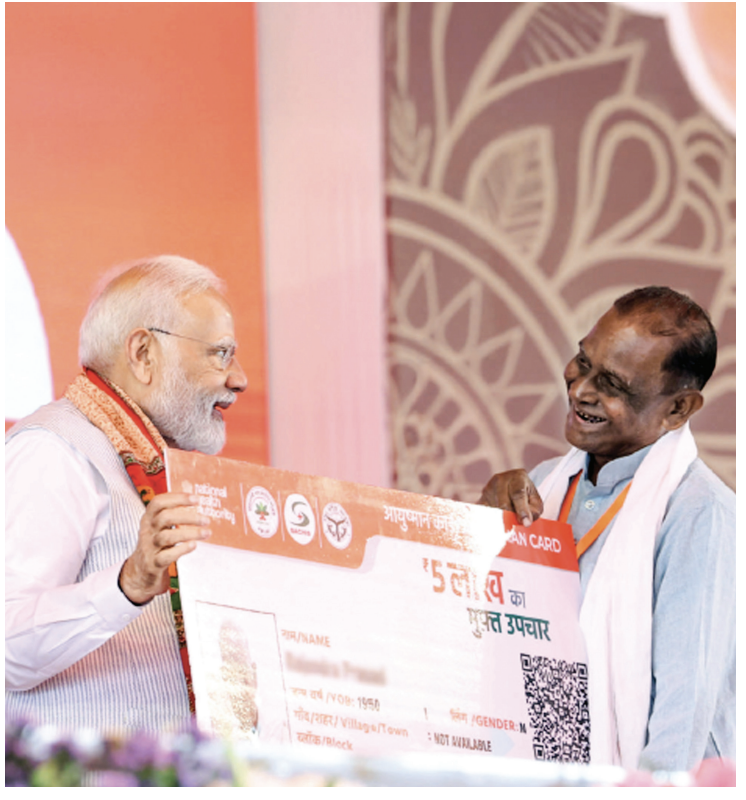
Over the past eleven years, India has witnessed a sweeping transformation in its healthcare system. Guided by Prime Minister Narendra Modi’s vision of “Sabka Saath, Sabka Vikas, Sabka Vishwas, Sabka Prayas,” the government has sought to make healthcare accessible, affordable, and equitable for every citizen. From the launch of Ayushman Bharat—the world’s largest health assurance scheme—to the world-beating Covid-19 vaccination drive, from the rapid rise of telemedicine to the expansion of AIIMS and medical colleges across states, India has taken definitive strides towards universal healthcare.
The Digital Backbone: Ayushman Bharat Digital Mission
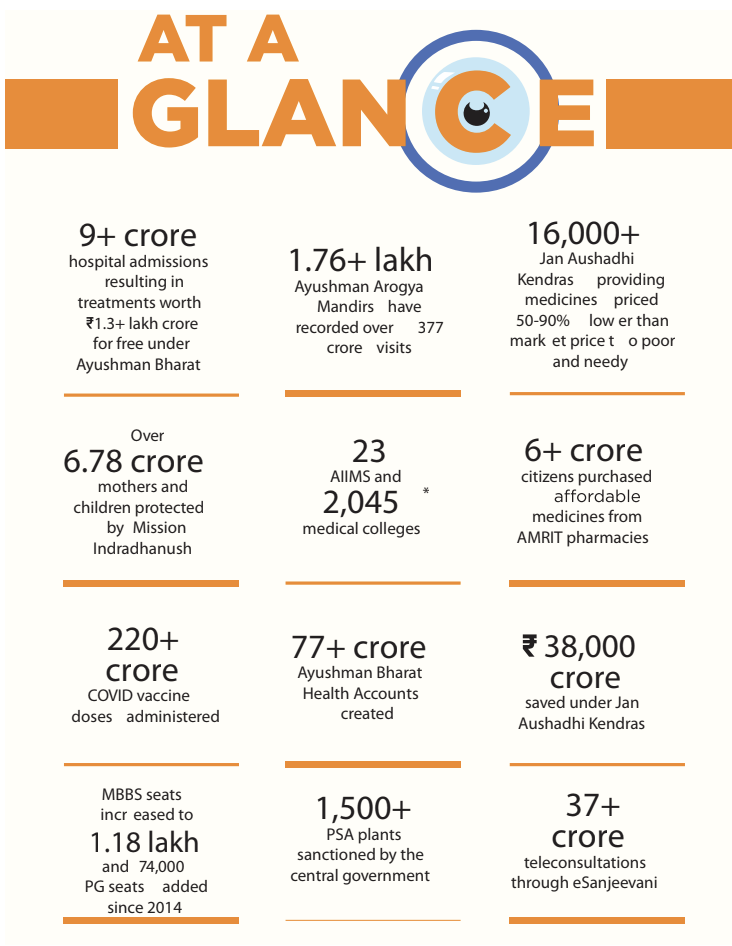
To strengthen healthcare delivery, the government introduced the Ayushman Bharat Digital Mission (ABDM). With 77 crore Ayushman Bharat Health Accounts (ABHAs) created, individuals can now maintain digital health records linked to their unique ID. These enable seamless, paperless, and portable access to health services across the country. This digital transformation is making healthcare smarter and more transparent, ensuring that even in the remotest regions, patients can access their health records and receive quality care without bureaucratic delays.
Covid-19 Vaccine Drive: A Global Milestone
India’s response to the Covid-19 pandemic will be remembered as one of the most remarkable public health achievements in history. The government rolled out the world’s largest vaccination drive, administering over 220 crore doses within two years. Unlike earlier times when India had to wait decades for vaccines, the country not only developed indigenous vaccines like Covaxin but also ensured swift distribution through the CoWIN platform, which became a global model for digital vaccine delivery. India’s vaccine task force was established early in 2020, even before many advanced nations had started planning. As a result, not only were Indian citizens protected, but under Vaccine Maitri, more than 30 crore doses were supplied to over 100 countries, reinforcing India’s role as the “pharmacy of the world.”
Telemedicine: e-Sanjeevani Brings Doctors Home
One of the biggest breakthroughs of the last decade has been the scaling up of telemedicine. The government’s flagship platform, e-Sanjeevani, has revolutionised access to medical consultations, especially in rural areas where specialist doctors are scarce. As of 2025, over 37 crore tele-consultations have been facilitated through e-Sanjeevani. This digital bridge has brought healthcare to the doorsteps of people, saving time, travel costs, and ensuring timely medical advice. Importantly, it has reduced the rural-urban healthcare divide, empowering even those in remote villages to consult doctors from leading hospitals.
Affordable Medicines: Jan Aushadhi Kendras
High medicine costs have traditionally been a major burden for Indian households. To address this, the Modi government expanded the network of Jan Aushadhi Kendras, where quality generic medicines are sold at 50-90% lower prices than branded equivalents. With 16,000+ Kendras operating across districts, citizens have collectively saved Rs 38,000 crore on medical expenses. These outlets also distribute the world’s cheapest sanitary pads at Rs 1 each, making menstrual hygiene affordable for millions of women. In addition, the government has supported AMRIT pharmacies, which have benefited over 6 crore citizens with affordable drugs for critical diseases like cancer and heart ailments.
Medical Education: Expansion of AIIMS and Colleges
Healthcare transformation cannot be sustained without a robust pipeline of trained medical professionals. For decades, India suffered from a shortage of doctors due to limited seats in government medical colleges and high costs in private institutions. The Modi government tackled this challenge head-on. Since 2014, the number of medical colleges has risen to 2,045, including 780 Allopathy, 323 Dental, and 942 AYUSH institutions. The number of AIIMS has tripled to 23, with the first-ever AIIMS in the Northeast inaugurated in Guwahati, Assam. This expansion has more than doubled medical education capacity, with MBBS seats increasing to 1.18 lakh and postgraduate seats to 74,000. The replacement of the corrupt Medical Council of India with the National Medical Commission (NMC) has ensured transparency, meritocracy, and fairness in admissions.
Mission Indradhanush: Protecting Mothers and Children
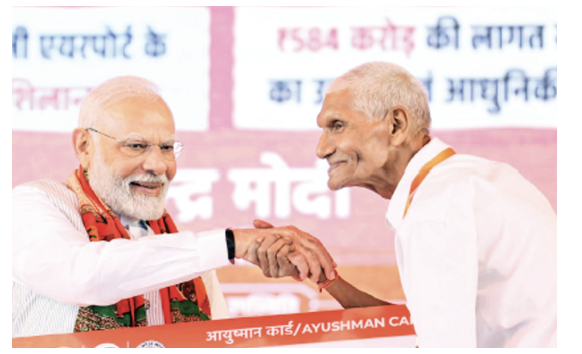
Beyond Covid-19, the government has prioritised immunisation against vaccine-preventable diseases. Under Mission Indradhanush, 5.46 crore children and 1.32 crore pregnant women have been vaccinated against 12 diseases. This has led to a sharp decline in maternal mortality, which dropped from 130 in 2014-16 to 80 in 2020 per lakh live births.
Strengthening Health Infrastructure: PM-ABHIM
To future-proof India’s healthcare system, the government launched the Pradhan Mantri Ayushman Bharat Health Infrastructure Mission (PM-ABHIM). With an investment of Rs 64,180 crore, the mission aims to establish new health and wellness centres, integrated public health labs, district-level critical care blocks, and strengthen pandemic preparedness. This mission ensures that India will be better prepared for future health emergencies, avoiding the vulnerabilities exposed during the early months of Covid-19.
Ahead of the Curve: India’s Proactive Approach
India’s proactive steps, such as airport screenings before the first Covid case, early lockdowns, and the rapid scale-up of testing infrastructure, demonstrated the government’s commitment to saving lives. These actions helped India avoid large-scale mortality in comparison to many advanced countries.

A Healthcare Model for the World
India’s journey in healthcare under Prime Minister Modi has been one of inclusivity and innovation. The country is no longer dependent on external powers for critical vaccines or medical infrastructure. Instead, it is exporting medicines, building digital health platforms, and training the next generation of doctors. The Modi government’s healthcare initiatives have reshaped the nation’s approach to well-being. Ayushman Bharat has lifted the financial burden of healthcare from millions of families. The Covid-19 vaccination drive has cemented India’s role as a global health leader. e-Sanjeevani has connected villages to specialists, while Jan Aushadhi Kendras have made medicines affordable for all. The expansion of AIIMS and medical colleges is securing the future of medical education.
Together, these reforms reflect a holistic vision where no Indian is denied care due to geography, poverty, or systemic shortcomings. As India steps into the Amrit Kaal, the foundation of “Healthcare for All” promises not just treatment, but dignity, security, and hope for every citizen.