For Prime Minister Narendra Modi, education is the ladder of social mobility and the backbone of nation-building—anchoring a decade of reforms shaping India’s future.
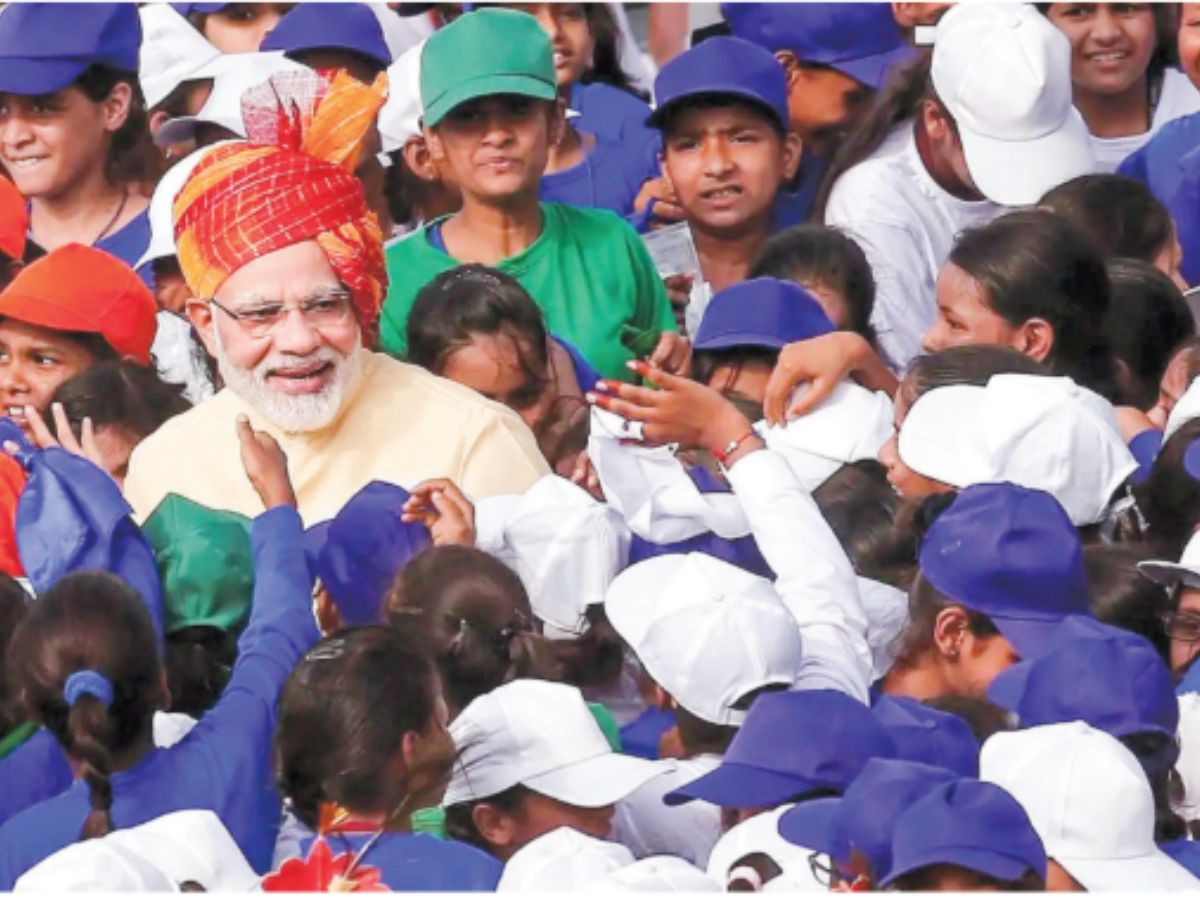
On the seventy-fifth birthday of Prime Minister Narendra Modi, it is instructive to look into how India is working to widen access, raise quality, and align learning with India’s aspirations for 2047. The Prime Minister’s personal story often anchors this project in lived reality. The official account records a childhood of constrained means, long hours helping at a small family tea stall, and a habit of spending free time in a local library. These details matter because they explain a consistent theme in his speeches: education as social mobility and national character. “Education should become a force for the nation’s character building,” he told students early in his tenure.
The National Education Policy 2020 provides the strategic pathway. It reframed the system around foundational literacy and numeracy, flexibility through credits and multiple entry–exit, and learning that cultivates “how to think” rather than rote “what to think.” The Prime Minister spelt out that pivot during the NEP 2020 launch dialogues and has since guided curricular and institutional reforms.
School education saw the earliest and widest operational changes. Under PM SHRI, chosen government schools are being upgraded to the standards set out in NEP 2020. States and Union Territories are joining the scheme through a performance-linked arrangement. By mid-2025, India had 12,079 PM SHRI schools, according to the Ministry of Education. The model emphasises experiential learning, assessment reform, inclusive infrastructure, and community engagement.
Foundational learning received a dedicated national mission in NIPUN Bharat, while “Vidya Pravesh” eased children into Grade 1 through a structured school-readiness module. Teacher capacity moved online at scale through DIKSHA, the national platform for content and training, and through NISHTHA modules that reached educators at the foundational, preparatory, middle and secondary stages. A digital public infrastructure approach, NDEAR, connected platforms and registries, so states could scale solutions without fragmentation. Together, these create continuity leading to teacher professional development, classroom curricular resources, and real-time visibility through Vidya Samiksha Kendras.
Digital access broadened during and after the pandemic through PM eVIDYA and SWAYAM. A crucial new layer is One Nation, One Student ID through APAAR, which links every learner to a lifelong academic account integrated with DigiLocker and the Academic Bank of Credits. CBSE has operationalised APAAR for board examinees, making it a practical gateway to credit portability and verified records. ABC now covers 2,469 institutions. More than 32 crore IDs have been issued, of which 2.36 crore unique APAAR IDs already carry credits. APAAR becomes the universal key.
Higher education expanded in both capacity and participation. The All India Survey on Higher Education shows total enrolment rising from 3.42 crore in 2014–15 to 4.46 crore in 2022–23, with women reaching 2.17 crore; the latest provisional national GER stands at 29.5. These are not abstract percentages. They represent first-generation entrants, more women on science and professional tracks, and deeper participation outside metros.

There is a noticeable increase in inclusion metrics. Between 2014–15 and 2021–22, enrolment among Scheduled Castes increased to 66.23 lakh. Enrolment of students from Scheduled Tribes rose to 27.1 lakh. OBC student enrolment reached 1.63 crore. Female participation improved across these groups. The North Eastern Region rose to 12.02 lakh enrolments in 2021–22, with women slightly ahead of men. These data points confirm a structural broadening of access.
Institutional growth underwrote this expansion. New IITs, IIMs, and AIIMS came up. The total IIT count now stands at 23, and IIMs at 22, while additional AIIMS progressed through multi-phase implementation under PMSSY. This growth is alongside the rise of institutions in national rankings and global tables. The NIRF 2025 cycle again placed IIT Madras at the top; India’s QS trajectory shows more institutions ranked and several moving upward, with IIT Delhi entering the global top-125 in 2026. The signal here is steady quality-building, reflected in research outputs, employer reputation, and international visibility.
Reform also targeted the operating system of higher education. The Academic Bank of Credits gives students a ledger to accumulate and redeem credits across institutions; the National Credit Framework extends this logic to school, skilling, and higher education, allowing mobility between general and vocational tracks. UGC and the Ministry of Education have pressed institutions to adopt ABC and upload credits against firm timelines. This assembly of registries, standards, and platforms makes multidisciplinary pathways a reality.
The research ecosystem has been reorganised around the Anusandhan National Research Foundation. Parliament passed the NRF Act in 2023. In 2024, the framework became operational, providing a standard anchor that helped research take root and expand across different fields and institutions. The IndiaAI Mission has an outlay of over Rs 10,300 crore. The mission complements the building of public computing, supporting indigenous models, and financing AI startups. India is moving from fragmented grants to mission-scale science and technology.
Skills, internships, and employability now run as a single thread through school, college, and the workplace. Under NEP 2020, hands-on vocational work in the middle and secondary years counts for credit through the National Credit Framework and leads into clear apprenticeship pathways. For example, TULIP connects graduates to structured urban governance internships. When institutions adopt SAMARTH ERP, they digitise processes that touch placements, alumni engagement, and credit records. The thrust on Indian languages and the integration of Indian Knowledge Systems has broadened participation further. Students can complete technical programmes with Indian-language support while working with IKS-aligned electives and research projects. These strands create employability with rootedness in Indian knowledge systems and Indian languages.
Student financing has become easier in recent years. Vidya Lakshmi is a one-stop portal for education loans from multiple banks, so students do not have to chase separate websites. The Pragati scheme has also widened its reach, giving more women in technical courses the support they need. Saksham is for learners with disabilities, offering scholarships and freeships. PM-USHA renewed Centre–state financing for quality, equity, and governance reforms for states and state universities. HEFA has funded infrastructure in centrally funded institutions at scale. The direction of travel in the Union Budget has favoured school-system programmes such as Samagra Shiksha and, more recently, research and AI infrastructure. The education sector saw higher yearly allocations.
There has been focused policy attention on gender and disability. Supernumerary seats for women in premier institutions such as IITs have changed classroom composition. Since 2017–18, India’s gender parity index in higher education has stayed at one or higher. In simple terms, a larger share of women than men are enrolled, a trend the AISHE 2021–22 data confirms. Teacher education is also changing. The new four-year Integrated Teacher Education Programme brings subject knowledge, pedagogy, and real classroom practice into a single, coherent degree. In-service teachers can make use of online platforms to avail sustained training. Teachers, for instance, engage NISHTHA modules on DIKSHA, participate in competency-based assessments, and share resources at the national level through national repositories. At the same time, mother-tongue-centred teaching and multilingual classrooms also get curricular support through the National Curriculum Framework. Publishers and boards have responded with materials that support bilingual and Indian-language pathways.
Internationalisation moved from policy intent to real campuses. Foreign higher educational institutions can now set up their campuses in India. Deakin University inaugurated the first international branch campus at GIFT City in January 2024. The University of Wollongong followed later in the year. The pipeline has now widened under UGC 2023 regulations. Five universities from Australia, five from the UK, one from the USA and one from Italy are setting up their campuses in Bengaluru, Chennai, Gurugram, Mumbai and NOIDA. Their presence in India creates high-quality choices at home and catalyses global research and teaching collaborations.

India now has a rapidly evolving educational system with registries, credit banks, curricular frameworks, guidelines, and financing so learners can move through flexible pathways with verified records. The results are visible in participation, inclusion, and global recognition. They are also visible in how the Prime Minister frames education as the bridge between a child’s aspiration and the country’s development goals. In 2020, he said NEP 2020 seeks to move learners toward creativity and commitment. In 2025, he described NEP 2020 as “the nation’s intellectual renaissance.”
The Prime Minister often links education to dignity and opportunity. In a widely cited reflection on his early years, he said he learned life lessons while helping at his father’s tea stall and that those experiences shaped a commitment to people experiencing poverty. That sentiment explains the policy preoccupation with access, credits, and flexible, multilingual pathways. It also describes his insistence that the next generation’s education will decide national capabilities. As PM speaks of Viksit Bharat in 2047, the education story of 2014–2025 points to multi-scale momentum. More children are mastering foundations. More young people are navigating flexible higher-education pathways with portable credits. From foundational literacy to national research missions, young Indians are working towards nation-building. That instinct reflects the Prime Minister’s own experience and priorities. As he has said, “The education of children, the right environment they get, to a large extent determines what the person would become in his future.”
Mamidala Jagadesh Kumar, Former Chairman, UGC and Former Vice-Chancellor, JNU (Views are personal)
