
Horrendous losses were endured by Germany and Ja- pan as a consequence of the misdeeds and horrors perpetrated on their own people and on other coun- tries throughout the 1930s until 1945. Both countries were occupied by the US military principally, a real- ity that continues, some- what anachronistically, to the present. Both countries were, as a consequence of their rulers at the time, bat- tered to the ground, with their economies shattered. And yet, not for a single moment during those years (1945–52), when the debris of war was being replaced with new construction, their economies set on the path to revival, and their populace gaining in self-confidence as a consequence of the fact that the post-War settlement in 1945 was unlike that in 1919 after World War I, were they not regenerative but retribu- tive.
As a consequence, Germa- ny regained the democracy that had briefly flickered into life during the 1918–33 Weimar Republic period. Japan became a constitu- tional monarchy, thanks to the wisdom of both Em- peror Hirohito as well as the victorious Allied forces led by General Douglas MacAr- thur.
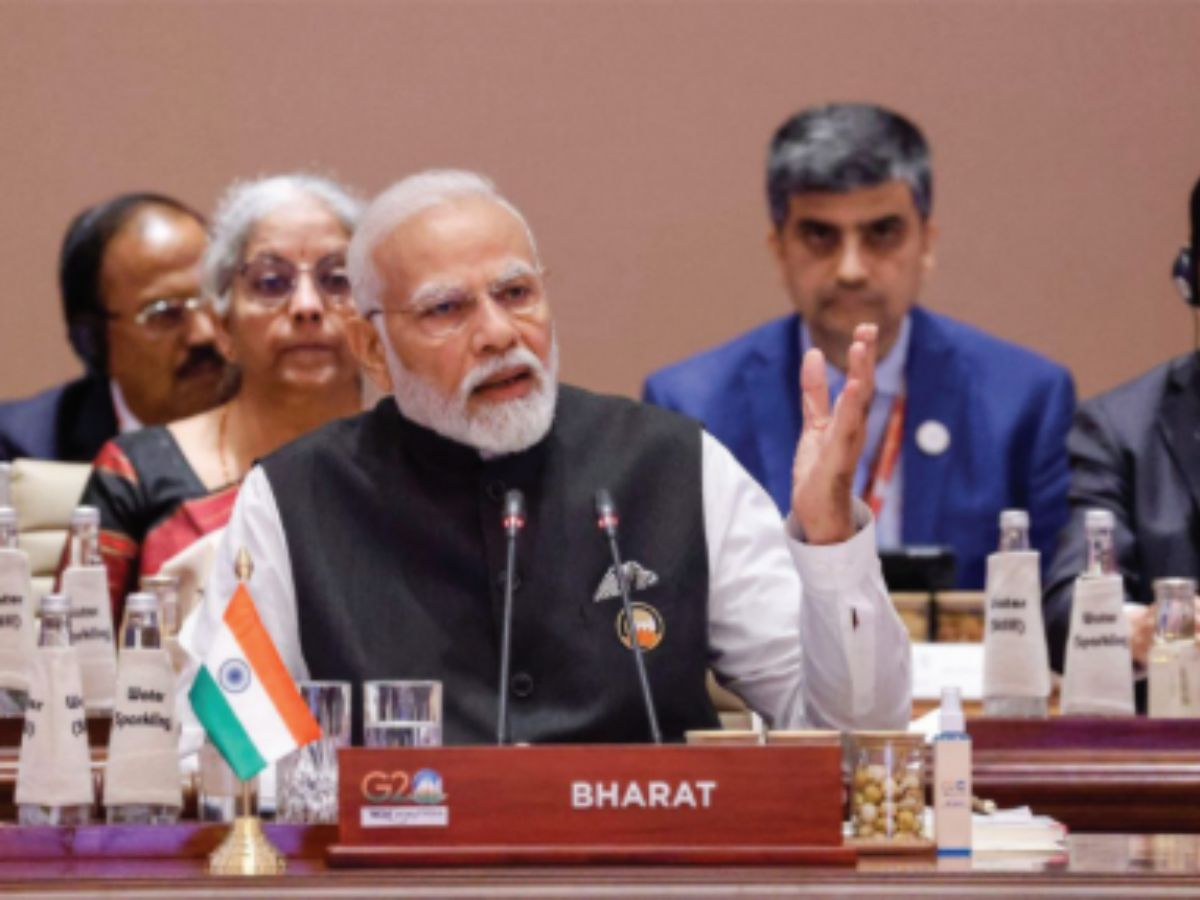
Not for a moment during the darkest moments of their lives did the people of Japan stop referring to their country within themselves as Nippon. Nor did the Ger- man people ever pause re- ferring to their country as Deutschland among them- selves. Only to the outside world were the two coun- tries ‘Germany’ and ‘Japan’, never to their own people. While those in authority in Tokyo and Berlin may not find sufficient reason to change the external names of their respective countries to Nippon and Deutschland, there is a compelling case for changing India’s name to Bharat, the original name of our ancient homeland. Perhaps the makers of the Constitution of India ought to have said Bharat, i.e., In- dia rather than India, i.e., Bharat, that too as a tem- porary provision in the manner of the now extinct Article 370 rather than con- tinue as a permanent part of the Constitution of, let us be clear, Bharat.
S h a ke s p e a r e w r o t e ‘What’s in a name?’ The answer is: a lot. It is tell- ing that countries in Europe persist in referring to Myanmar as Burma. The latter was the name given to a colony; the former is the traditional name of a proud people. ‘India’ came into use much before the British, with some tracing it to 327 bc, when Alexander the warrior roamed with his soldiers across the Punjab before returning home, leav- ing behind several of his of- ficers and soldiers to settle down in the territories that had been discovered and occupied by them. It is tell- ing that the term ‘India’ is said to have originated dur- ing a period of conquest by a foreign army, and that it continued to be used by the British, who took over much of the subcontinent and ad- ministered it for the benefit of their own country and at an incalculable cost to the people of Bharat. While the appellation ‘Bharat’ brings to mind a land with a glo- rious and extraordinarily long history, ‘India’ awak- ens often subconscious memories of the period when Bharat was invaded and large parts of it occupied by foreign powers.
The concept of the idea of India has been presented by protagonists of the name in a romantic hue, which cam- ouflages the reality that it was a term in common use not among the people of Bharat but among its con- querors. It is such a sub- conscious association with a glorious—as distinct from ed—past, which makes it not just desirable but imperative to replace the idea of India with the idea of Bharat. The process has been acceler- ated significantly during the Modi decade (2014–24) and is expected to become entrenched not only within the country but also interna- tionally, should the Modi era continue for another fresh five-year term after the 2024 Lok Sabha polls.
The idea of India has been characterised as secular by its protagonists. Yet, in its operation, the idea is the reverse of secularism. Af- ter the bolting of the horse of Partition on the specious grounds of Hindus and Muslims being ‘two nations’ rather than a single people, a construct was created that sought not to erase dif- ferences but to emphasise them. Secularism is when religion does not play a role in policy.
During the Modi decade, multiple schemes have been rolled out that are of benefit to the needy, including the giving of free rations of grain to 800 million citizens of Bharat. There is no dis- crimination between those professing different faiths in these schemes; the criteria laid down is applicable to all citizens. Contrast such a secular approach with the UPA-era Right to Education (RTE) Act. Only institutions started by the ‘majority com- munity’ are subjected to its provisions, while those cre- ated by ‘minority communi- ties’ are exempt. Indeed, the concept of those belonging to a particular faith being from the majority commu- nity while those of other faiths are minorities merits examination in terms of the realities within the society of the country that is the most populous in the world. Income is a much more ac- curate measure of intra- population differences than faith. Individuals belonging to different faiths but having similar income levels have much in common that they do not at all share with those of their own faith. What is termed as the middle class is an example. Across the country, this group shares numerous interests, such that they mingle and deal with each other across the country in a truly secular way. Preservation, indeed the deepening of concepts of divergence that are based on the sole ground of the re- ligion practised, is the con- verse of secularism rather than—as proponents of the idea of India claim—its af- firmation.
At the heart of the secular ideal lies ‘Sabka saath, sabka vikas, sabka prayaas’—an en- tirely inclusive concept. Yet, the originator of this notion, Prime Minister Narendra Modi is traduced by many proponents of the ‘idea of India’ for supposedly falling short of that ideal. Ironically, these critics, who constantly divide people solely on re- ligion grounds, consider themselves to be ‘secular’. Equal treatment to people of all faiths by the governance mechanism is at the heart of the secular ideal. Which is why not just Egypt and Tur- key but Western countries have a uniform civil code. Yet, when the same topic is barely touched upon in Bharat, it is condemned as a negation of secularism. There are many individu- als in the country and out- side who seem to prefer that the idea of Bharat remains synonymous with the idea of India, seen as a country where emphasis is placed not on the commonality of interests of all citizens but on assumed divergences be- tween them on the ground of religion.
Every segment, each strand, of the variegated history of Bharat belongs to each and every citizen of the country, whatever be their faith. Accompany- ing the idea of India was an emphasis in textbooks of specific periods, such as the period since 1857, marked by a widespread re- volt against British rule, or the period since 1915 when Mahatma Gandhi returned to Bharat and began to lead the non-violent stream of the popular movement against the British rule. Or the period since Rob- ert Clive began expanding British influence through treaties and conquests in the mid-1770s. Or Babur’s invasions beginning 1519 until 1523. Although more than nine-tenths of the his- tory of Bharat took place before Babur stepped foot into the subcontinent, less than 10 per cent of history as it is taught in schools re- lates to that period. Believ- ers in the idea of India ap- parently did not want any cognisance of that period, much of which was incor- rectly described as myth during the British rule, and hence undeserving of mention in history books. Even as the idea of Bharat is gaining traction during the prime ministership of Narendra Modi, such self- imposed constraints and distortions in the teach- ing of the history of this land are melting away. In- creasing emphasis is being placed on the entirety of the history of Bharat, a tapestry that belongs equally to ev- ery citizen of Bharat. The persistent emphasis on at most a tenth of the coun- try’s historical record has not, contrary to the claims made by those uneasy about the continuation of colonial-era pedagogy, been replaced solely by an em- phasis on the initial nine- tenths, but rather a history of Bharat as a whole. No period has been neglected. Even once scarcely men- tioned treasures from the past, such as the spread of the Chola Empire, have re- gained the prominence that should have been theirs from the start of the period since the Union Jack was replaced atop the Viceregal Palace—which has been the Rashtrapati Bhavan since 1947—with the tricolour.
There is a difference between arrogance and pride. The first is exclusiv- ist and destructive, while the other is inclusive and constructive. Ideas rooted not in reason but in preju- dice, such as racial or re- ligious supremacy, breed intolerance, while those based on understanding and acceptance promote the societal cohesion nec- essary for Bharat’s leap into the middle-income tier of countries.
DNA mapping has shown that people across both sides of the India–Paki- stan border are the same, although the trajectories of both countries are very dif- ferent. Votaries of the idea of India remain silent about such phenomena as the disappearance of religious minorities in Pakistan, whether they be Sikh, Hin- du, Christian or other. If quizzed, their reply is that ‘India is not Pakistan’. Ab- solutely, which is why what is happening to essentially the same people but on the other side of the border need to be the concern of citizens of Bharat. What is happening there is a cau- tionary tale about what could happen if the fanati- cism fuelled by religious ex- clusivism proliferates with- in a society and becomes normalised across the pop- ulation. Both the UK and the US have large numbers of citizens who ethnically are Pakistani or Indian. Whether in tables relating to per capita income or in the per capita distribution in police records of crimes committed, the difference between the two is striking. Much of the first half of the twentieth century showed the pitfalls of exclusivist, supremacist approaches, habits of thought that en-gendered conflict and its attendant misery. Colonies were supposed to be the sources of whatever prog- ress was made by countries in Europe that had built up vast empires. Yet, whether it be Spain, France, the Netherlands or the UK, the quality of life of the average citizen is far better in an era where colonies were lost, as compared to periods when conquered lands were there in plenty. Such a paradox illustrates the wisdom be- hind the emphasis on Va- sudhaiva Kutumbakam, meaning the earth is one family, placed by the prime minister and made the cen- tral motif in 2023, the year of Bharat’s presidency of the G20 comprising the largest economies of the world. As a consequence of the efforts of the 2023 presidency of the G20 by Narendra Modi, the Afri- can Union joined the Eu- ropean Union as a member of what is now the G21. In a way, such a change rep- resents the shift away from the twentieth to the twenty- first century of Bharat dur- ing the past decade.
Emphasis has been placed not only in the entirety of history but in the entirety of the population. Wheth- er it be smokeless kitchens, weatherproof homes or avoiding the need to use open spaces for ablutions, hundreds of millions of lives have been transformed over the past decade. This is a change that is visible ev- erywhere, even to a casual visitor. All this has created a sense of pride in the coun- try, a belief that each citizen has the potential to succeed in the way Narendra Modi, a lad from an underprivi- leged background in Vad- nagar, Gujarat, has done. The odds were daunting, yet were met and over- come by a dauntless spirit based on knowledge of, and hence respect for, the idea of Bharat. If the idea of India can be compared to a lake, the idea of Bharat is an ocean, serving as a far greater motivator for indi- vidual excellence needed to achieve the double-digit growth rates necessary to uplift all its people from poverty to adequacy in liv- ing standards. A sense of empowerment is very dif- ferent from a feeling of enti- tlement, such as that which is felt by those born with sil- ver spoons in their mouths. An ambience is being cre- ated that engenders a sense of empowerment within each citizen, thereby giv- ing them the courage and the determination to aim not for moon but the stars. Such an ambience has been created as a consequence of the life and work of Prime Minister Modi.
During the colonial peri- od, only the state was con- sidered deserving enough of an abundance of respon- sibility. Even after 1947, this mindset continued, such that it became a nightmare and very often impossible to set up and run within the country a private enterprise on the scale needed to com- pete globally. That period of discrimination is over, and in several sectors, the private sector is the leader rather than the follower. Segments of activity such as space research and de- fence production that were once barred to private en- terprises have been thrown open, to the immense ben- efit of the country. Begin- ning from the 1970s, when Snamprogetti had over- powering influence over policy, and lasting until the 1990s, the domestic private sector was treated with con- tempt even as foreign sup- pliers were encouraged. As a consequence, by 2014 more than 80 per cent of critical defence needs were met by imports, thereby causing a chasm of vul- nerability in the event of a conflict. That period began to melt away in 2014, and by 2029, Bharat will be on track to emerge as one of the top five, if not the top three, defence exporters of the world. From one nuclear power plant every decade to one every year, domestic production of critical items has been supercharged, again without any discrim- ination between the public and private sectors.
Secularism as practiced in India is contrary to the fun- damental tenet of equality of treatment underpinning that term. Until 2014, there was no prospect of ensuring that Mathura, Ayodhya and Kashi, the three sacred loca- tions of the Hindu commu- nity, were returned to what they were before Aurang- zeb destroyed the temples standing on the birthplaces of Lord Krishna and Lord Ram, as well as the Kashi Viswanath temple that was standing on the spot consecrated by Lord Shiva. According to proponents of the idea of India, such a return was unnecessary and indeed unwelcome. Even the joy felt at the re- turn of the Ram Mandir to its pre-Aurangzeb state was frowned upon as being al- most anti- Indian. We are all children of the same Al- mighty power, and to treat a community of over a billion people whose country was vivisected by the British colonial masters in 1947 on the explicit grounds of faith was to treat them as ‘chil- dren of a lesser god’. Such a mindset is not conducive to the self-confidence and de- termination required of citi- zens of Bharat to enable not just themselves but their country and indeed the world to prosper. Over the decade, individuals at the higher echelons of society who have such a discrimi- natory mindset have wit- nessed a diminution in their influence, a fact that has led them to make increas- ingly vehement denuncia- tions of such a change. The expectation is that Kashi and Mathura will follow the path set by Ayodhya, and reclaim a past that was marred by the exclusivism and supremacist sentiment of the emperor who was re- sponsible through his mis- deeds for the collapse of the Mughal Empire. And that the British-era takeover of temples and their lands will be reversed, at least so far as Hindu temples are con- cerned. Far from promoting fanaticism and hatred in the way that votaries of the idea of India claim, such a move would lead to a steep decline in such sentiment within the populace, and in the harmony between faiths that was sought to be dam- aged by the British Empire.
In the 1980s, when Prime Minister Rajiv Gandhi sought to make widespread the use of computers in In- dia, there was an uproar similar to that which en- sued when colour televi- sion was introduced in the country a few years earlier. Indians were seen as too backward to merit such innovations, or to operate them. Soon afterwards fol- lowed the period when In- dia began to lead the world in the number of computer operators and software engineers. From the start, Narendra Modi has kept abreast of technology and understood the value of the country keeping pace with technological changes. This is why he made Digital Bharat a flagship initiative. Whether it be the creation of a home- grown COV- ID-19 vaccine or a soft land- ing on the south side of the lunar surface, Bharat has shown that a country that is at the centre point of the Global South can equal, and in several respects excel, the Global North in the twenty- first century. Foreign policy has been tailored to meet the challenge of ensuring progress in the milestones determined upon by Prime Minister Modi, whether it be inclusive growth domes- tically, catalysing growth internationally, or ensur- ing that the waterways of the Indo- Pacific remain free, open and inclusive. Bharat has stood up, and the people of Bharat have shown the world what a country that eschews the predatory ways of colo- nialism, both past and present, is capable of. It is a country that does not seek to expand its territories at the cost of others. Such has been the transformation of India into Bharat since 2014 when Narendra Modi was sworn in as the prime minister of the world’s most populous country.
Madhav Das Nalapat is Edi- torial Director, The SUnday Guardian. He is also the UNESCO Peace Chair at Mani- pal University and Director of the Department of Geopolitics and International Relations. This article is extracted from the essay Replacing the ‘Idea of India’ with the ‘Idea of Bharat’ published in the book Indian Renaissance: The Age of PM Modi, edited by Aishwarya Pandit.




