
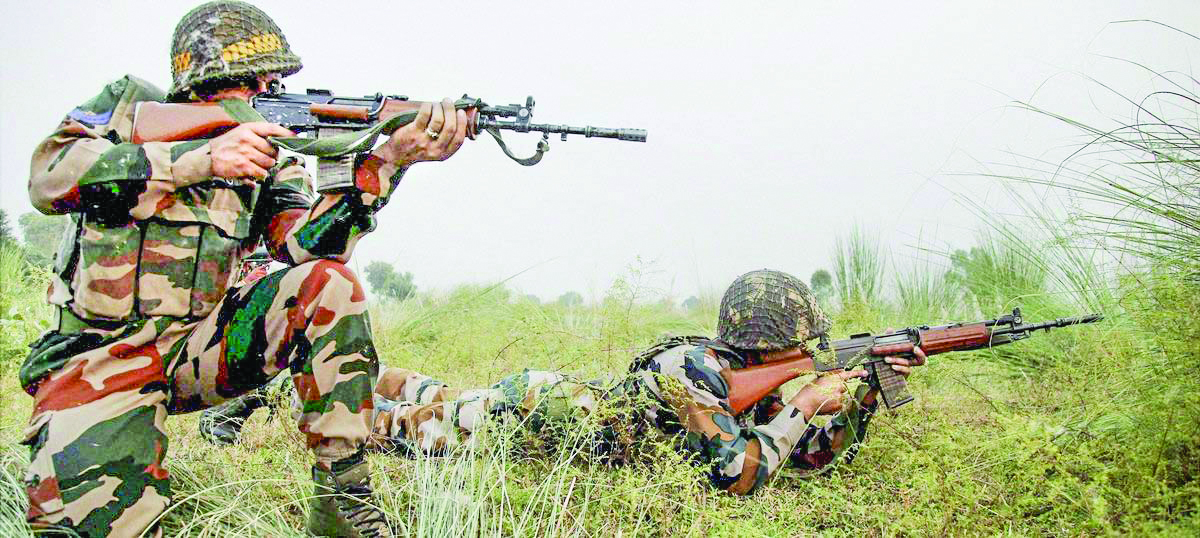
NEW DELHI: In the early hours of September 29, 2016, India’s military and political leadership took a step that altered the country’s counter-terrorism playbook. The announcement by Lt Gen Ranbir Singh, then Director General of Military Operations (DGMO), was brief but historic: Indian Army special forces had conducted surgical strikes across the Line of Control (LoC), targeting terrorist launch pads in Pakistan-occupied Kashmir.
The statement marked a turning point. For decades, India had absorbed terror attacks emanating from across the border, its responses largely confined to defensive measures or covert action. But the public acknowledgment of a cross-LoC strike signalled a departure from “strategic restraint” towards what many analysts call a doctrine of responsible retaliation.
The timing was no coincidence. Just 11 days earlier, militants had attacked the Army’s Uri brigade headquarters in Kashmir, killing 19 soldiers in one of the deadliest assaults on security forces in recent memory. Public anger was palpable, pressure on the government intense. India’s leadership had to demonstrate resolve—not just in words, but in action.
GATHERING THE INTELLIGENCE
Behind the DGMO’s calm words lay weeks of preparation. Intelligence inputs about launch pads—temporary shelters where terrorists assembled before infiltrating into India—had been building up. According to the government’s official briefing, “very credible and specific information” indicated that multiple groups of militants were waiting to cross over.
Sources confirm that the surveillance matrix was exhaustive. Satellite imagery, unmanned aerial vehicles (UAVs), intercepted radio chatter, and inputs from human assets all converged to map out targets. By the last week of September, it was clear that infiltration attempts were imminent. What was required was a calibrated response that would neutralise the threat and send a wider strategic message.
PLANNING THE OPERATION
Once the political go-ahead was secured, the task was handed to the Army’s Para Special Forces (SF)—elite units trained for high-risk missions. These soldiers were no strangers to such terrain. Years of operating in Kashmir’s rugged valleys and the Northeast had honed their skills in stealth, endurance, and precision strikes.
Operational planning began at multiple levels. Commanding officers worked closely with intelligence agencies to finalise targets. Teams were assigned specific launch pads, infiltration routes, and exfiltration plans. Synchronisation was key: multiple teams would cross at different points along the LoC, strike simultaneously, and return before Pakistani forces could react.
Every detail was accounted for. Ingress routes were studied using satellite data and local terrain knowledge. Backup fire support was positioned in case teams encountered resistance. Communications were secured, and command posts monitored the operation in real time. Helicopters were kept on standby but ultimately not used, preserving the element of surprise.
THE STRIKES ACROSS THE LOC
Shortly after midnight on the intervening night of September 28-29, the Para SF teams moved out. Under the cover of darkness, small groups crossed the LoC at multiple locations. The movement was silent, rehearsed, and disciplined.
By dawn, they had reached their targets—launch pads where groups of militants had gathered with weapons, equipment, and supplies. Using small arms, grenades, and carefully placed explosives, the commandos destroyed the camps. Firefights broke out at some sites, but the element of surprise tilted the balance. By first light, multiple launch pads lay in ruins, and the teams began their return journey.
Indian officials later briefed that the strikes inflicted “significant casualties” on terrorists and those supporting them. While casualty figures were never officially released, estimates in Indian media ranged from 35 to 70 militants killed. What made the operation remarkable was that all Indian troops returned safely—officially with zero fatalities, though one soldier was later reported to have suffered a minor injury from a mine.
PUBLIC ANNOUNCEMENT: A STRATEGIC FIRST
If the strikes were unprecedented, the government’s decision to announce them was equally significant. India had conducted cross-border raids in the past, but they had always been denied or left unacknowledged. The DGMO’s public briefing changed that tradition.
The announcement served multiple audiences. Domestically, it reassured citizens that the Uri attack had not gone unanswered. Internationally, it underlined India’s right to self-defence while emphasising restraint. Lt Gen Singh stressed that the operation had ceased, that India had targeted only terrorist infrastructure, and that there were no plans for escalation. The carefully worded statement projected strength without recklessness.
PAKISTAN’S DENIAL AND GLOBAL REACTIONS
As expected, Pakistan denied the strikes ever took place, insisting that only cross-border firing had occurred. Its Inter-Services Public Relations (ISPR) called India’s version “an illusion.” Yet, the tone of denial itself suggested that the strikes had unsettled Rawalpindi’s calculus.
Globally, reactions were cautious. Most countries urged restraint, wary of escalation between two nuclear-armed neighbours. But international think tanks and media noted the novelty: India had demonstrated that limited, precise retaliation was possible without triggering uncontrolled conflict. Analysts described it as a case study in deterrence under a nuclear shadow.
PROFESSIONALISM AT THE CORE
For the Army, the operation was a showcase of professional excellence. Every aspect—intelligence gathering, planning, stealthy execution, and safe exfiltration—spoke of meticulous preparation. That no civilian casualties were reported, no collateral damage claimed, and the strikes concluded before Pakistani forces could retaliate underscored the precision.
Recognition followed swiftly. Nineteen soldiers who took part were awarded gallantry medals in 2017. Major Rohit Suri received the Kirti Chakra, one of India’s highest peacetime honours, for his role in leading the mission.
CHANGING INDIA’S MILITARY DOCTRINE
The 2016 surgical strikes did not end cross-border terrorism, but they altered India’s doctrine. From “strategic restraint,” India had moved to a calibrated retaliation strategy. The strikes set a precedent for the Balakot air strikes in 2019, where the Indian Air Force crossed the international border to hit a Jaish-e-Mohammed camp in Pakistan’s Khyber Pakhtunkhwa province.
For the Army, the strikes validated the capabilities of the Special Forces and justified years of investment in training, technology, and readiness. For the political establishment, it reinforced the value of civil-military synergy, where the armed forces were given the mandate to act and delivered with professionalism.
LESSONS AND LEGACY
The legacy of the 2016 strikes lies in the way they reshaped India’s deterrence posture. They demonstrated that deterrence is not just about weapons, but about credibility—the willingness and ability to act when provoked. They also showed how professionalism ensures restraint, with careful planning preventing collateral damage and strengthening India’s case internationally.
Civil-military coordination emerged as another lesson. The strikes highlighted how political will and military precision must work in tandem to deliver decisive results. Finally, the episode underlined the importance of narrative control. By going public, the government framed the strikes as a legitimate act of self-defence, shaping both domestic opinion and international discourse.
START OF A DOCTRINE
The surgical strikes of September 2016 stand as a milestone in India’s counter-terrorism journey. They demonstrated that measured force, applied with precision and professionalism, can alter strategic equations without plunging the region into uncontrolled conflict.
For the soldiers who crossed the LoC that night, it was about mission accomplishment and safe return. For India’s leadership, it was about sending a message—that the days of silent endurance were over. And for the country, it was a moment of assurance: that when tested, the Army could act with both courage and restraint, defending the nation while upholding its democratic values.
Nine years on, the strikes remain a defining reference point in South Asia’s security discourse—a reminder that credible deterrence lies not just in weapons, but in the discipline and professionalism with which they are used.
Ashish Singh is an award-winning senior journalist with over 18 years of experience in defence and strategic affairs.




