
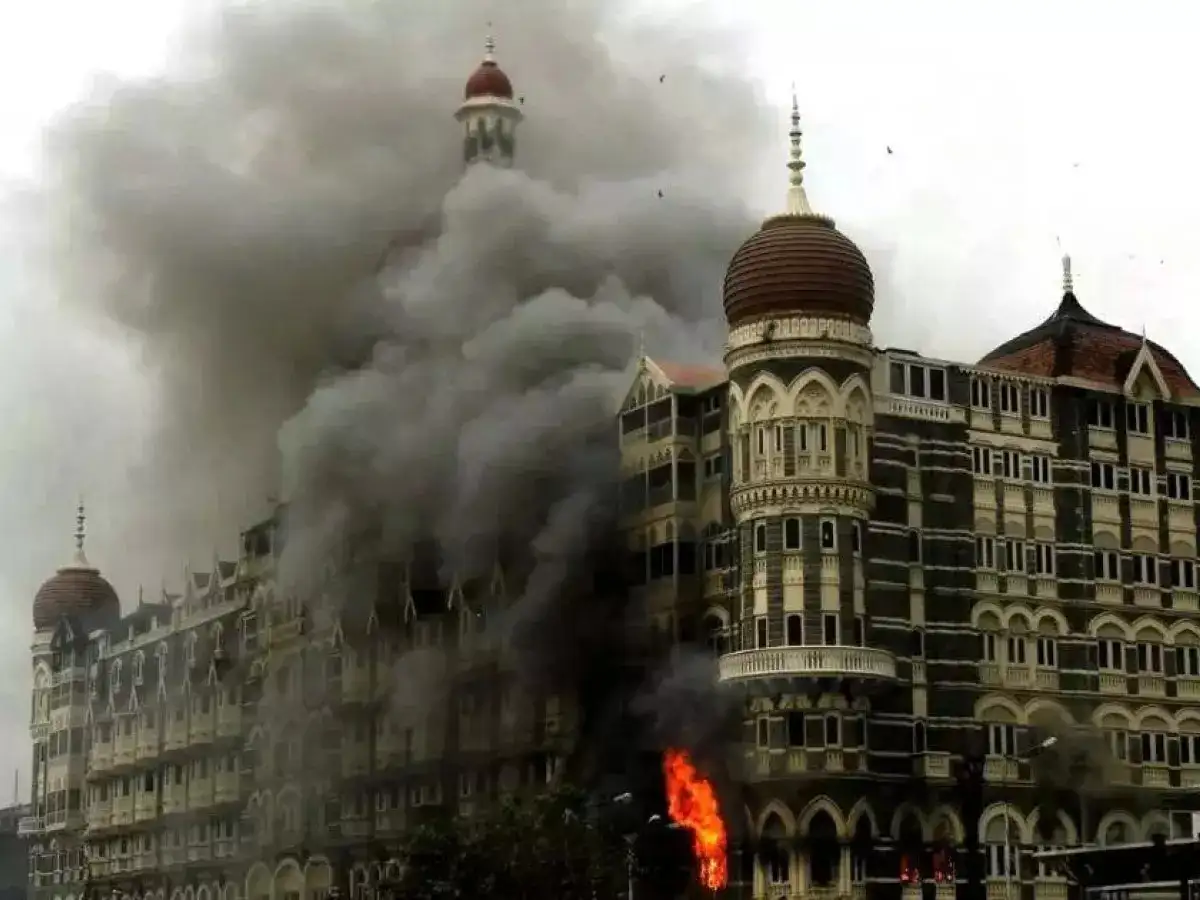
NEW DELHI: Prime Minister Narendra Modi on Wednesday invoked the 26/11 Mumbai terror attacks while addressing Israel’s parliament, the Knesset, recalling the loss of innocent lives, including Israeli citizens.
Nearly eighteen years after the 26/11 Mumbai attacks, questions about the movement of the attackers before 26 November 2008 have resurfaced alongside renewed focus on Pakistan’s own acknowledgment that the conspiracy was planned and launched from its soil.
The official reconstruction of the attack established that ten operatives of Lashkar-e-Taiba sailed from Karachi, hijacked the Indian fishing trawler Kuber, killed its crew and entered Mumbai by inflatable dinghy on the evening of 26 November. The lone surviving gunman, Ajmal Kasab, was captured alive, tried in India and later executed after the completion of the due judicial process.
However, survivor Anamika Gupta, who was shot three times during the attack at Leopold Cafe, has maintained that she saw at least four of the attackers two days before the assault.
“I saw at least four of them two days prior to 26/11. I had seen them at least twice. They were roaming around on two bikes in the same area and also visited the cafe,” Gupta told the Sunday Guardian.
Her account is consistent with what she had said after the attacks, where she described seeing four men on two motorcycles in Colaba before the attacks and again spotting some of them at Leopold Cafe shortly before the shooting began. Her statement was not part of the evidence relied upon in the Kasab trial. “We (she and her friends) were regular visitors at Leopold and most of the time we would go at night. It was crowded with customers, and we saw them sitting there,” she recalled.
Separately, in a 2013 interview, V. Balachandran, one of the two members of the High-Level Enquiry Committee headed by former Union Home Secretary R.D. Pradhan, stated that during the committee’s inquiry there were inputs suggesting that the terrorists may have reached Mumbai days before 26 November and could have stayed in the Machhimar-nagar area of Colaba while conducting reconnaissance of targets. Balachandran said the committee passed this information to central agencies but clarified that the panel’s mandate did not permit it to carry out a full-fledged investigation into that aspect.
The High-Level Enquiry Committee, commonly referred to as the Pradhan Committee, was constituted by the Maharashtra government on 30 December 2008 to examine intelligence handling and response failures. Its remit was to assess systemic lapses, not to determine the cross-border origin of the conspiracy.
To date, there has been no further probe on this particular aspect.
Former Intelligence Bureau officer Rajinder Kumar, who held a senior position in 2008, in a strange coincidence travelled from Pakistan to India on 26 November 2008 and was on the same flight as Pakistan’s then foreign minister Shah Mahmood Qureshi. He landed in India hours before the attacks began. Kumar was a part of an official team that had gone to Pakistan, while others went to visit the mountain resort city of Murree, Kumar chose to come back after the official work was done.
Kumar said that while accounts such as Gupta’s and the information referred to by Balachandran raise operational questions, the theory that the ten gunmen were stationed inside India for days carries serious logistical implications.
“If they had been hiding in India for days, the chances of information leaking out would have been very high. An operation of that scale would have come into the public domain,” Kumar said. He argued that sustaining secrecy for a heavily armed foreign group in a dense urban environment would have significantly increased the risk of detection.
At the same time, Kumar acknowledged that the attackers demonstrated familiarity with narrow lanes and target locations. He attributed that to reconnaissance and facilitation networks rather than prolonged physical presence of the ten gunmen. Among those identified in the broader conspiracy was David Coleman Headley and Tahawwur Hussain Rana, who conducted detailed surveillance of Mumbai targets prior to the attacks and later pleaded guilty in a United States court. Last year Rana was extradited to India from the United States and presently under the custody of the National Investigation Agency.
Kumar also referred to Rahul Bhatt, who was questioned by Indian investigators because of his association with Headley. Kumar said the extent of Bhatt’s knowledge and interactions was examined, but significantly as it should have been.” Investigative agencies did question Bhatt during the probe and no charges were filed against him. Bhatt is the son of film director Mahesh Bhatt and Kiran Bhatt.
Kumar maintained that the central issue remains Pakistan’s own investigative record and pointed towards the investigation by Tariq Khosa, who led Pakistan’s investigation as Director General of the Federal Investigation Agency.
In August 2015, Khosa wrote in the Dawn that the Mumbai attacks were “planned and launched from its soil.” Khosa detailed confirmation of Kasab’s nationality, identification of a training camp near Thatta in Sindh, tracing of financial flows, recovery of communications evidence linking handlers in Karachi to the attackers and arrests of alleged masterminds including Zaki-ur-Rehman Lakhvi, while noting procedural delays in prosecution.
“The following facts are pertinent. First, Ajmal Kasab was a Pakistani national, whose place of residence and initial schooling as well as his joining a banned militant organisation was established by the investigators. Second, the Lashkar-e-Taiba (LeT) terrorists were imparted training near Thatta, Sindh and launched by sea from there. The training camp was identified and secured by the investigators. The casings of the explosive devices used in Mumbai were recovered from this training camp and duly matched. Third, the fishing trawler used by the terrorists for hijacking an Indian trawler in which they sailed to Mumbai, was brought back to harbour, then painted and concealed. It was recovered by the investigators and connected to the accused. Fourth, the engine of the dinghy abandoned by the terrorists near Mumbai harbour contained a patent number through which the investigators traced its import from Japan to Lahore and then to a Karachi sports shop from where an LeT-linked militant purchased it along with the dinghy. The money trail was followed and linked to the accused who was arrested. Fifth, the ops room in Karachi, from where the operation was directed, was also identified and secured by the investigators. The communications through Voice over Internet Protocol were unearthed. Sixth, the alleged commander and his deputies were identified and arrested. Seventh, a couple of foreign-based financiers and facilitators were arrested and brought to face trial”, Khosa wrote in the article. Khosa, who joined the force in 1976, retired in 2011.
Kumar said that Khosa’s admission and the chargesheet that was filed in the court by him weakens subsequent Pakistani claims that India did not share sufficient evidence.
According to him, debate over whether the attackers were present in Mumbai days earlier should not overshadow the fact that Pakistan’s own former chief investigator publicly acknowledged that the conspiracy originated within its territory. Nearly two decades later, India’s judicial process in the Kasab case has concluded with his hanging, while proceedings in Pakistan remain more of a hogwash with main conspirators and accused roaming free despite published acknowledgment of the conspiracy’s Pakistani origin.




