The accusation that General Dwivedi’s personal temple visits or civic engagements constitute 'ideological signalling’ reflects an overreach that borders on paranoia.
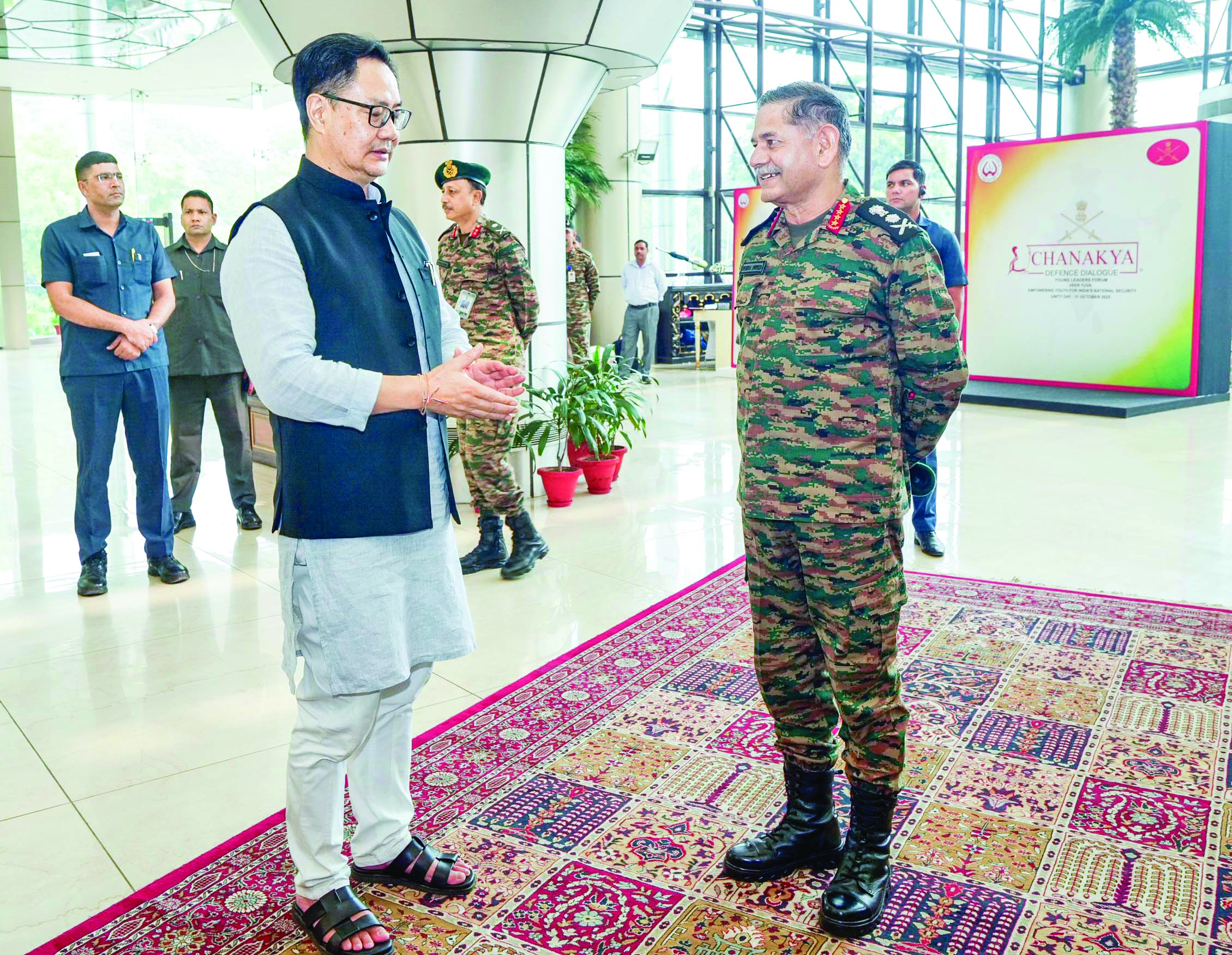
Union Minister Kiren Rijiju and Army Chief General Upendra Dwivedi during the Young Leaders Forum, a pre-event to the Indian Army’s flagship Chanakya Defence Dialogue 2025, in New Delhi on 31 October (Photo: ANI)
NEW DELHI: A recent opinion piece has raised alarms about an alleged "ideological fusion" within India's armed forces, accusing them of blurring the line between national defence and regime protection. It paints a dark picture of think tanks turned political platforms, of temple visits choreographed for optics, of military operations conveniently timed to aid electoral narratives. These are serious charges. Yet, on closer examination, what the critics describe as "ideological capture" is, in truth, the manifestation of an adaptive professionalism a military evolving to meet the demands of multi-domain warfare, technological change, and national integration in a democratic framework.
From 'Operation Sindoor's' swift retaliation against cross-border terrorism to the 'Veer Yuva Young Leaders Forum' organised by the Centre for Land Warfare Studies (CLAWS), the evidence suggests not politicisation but transformation the armed forces recalibrating to engage an informed, participative society. According to a Press Information Bureau release dated 31 October 2025, the forum's objective was clear: "empowering youth for India's national security". Such outreach exemplifies strategic civic engagement, not partisan alignment.
In Ready, Relevant and Resurgent (Pentagon Press, 2025), Chief of Defence Staff General Anil Chauhan defines "civil-military fusion" not as an ideological symbiosis but as a structural necessity the coordinated use of military, economic, and technological resources to secure India's national interests. Those invoking fears of politicisation mistake adaptation for capture, reform for regression.
The charge that CLAWS has become a stage for political theatre betrays a misunderstanding of its institutional role. The Veer Yuva Young Leaders Forum, held on 31 October 2025 at New Delhi's Manekshaw Centre, was a curtain-raiser to the Chanakya Defence Dialogue, co-hosted by the Indian Army and CLAWS to mark National Unity Day. Official records show that Union Minister Kiren Rijiju, Chief of Army Staff General Upendra Dwivedi, and Member of Parliament Tejasvi Surya addressed participants on the theme of "Yuva Shakti for a Sashakt aur Suraloshit Bharat".
Far from political posturing, the event showcased youth-led innovation and public participation in defence discourse. Surya's address, "An Inspiring Vision for India's Future," focused on defence start-ups and strategic research a point corroborated by the PIB release (PRID-2184710) and the speech archived on his official YouTube channel. To label such engagement as "politicisation" is to conflate democracy's natural interface between civil and military spheres with partisanship. If every dialogue between serving officers and elected representatives were treated as contamination, civil-military discourse itself would collapse. Democracies thrive not on isolation but on dialogue, and institutions like CLAWS, USI, and IDSA are precisely where that dialogue must occur.
The Forces First Conclave of 18 October 2025, co-hosted by CLAWS and a national television channel, followed the same rationale: an open forum for discussing integrated theatre commands and multi-domain operations. Comparable practices exist globally; in the US, the UK, and France, defence institutions routinely collaborate with media outlets to educate the public and encourage informed debate. Shielding the military from public scrutiny would be far more dangerous than any supposed "exposure" to civic engagement.
The accusation that General Dwivedi's personal temple visits or civic engagements constitute "ideological signalling" reflects an overreach that borders on paranoia. His June 8, 2025, pilgrimage to Kedarnath with his family was not an official act but a private visit during peak pilgrimage season—an event covered neutrally by news agencies. Such visits have precedent: General Bipin Rawat's 2019 Vaishno Devi pilgrimage drew little criticism, as have visits by chiefs of all faiths to shrines, gurdwaras, churches, and mosques.
The Indian Armed Forces are among the most pluralistic institutions in the country over 75% of their personnel hail from diverse caste, linguistic, and religious backgrounds. Personal faith, expressed privately or ceremonially, does not compromise institutional secularism. To argue otherwise is to misunderstand the deeply inclusive ethos that underpins Indian military culture.
Similarly, General Dwivedi's October 31, 2025, hometown visit to Rewa, where he addressed students at his alma mater Sainik School Rewa and spoke at TRS College, was a blend of professional duty and personal roots. His address on "Evolving Security Challenges" was covered by the media a civic outreach, not a political spectacle. Generals before him from M.M. Naravane to R. Hari Kumar have undertaken comparable engagements. These events reinforce public trust, nurture the next generation of officers, and reaffirm the armed forces' social contract with the citizenry they defend. To call these "choreographed war hero narratives" is to wilfully disregard decades of democratic normalcy.
No example better illustrates the gap between accusation and fact than Operation Sindoor. Following the Pahalgam terror attack (22 April 2025) that killed 26 civilians , India launched a precision operation against terror infrastructure across the Line of Control on 7 May 2025. The operation concluded within four days, ending after Pakistan's limited drone retaliation at 1700 IST. Analysts from BASICINT termed it an example of "cumulative deterrence" a calibrated military response without escalation. The Ministry of External Affairs confirmed operational closure on 10 May 2025, underscoring discipline, restraint, and professional control.
Claims that the operation was politically staged for electoral optics collapse under scrutiny. The humanitarian tragedy that precipitated it left no government of any party with the option of inaction. Moreover, allegations that critics faced "police summons" for questioning the operation are unsubstantiated; no credible reports from press watchdogs, opposition leaders, or human rights organisations corroborate this claim. The operation's visibility through press briefings, video clips, and official imagery was not propaganda but strategic communication, consistent with the government's Atmanirbharta and deterrence transparency policies. India's public now expects visibility, accountability, and explanation of military action. That is democracy at work, not propaganda in uniform.
Where the alarmist argument truly collapses is in its distortion of General Chauhan's idea of civil-military fusion. His framework in Ready, Relevant and Resurgent is administrative, not ideological. It calls for "whole-of-nation" synergy, integrating ministries, academia, and industry to enhance efficiency in command structures and resource use. The model aligns with the US Department of Defense's comprehensive approach, the UK's Fusion Doctrine, and Japan's Defence Innovation Strategy. Such integration reduces duplication, accelerates technology absorption, and strengthens deterrence. To equate this with "party control" is a fundamental category error.
India's democratic safeguards remain intact: Parliament scrutinises defence spending, the Cabinet Committee on Security supervises strategic direction, and the Supreme Court retains jurisdiction over military matters, from promotions to rights protections. These institutions provide robust civilian oversight the antithesis of the authoritarian command structures in Beijing or Moscow.
India's armed forces operate in an environment of unprecedented complexity—confronting terrorism in the west, assertiveness from China in the north, cyber and drone warfare in the grey zone, and humanitarian missions across the Indian Ocean. These realities demand adaptability and openness to public engagement. Initiatives like the Veer Yuva Forum, operational innovations like Sindoor, and conceptual reforms like civil-military fusion all signal evolution, not erosion. The Indian military's constitutional subordination to civilian authority has endured uninterrupted through every political transition—from Nehru to Modi, from Congress to BJP and back through coalitions. To misread this continuity as ideological drift is to ignore the discipline, restraint, and professionalism that have defined the Indian military for over seven decades.
Critics serve democracy by questioning power, but their critiques must rest on evidence, not insinuation. Genuine debate about transparency and institutional autonomy is welcome but fearmongering about "regime security" only muddies public understanding. India's soldiers, sailors, and airmen have stood firm through war, insurgency, and disaster apolitical yet profoundly patriotic. They have earned the right to engage their society without being accused of ideological capture. In the final reckoning, professionalism not politicisation remains the lodestar of India's armed forces.
Ashish Singh is an award-winning senior journalist with 20 years of experience in defence and strategic affairs.
