HAL and HENSOLDT join forces to develop a LiDAR-based Obstacle Avoidance System for Indian military helicopters, enhancing safety in extreme flying conditions and marking a major step in indigenous defence technology.
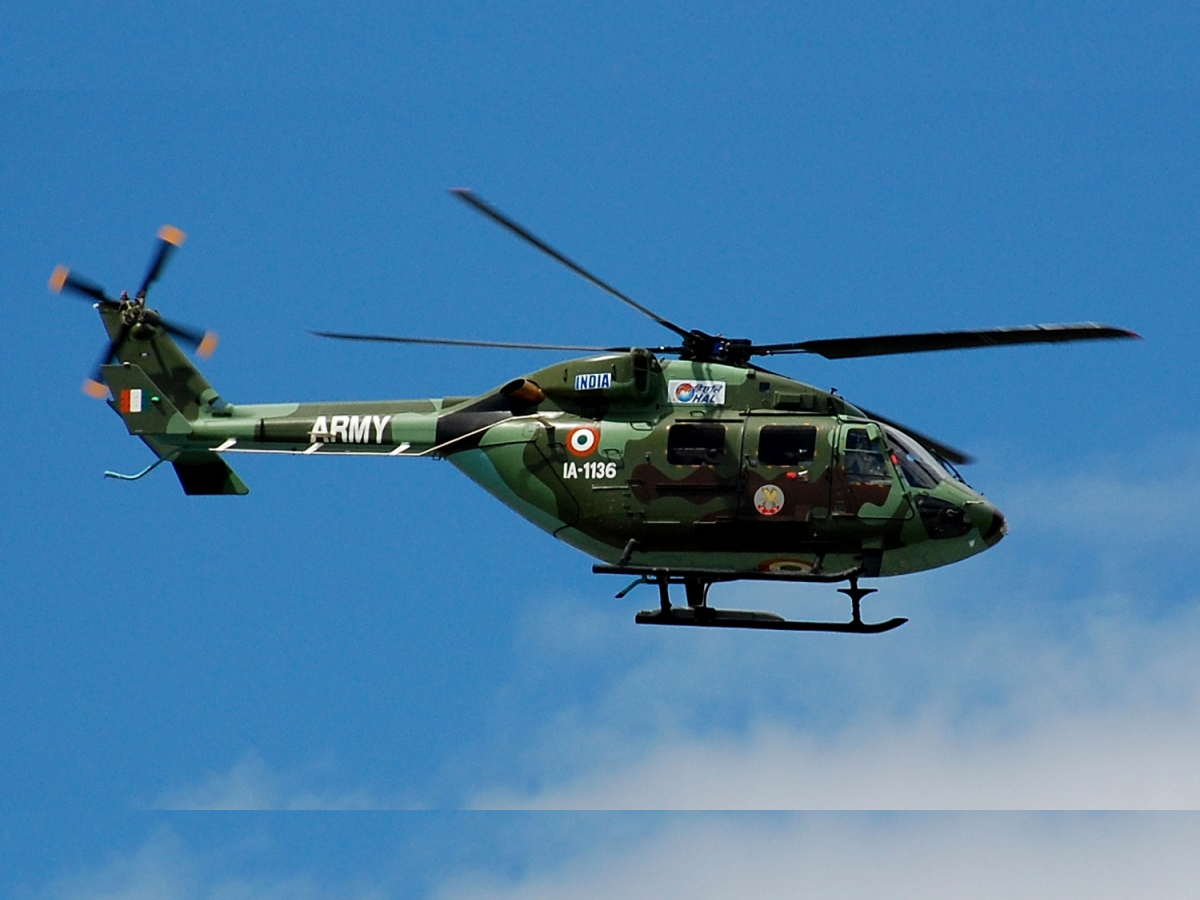
HAL and HENSOLDT join forces to develop a LiDAR-based Obstacle Avoidance System for Indian military helicopters, enhancing safety in extreme flying conditions and marking a major step in indigenous defence technology. (Image Credit: Aviation Defence Universe)
For decades, Controlled Flight into Terrain (CFIT) has remained one of the most persistent anxieties for India’s military aviation community—an ever-present threat that arises not from engine failure or mechanical malfunction, but from a momentary loss of situational awareness in unforgiving environments. Whether flying in Ladakh’s rarefied air, navigating the steep valleys of Arunachal Pradesh, or approaching makeshift landing zones during counter-insurgency operations, Indian helicopter crews have often operated at the very limits of what their onboard systems were designed to handle.
That reality is now poised for transformation. At the Dubai Airshow 2025, state-owned Hindustan Aeronautics Limited (HAL) and government-backed German defence electronics major HENSOLDT signed a landmark agreement to co-develop a LiDAR-based Obstacle Avoidance System (OAS) for Indian military helicopters. The partnership places India among a select group of nations with sovereign access to this class of advanced helicopter safety technology.
Few militaries in the world fly as frequently in degraded visual environments as India’s. Dust-laden brownouts in the deserts of Rajasthan, blinding whiteouts over Siachen, fog-bound landings in the plains, and night missions in unfamiliar terrain have all contributed to a long history of close calls and operational risk. Even the best-trained crews face natural limits when the landscape simply disappears from view.
The new Indo–German system is built precisely for such challenges. It integrates HENSOLDT’s SferiSense LiDAR with a high-speed Degraded Visual Environment (DVE) computer and advanced synthetic vision to detect wires, pylons, ridgelines and micro-obstacles in real time, out to distances of more than a kilometre. The LiDAR’s angular accuracy allows reliable detection even when obstacles lie at oblique angles. Early-warning cues generated in milliseconds provide pilots with crucial reaction time—often the difference between a safe landing and a catastrophic CFIT incident.
This fusion of sensors and symbology effectively gives helicopter crews a clearer, more reliable picture of the world outside the cockpit, even when human perception is compromised by weather, altitude or terrain.
India has long spoken about reducing its dependence on imported avionics, but this agreement goes significantly beyond the usual procurement model. Germany has committed to transferring design and manufacturing IPR, enabling HAL to produce the OAS domestically, integrate it across Indian platforms, and sustain it over the long term. HAL will also hold the rights to export the completed system.
In practical terms, India is not merely acquiring equipment—it is acquiring the capability to build, refine and own the technology. The system is intended for integration across India’s indigenous military helicopter fleet, supporting both current and future rotary-wing programmes.
The agreement marks an important evolution in HAL’s trajectory, from being primarily a build-to-print manufacturer to a build-to-spec developer with shared ownership of sophisticated avionics. Germany’s willingness to partner at this depth—especially in a technology domain mastered by only a few nations—reflects the rising level of trust between the two countries and India’s growing weight as a defence industrial power.
It also illustrates India’s changing approach to defence partnerships. Increasingly, the priority is on absorbing knowledge, acquiring IPR, and building local ecosystems rather than simply assembling imported systems.
For helicopter crews, the impact of this technology will be immediate. Whether conducting nap-of-the-earth manoeuvres or approaching challenging landing zones during high-risk missions, India’s indigenous rotary-wing platforms will benefit from significantly enhanced clarity of obstacles and terrain. Pilot workload will decrease during demanding flight phases, routing will become safer in hostile or unfamiliar zones, and missions once considered too risky may become operationally viable.
In essence, crews will fly with better information—and fewer surprises—directly enhancing both safety and tactical flexibility.
The HAL–HENSOLDT partnership sits at the crossroads of operational necessity and industrial ambition. It arrives at a time when India’s military responsibilities are expanding, the need for indigenous capability is sharpening, and aviation safety has become a strategic priority. With this pact, India moves decisively to bridge a technological gap that has lingered for years.
Once deployed, the system has the potential to reshape the safety profile of India’s rotary-wing fleet for the next generation—delivering a capability that frontline pilots have long known they needed, and one that India can finally claim as its own.
(Aritra Banerjee is a columnist specialising in Defence, Strategic Affairs and Indo-Pacific geopolitics. He is the co-author of The Indian Navy @75: Reminiscing the Voyage. Having spent his formative years in the United States before returning to India, he brings a global outlook to his reporting from overseas defence assignments and conflict-affected regions such as Kashmir. He holds a Master’s in International Relations, Security & Strategy from O.P. Jindal Global University, a Bachelor’s in Mass Media from the University of Mumbai, and Professional Education in Strategic Communications from the King’s Institute for Applied Security Studies, King’s College London.)
