
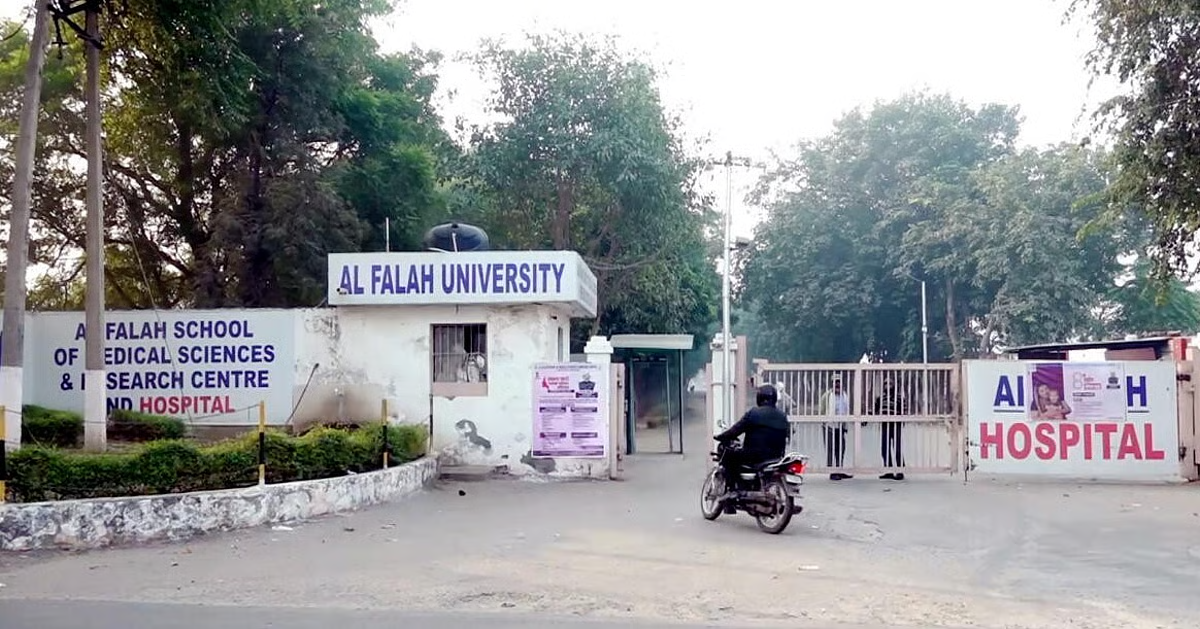
NEW DELHI: Since the National Investigation Agency (NIA) has taken over the case and registered an FIR under the Unlawful Activities (Prevention) Act (UAPA), the investigation has begun to unfold several interlinked layers, many of which point toward Al Falah University.
Forensic experts are now comparing the material recovered from the Hyundai i20 used in the blast with samples seized in Faridabad to determine whether both originated from the same batch of ammonium nitrate. Meanwhile, The Sunday Guardian reached out to Royal Car Zone in Faridabad, as the Hyundai i20 used in the Red Fort explosion had been sold to Umar through this dealership. Amit Patel, the owner of Royal Car Zone, told The Sunday Guardian that he has been questioned multiple times by the Special Cell, Crime Branch, and Haryana Police since November 10 in connection with the case. His associate Sonu, who handled part of the car’s sale process, remains under close scrutiny and continues to face interrogation by investigators.
Explaining the sequence of events, Patel revealed that Salman, the original owner of the i20, had listed it for sale on OLX. Later, his associate Sonu took possession of the vehicle as a commission and subsequently sold it to Dr. Umar, who has since been identified as the prime accused in the blast. Patel clarified that the vehicle’s Registration Certificate (RC) was still in Salman’s name at the time, as the No Objection Certificate (NOC) transfer process generally takes around 20 days—a window during which the explosion occurred. Patel further stated that he had no knowledge of Umar’s criminal involvement. “I had verified all necessary documents before completing the sale,” he said, adding that Umar had introduced himself as a doctor and professor at Al-Falah University, which gave no reason to suspect foul play: “I never imagined the vehicle would be used for such an act,” Patel emphasized, insisting that the transaction appeared completely legitimate.
In Khandawali village a local resident named Shamim told The Sunday Guardian that an unidentified person abandoned a car on his property late Monday night. “We discovered the vehicle the next morning, Because of this, our names and that of our village are being unfairly dragged into controversy,” he said. Additionally, the Delhi Police detained a man named Fahim from Khandawali village, who is reportedly associated with Al-Falah University, where he worked as a computer operator. Investigators believe Fahim was responsible for parking the red EcoSport at Khandawali.
Investigating agencies have since traced the fourth vehicle a silver Maruti Brezza registered in the name of Dr. Shaheen. Sources said that this car was also part of the terror module’s network. The first vehicle identified in the case was a Swift Dzire belonging to Dr. Shaheen Shahid, while the second, a Hyundai i20, was used in the blast. The third, a red Ford EcoSport, was recovered from Khandawali village and is suspected to have been used to transport ammonium nitrate to multiple destinations. Authorities later recovered the fourth car, the Maruti Brezza, from the Al-Falah University premises. Preliminary findings indicate that the vehicle had been driven nearly 35,000 kilometres within just one and a half months. During interrogation, arrested accused Dr. Shaheen informed Jammu and Kashmir Police that her Brezza had been parked at the university campus. The Brezza was found beside the hostel building where Al-Falah University’s trainee students reside.
Investigators have confirmed that a doctor named Muzammil, working at Al-Falah Medical College, has been arrested for his alleged involvement in the terror network. Another key member, Dr. Umar, who was also employed at the same institution, managed to escape when agencies intensified their crackdown. According to sources, Umar, while attempting to evade capture, acted out of panic and desperation actions that are believed to have culminated in the Red Fort blast.
As part of The Sunday Guardian’s ground report, a visit to Al-Falah University revealed that multiple investigative agencies are still stationed on campus. Around thirteen professors and staff members have been questioned, including Dr. Muzammil Ganaie and Dr. Shaheen Sayeed who were subsequently arrested. A student from the university, speaking on condition of anonymity, said, “He was a junior resident doctor in the emergency department, so he rarely interacted with us. We only learned about him after hearing the news of his arrest.”




