An in-depth analysis of Indian leaders who believed they were bigger than their parties, why most failed, and how rare exceptions like Sharad Pawar rewrote the rulebook.
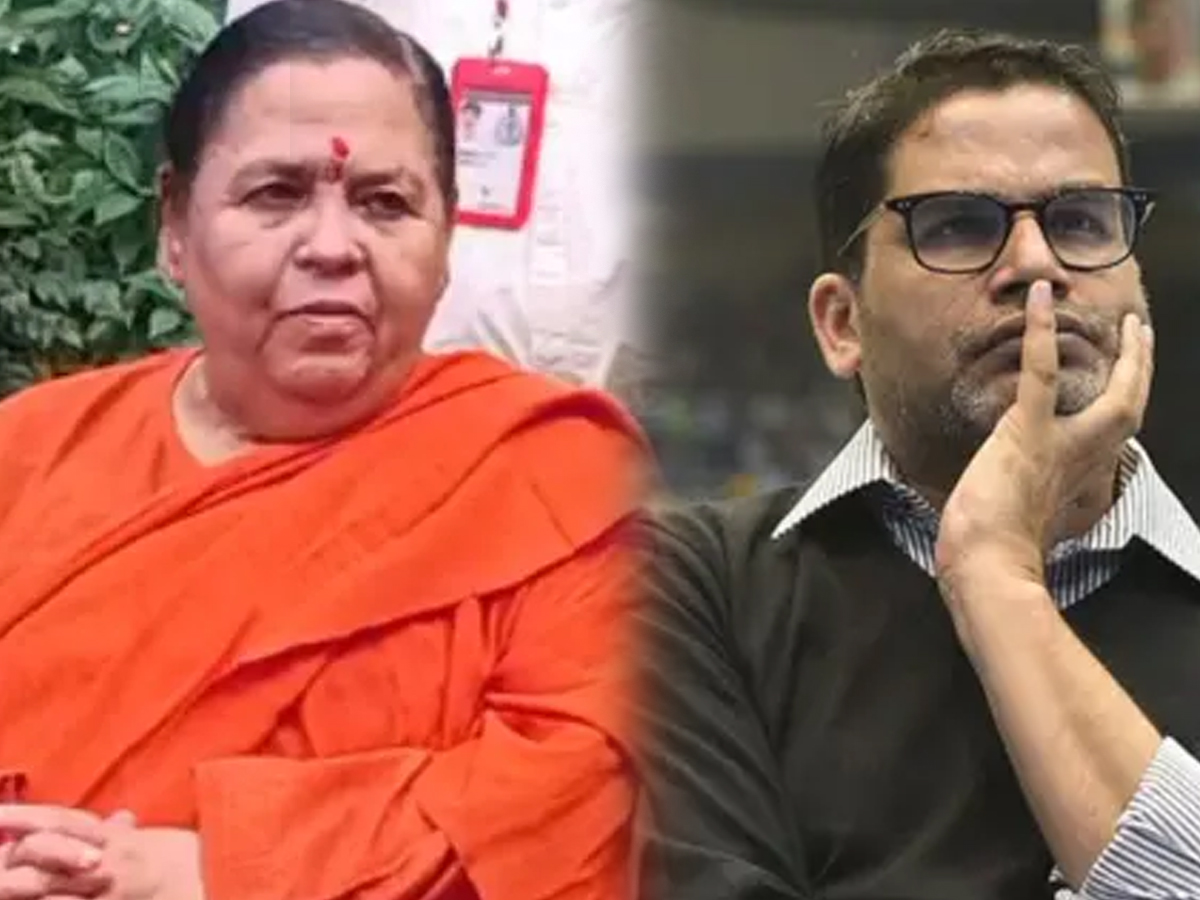
The trajectory of Uma Bharti is the purest early case study of this syndrome.
New Delhi: Indian politics is marked by a recurring delusion: a leader begins to mistake applause for permanence and their authority for absolute ownership. The shift is subtle at first, then absolute—they conclude: "I am the party. Without me, it collapses."
The trajectory of Uma Bharti is the purest early case study of this syndrome.
In November 2003, she became Chief Minister of Madhya Pradesh, elevated by the BJP as a mass mobiliser and Hindutva icon of the Ram Janmabhoomi era amidst slogans like “Bharat ki beti kaisi ho, Uma Bharti jaisi ho”.
By then, her self-perception had already evolved from leader to the embodiment. The rupture came in August 2004, when the Supreme Court revived the 1994 Hubli case and the BJP leadership asked her to step down. She resigned, even as plans were already in play within the party to ‘cut her to size’. By April 2005, she walked out of the BJP and launched the Bharatiya Jan Shakti Party — not as a carefully designed alternative, but as an act of political defiance.
The belief was clear: the BJP would sink in Madhya Pradesh without her. The verdict arrived in December 2008. Her party, which had contested 201 seats, could only win 5. The BJP strengthened under Shivraj Singh Chouhan while her party shrank into irrelevance. By April 2011, Uma Bharti returned to the very organisation she once tried to politically punish. The organisation endured. The myth did not.
This pattern became familiar.
In August 2017, one of the tallest socialist leaders and one of the poles of Janata Dal (united) Sharad Yadav revolted against his disciple turned ‘boss’ Nitish Kumar, convinced that ideological history and the ‘real’ JDU would walk with him. By 2018, his faction had faded into political insignificance while the party remained intact.
In September 2021, Captain Amarinder Singh resigned from the Congress and announced his own outfit in October 2021, believing Punjab still revolved around his persona. The February 2022 Punjab Assembly elections dismantled that illusion. His party barely registered on the electoral map.
A further illustration of this pattern was seen in Chhattisgarh through the political arc of former CM , the late Ajit Jogi. After being sidelined by the Congress leadership, Jogi floated the Janata Congress Chhattisgarh (JCC) in 2016, projecting it as a decisive alternative to both the Congress and the BJP.
In the 2018 Chhattisgarh Assembly elections, his party contested widely and secured over 1 million votes with a vote share exceeding an impressive 7 percent. However, this did not translate into structural political dominance, as the Congress swept the state with a decisive majority while Jogi’s formation won only five seats. Despite initial visibility and regional influence, the party failed to evolve into a durable electoral force and remained peripheral to the main power centres in the state.
Yashwant Sinha’s exit from the BJP in January 2018 followed a similar trail of moral defiance and the much anticipated internal revolt—neither materialised. Sinha, one of the most well-read leaders of the Vajpayee era BJP, couldn’t read the winds.
Similarly, Babulal Marandi’s journey mirrors the same delusion-reality cycle. After becoming Jharkhand’s first Chief Minister in 2000 under the BJP banner, he grew increasingly convinced that his individual appeal outweighed the party’s organisational strength. In 2006, he walked out and formed the Jharkhand Vikas Morcha (Prajatantrik), assuming his personal stature would convert into a parallel power centre. Instead, the BJP reconfigured itself in Jharkhand while Marandi’s political footprint steadily eroded. By 2020, the man who once believed he could break the BJP returned to it — a full-circle confirmation that the organisation had outlived the rebellion.
Upendra Kushwaha followed a comparable arc in Bihar politics. A serial defector with persistent belief in his own indispensability, he exited the JD(U) multiple times, forming and reforming outfits such as the Rashtriya Lok Samata Party and later walking away again. Each move was framed as ideological conviction or personal affront. Each time, the electoral results exposed the same structural truth: without a machine, personality dissolves. Despite ministerial stints and momentary relevance, Kushwaha’s independent political ventures consistently failed to create a durable base, reinforcing the pattern of inflated self-importance meeting organisational reality.
The most dramatic failure of this delusion came with the Aam Aadmi Party’s national overreach.
Following its spectacular victory in Delhi in December 2013, Arvind Kejriwal and his leadership circle began interpreting a city’s revolt as a nation’s awakening. By early 2014, AAP behaved less like a new political force and more like a government-in-waiting for India. In the April–May 2014 Lok Sabha elections, it launched an all-India foray, contesting over 400 seats, distributing tickets to retired IAS and IPS officers, activists, social reformers and technocrats, convinced that moral authority itself would translate into mandate. Kejriwal even took on Narendra Modi in Varanasi, certain that the “aam aadmi wave” was unstoppable.
The result was crushing. AAP won just four seats nationally, all from Punjab, and was politically obliterated across the rest of India. The wave existed — but only in Delhi. The party had confused momentum with inevitability, and applause with national allegiance. It took years of retreat and recalibration for AAP to relearn the limits of its own footprint.
Each of these cases followed the same arc: stature inflated into mythology, mythology tested by reality, reality refusing to cooperate.
But this psychology does have an exception — and that exception sharpens the argument rather than weakens it.
The counter-thesis lies in Sharad Pawar’s split from the Congress in 1999.
When Pawar walked out in June 1999 over Sonia Gandhi’s foreign origin and formed the Nationalist Congress Party with P.A. Sangma and Tariq Anwar, it momentarily resembled another ego rupture. Historically, this should have ended in marginality. Instead, it became one of the most clinically executed power manoeuvres in modern Indian politics.
Pawar did not leave to perform rebellion. He left to redesign leverage.
The NCP was never conceived as a national alternative to the Congress. It was crafted as a regional pressure architecture, with Maharashtra as its centre of gravity. Within four months of its birth, the party secured 58 seats in the October 1999 Maharashtra Assembly elections and positioned itself as kingmaker. The Congress could not govern without Pawar. The BJP-Shiv Sena alliance could not bypass him. He did not replace the organisation — he made both blocs dependent on him.
Here lies the essential distinction. Pawar did not claim he was bigger than the Congress. He calculated, correctly, that in Maharashtra the Congress was smaller than the ecosystem he had built over decades: cooperative banks, rural credit societies, sugar federations, district satraps, caste alliances and institutional memory. His authority was not rhetorical. It was infrastructural.
So while most leaders who walk out mistake applause for permanence, Pawar walked out with arithmetic, sociology and coercive relevance. His 1999 split was not a delusion of grandeur. It was strategic secession — a rare instance where the man did not imagine himself bigger than the party; he had already engineered reality to make it so in his domain.
Similar is the case of leaders like Mamata Banerjee and Jagan Mohan Reddy.
When Mamata founded the Trinamool Congress in January 1998, and when Jagan launched the YSR Congress Party in March 2011, neither simply stormed out in fury. They dismantled and rebuilt political ecosystems. They did not declare themselves bigger than the organisation — they became the organisation through infrastructure, narrative and emotional ownership. Their exits were architectural, not theatrical.
Which brings us to the most contemporary case study: Prashant Kishor.
For over a decade, Kishor was seen as someone who scripted victories, shaped narratives, refined messaging and assembled winning coalitions. Somewhere along this arc, the logic shifted: if I make chief ministers, why should I not become one?
When he launched the Jan Suraaj campaign in October 2022 and began his Bihar padyatra in January 2023, the transformation was visible. The strategist had begun to see himself not as facilitator but as inevitable ruler. The assumption was that his intellect, brand recall and “kingmaker” reputation would convert seamlessly into mass mandate.
What followed was not merely defeat — it was statistical humiliation.
Jan Suraaj failed to win a single seat. In multiple constituencies, its candidates polled fewer votes than NOTA. Deposits were lost across large swathes of the state. Vote shares remained so low that the party often failed to even register as a serious third force. This was not a narrow debut failure. It was structural rejection.
For someone who had built a career on understanding voter psychology, the verdict was stark: strategy without emotional anchoring does not create loyalty. The kingmaker myth collapsed the moment the kingmaker had to seek votes for himself.
From Uma Bharti’s rebellion in April 2005, to AAP’s national overreach in April–May 2014, to Prashant Kishor’s collapse after October 2022, the same psychology repeats. Leaders begin to believe the applause is permanent, the crowd is personal, and the organisation is expendable.
But the Sharad Pawar exception clarifies where the line truly lies.
It is not departure that destroys leaders; it is departure without infrastructure. In Indian politics, power does not function on ego, but on ecosystems. Booth structures, caste matrices, cooperative control, social networks, and emotional loyalties do not migrate simply because an individual feels indispensable.
The moment a politician behaves as if the organisation owes its existence to them, the clock starts ticking. The party adapts, the crowd recalibrates, and the myth dissolves.
This is why the organisation survives, the wave recedes, and another name joins the long archive of political overconfidence.
