
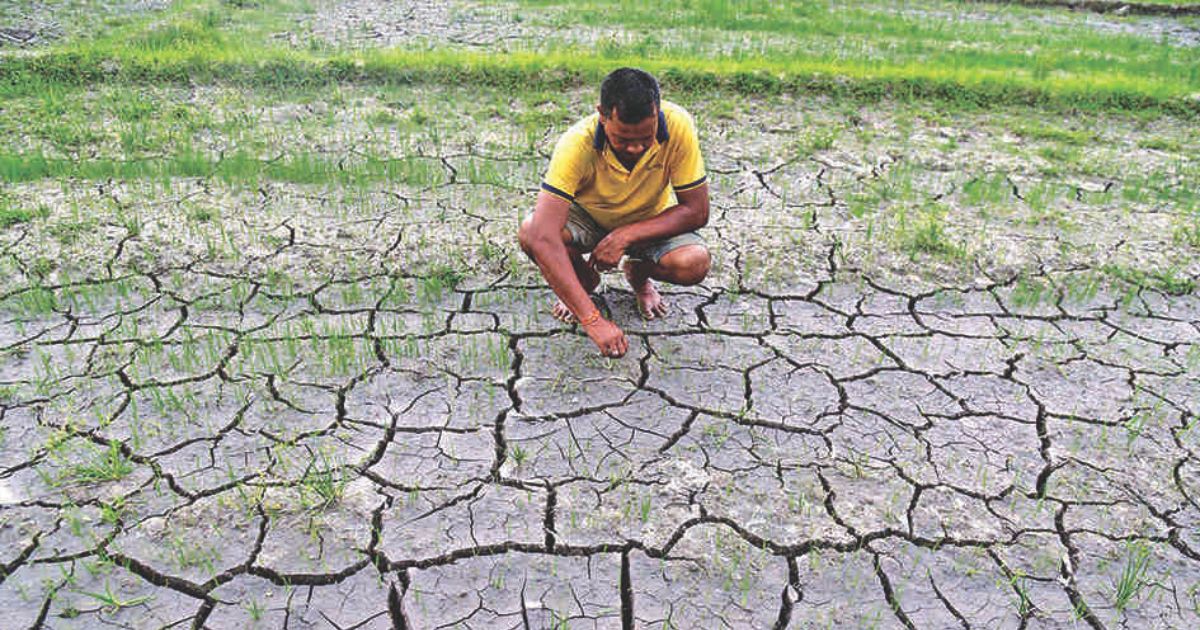
Widespread rainfall deficit cripples Assam’s farming, sparks fears of food insecurity.
Guwahati: In Assam, July typically brings the threat of floods, displacing communities and damaging crops. But in 2025, the narrative has dramatically shifted. Instead of inundation, large parts of the state are gripped by a drought-like situation, severely affecting agriculture and the daily lives of ordinary people. Farmers are staring at parched fields, wilting hopes, and an uncertain future.
The worst-hit districts include Kamrup Metro, Kamrup, Dhubri, Nalbari, Barpeta, Bongaigaon, and Darrang—each facing a rainfall deficit between 60% and 80%. The lack of rain has left paddy fields dry and cracked, making it impossible for farmers to plant Sali paddy, the state’s primary monsoon crop.
According to sources, a preliminary assessment by the Assam Agriculture Department indicates that 14 districts are experiencing “high deficit rainfall,” while 13 others are classified under “deficit” conditions. In response, the State government has initiated urgent measures to tackle the growing drought-like conditions across Assam.
Case Study: The Crisis in Barpeta
In the lower Assam district of Barpeta, the drought has already left devastating marks. Fields in the Keotkuchi area, once lush and fertile, are now barren, with widening cracks visible across roughly 1,500 bighas of agricultural land. Over 600 farmers in the region are reportedly struggling due to the extended dry spell.
With only two to three days left before the Assamese month of Ahar ends, Sali paddy cultivation has not begun. The fields remain sun-scorched, with seedbeds (kothiya) lying dry and unprepared. Farmers fear that without rainfall in the next 20 days, the entire Sali paddy season will be lost.
“I cultivate nearly 50 bighas of land, including my own and others’. But due to the absence of rainfall, I haven’t been able to start cultivation,” one farmer told The Sunday Guardian. “Even irrigation is not possible. Although I received a water pump from the Agriculture Department in 2021, it has been out of order for a long time.”
Another farmer added, “The rainfall in Barpeta this year is abysmally low. Even dry ploughing isn’t possible due to the lack of water. With no irrigation facilities in our farmland, we are forced to wait helplessly. If it doesn’t rain soon, we’ll miss the window for Sali cultivation.”
Lowest Rainfall Districts and Regional Disparities
Rainfall data from 1 June to 25 July 2025 reveals that the districts of Biswanath (8.3 mm), Dhemaji (1.5 mm), and Dibrugarh (1.1 mm) have received some of the lowest rainfall totals in the state—Dhemaji and Dibrugarh being 93% below normal.
In sharp contrast, neighbouring states are witnessing excessive rainfall. Jharkhand has received 676 mm of rain—41% above normal. Ranchi and East Singhbhum have both surpassed 900 mm. Bihar is seeing vigorous monsoon activity, and Kolkata has logged over 693 mm in July alone.
Understanding the Rainfall Deficit
Dr. Sanjay O’Neill Shaw, Scientist-F at the Regional Meteorological Centre (RMC), Guwahati, attributes the deficit to a combination of climatic factors. “There has been less cloud cover and reduced moisture incursion from the Bay of Bengal,” he explained.
“Both contribute significantly to monsoon rains in the Northeast.” Dr. Shaw also noted that the India Meteorological Department had earlier forecast below-normal rainfall for the region.




