Over 10,000 Bodo dancers perform Bagurumba in Guwahati, marking Assam’s journey from conflict to cultural celebration and socio-political transformation.
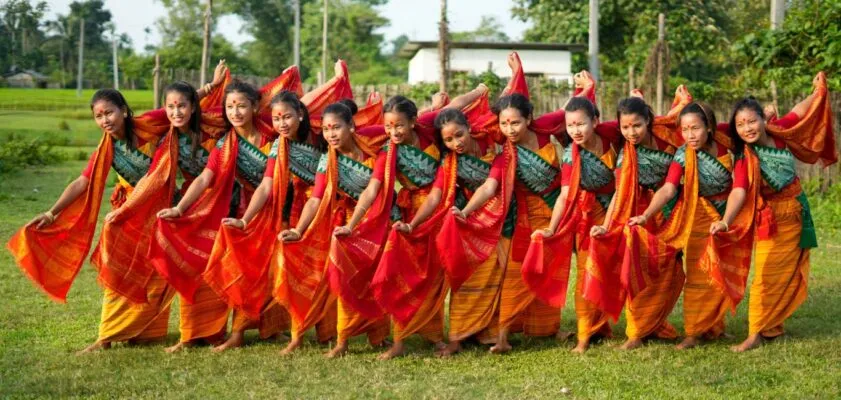
Thousands of Bodo dancers gather in Guwahati for the historic Bagurumba Dwhwo, showcasing Assam’s rich heritage and peace-driven progress (Photo: File)
GUWAHATI: The cultural landscape of Assam witnessed a defining moment on January 17 as over 10,000 Bodo dancers gathered at Guwahati’s Arjuna Bhogeswar Baruah Sports Complex to perform the revered Bagurumba dance. The Bagurumba Dwhwo has been organised by the Government of Assam under the dynamic leadership of Chief Minister Dr Himanta Biswa Sarma, and this unprecedented gathering through a cultural event is a landmark in the state's socio-political evolution.
The dance form Bagurumba is at the heart of Bodo cultural identity. Often described as the "butterfly dance" due to its elegant, flowing movements, Bagurumba reflects the Bodo community's deep connection to nature. Traditionally performed by women during Bwisagu, the Bodo New Year festival, the dance symbolises harmony and renewal. Passed down for generations, it embodies the community's values and spirit.
Bringing together performers from across Assam, including districts outside the Bodoland Territorial Council (BTC), this world-record initiative has served multiple purposes. Culturally, it has placed Bodo heritage on the national stage. Politically and socially, the Bagurumba Dwhwo has affirmed Assam's journey from insurgency to peace, from conflict to cultural assertion.
The presence of Prime Minister Narendra Modiji at this historic event has elevated the importance and gravity of the event vis-à-vis the focus of the Central Government for Assam. His commitment to peace and development in the Northeast has continued to inspire the people of the state. This has reaffirmed the Centre's support for the integration and celebration of indigenous cultures, particularly those previously affected by violence and marginalisation.
Speaking exclusively to TSG, Assam Police Additional Director General of Police (ADGP) Hiren Nath highlighted the long and complex process behind this transformation. He said Assam, including the five districts of the BTR, had witnessed nearly three decades of militancy involving multiple armed groups such as the Bodo Liberation Tigers (BLT), Bodo Security Force (later NDFB), and several splinter factions, along with other ethnic outfits.
According to Nath, the present government adopted a three-pronged strategy to restore peace—intensive security operations against armed groups, sustained negotiations leading to peace accords, and large-scale rehabilitation of surrendered cadres. Over the last five years, five Memorandums of Settlement (MoS) were signed with different militant groups, including three factions of the NDFB, Karbi groups, Adivasi groups, ULFA factions and DNLA.
"These peace agreements led to the disbanding of militant organisations and the surrender of more than 11,000 cadres, of whom over 9,000 have already been rehabilitated," Nath said. He added that many former militants, once living in jungles with no future prospects, are now engaged in farming, small businesses, animal husbandry, beekeeping and other livelihood activities.
The rehabilitation process, Nath explained, involved coordinated efforts by state and central agencies, skill development missions, NGOs and departments such as agriculture, horticulture, fisheries and animal husbandry. Special emphasis was placed on soft-skill training and psychological counselling to help former militants reintegrate into mainstream society. "The biggest change is that violence and bloodshed have been replaced by development, peace and celebration. Young people who once picked up arms are now performing traditional instruments on a national stage," he said.
