Government order says engineers failed to act on warning signs before the floods struck, putting at risk a vast population.
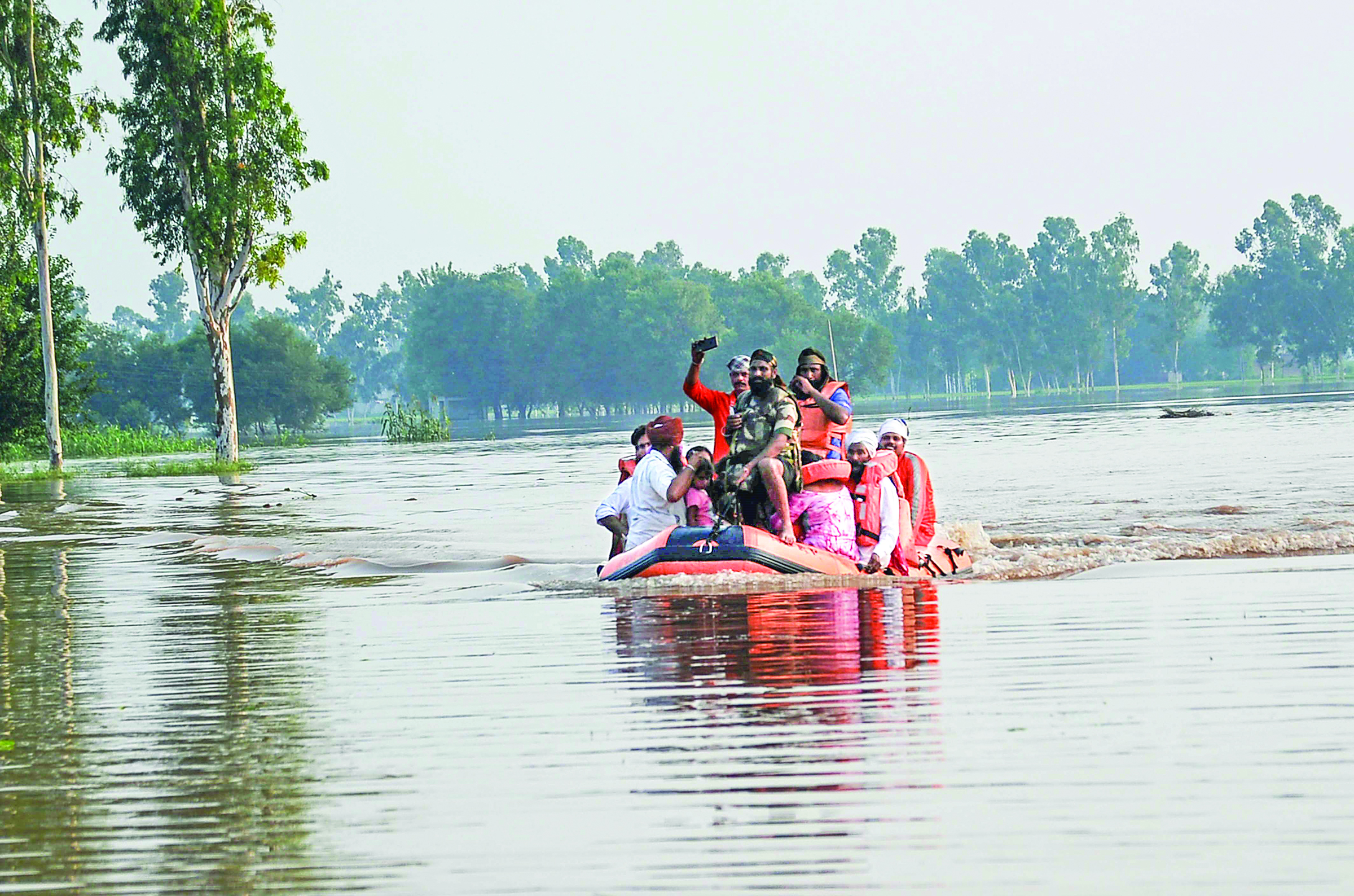
NDRF personnel rescue people from flood-affected areas in Punjab (Photo: ANI)
Chandigarh: The Punjab government has suspended three engineers of the Water Resources Department after a gate at the Madhopur Headworks in Gurdaspur collapsed during the recent floods. The suspension of the officers marks the first step in fixing responsibility for lapses that endangered thousands of people living downstream and disrupted the state’s vital irrigation system.
In a notification issued on September 15, the principal secretary, Water Resources Department, ordered the suspension of executive engineer Nitin Sood, posted with the Gurdaspur Canal and Ground Water Division. Along with him, sub divisional officer Arun Kumar and junior engineer Sachin Thakur were also placed under suspension.
The order notes that the three officials failed to discharge their duties in maintaining the Madhopur Headworks and did not act on warning signs before the floods struck. Their lapses directly contributed to the collapse of the gate, which risked both public safety and agricultural livelihoods.
The government has instructed all three officers to report to the chief engineer headquarters in Chandigarh. A departmental inquiry has been initiated, and further disciplinary action will depend on its findings.
The Madhopur Head works, located on the Ravi-river, regulates water flow into the Upper Bari Doab Canal. Built over a century ago, the structure is central to Punjab’s irrigation network. During the September floods, one of its gates gave way under immense water pressure.
On August 27, 2025, during heavy monsoon floods, at least two floodgates of the Madhopur barrage collapsed.
Locals reported that cracks and rusting on the gate had been visible for months. The flood inflows magnified the stress, and the structure failed at the peak of the deluge. The sudden collapse disrupted the controlled release of water, sending a surge down-stream and creating panic in nearby villages.
Authorities rushed emergency teams to prevent further damage and stabilise the adjoining gates. Though no lives were lost in the incident, several low-lying areas in Gurdaspur and Pathankot districts were inundated, and standing crops suffered extensive damage.
Farmers complained that the collapse also affected canal water supply, coming at a crucial time for paddy and vegetable cultivation. Roads and local infrastructure were temporarily disrupted, with the bridge near the headworks closed to traffic for safety checks.
The Water Resources Department has admitted that the collapse was preventable and linked to lapses in routine maintenance. Officials say the suspension of the three engineers is a strong message that negligence will not be tolerated.
A senior officer explained that an immediate technical audit of all floodgates at Madhopur Headworks has been ordered. Teams of engineers are inspecting each gate for signs of wear and damage. Repairs are being carried out on priority to ensure the headworks remains stable for the remainder of the monsoon season.
Beyond Madhopur, the chief engineer has been tasked with surveying all major headworks, barrages and gates in Punjab. The report is to be submitted within one month. The government has assured that funds will be released for urgent strengthening measures.
The department has also recommended that a predictive maintenance system be put in place. This will include periodic digital monitoring of gates, replacement schedules for old structures, and pre-monsoon safety drills. Villagers around Madhopur expressed anger at what they called “avoidable negligence.” They said repeated complaints about the condition of the gates had been ignored for months. “The rust and cracks were visible to everyone. Why did it take a flood and a collapse for the department to act?” asked a farmer from a nearby village.
Others recounted the panic on the day the gate failed. “We saw water rushing with tremendous force. Families were packing their belongings to leave. People feared that more gates would break,” said a resident of Pathankot.
Farmer unions have demanded compensation for crop losses due to waterlog ging and damage to irrigation schedules. They have also asked for a permanent monitoring system for the Ravi embankments and Madhopur gates.
Constructed in the early 20th century, the Madhopur Headworks is one of Punjab’s most important irrigation control points. It diverts water from the Ravi into the Upper Bari Doab Canal, feeding lakhs of acres in Gurdaspur, Amritsar, Tarn Taran and beyond. Its role is not limited to Punjab; through downstream links, it also supports irrigation in parts of Rajasthan.
Experts say that while the headworks has withstood decades of floods, its aging gates require urgent replacement. A single gate failure, they warn, can disrupt the balance of water distribution across multiple districts.
A retired engineer explained: “The Ravi’s water pressure is immense during the monsoon. Gates must be tested before every flood sea son. Any lapse in welding, greasing or alignment can lead to disaster. What happened at Madhopur should be treated as a warning.”
With three officials suspended and an inquiry underway, the focus now is on preventing further mishaps. Emergency repair work is progressing, and the dam aged gate is expected to be restored soon.
The government has also instructed district administrations to remain on high alert for any more flood related emergencies.
