
KOLKATA: As West Bengal gears up for the 2026 Assembly elections scheduled for March-April, religious symbolism and communal rhetoric have emerged as dominant themes in the political discourse, with both the ruling Trinamool Congress and the opposition Bharatiya Janata Party (BJP) deploying temple projects and religious imagery to mobilize their respective vote banks. The battle for Bengal’s 294 Assembly seats has increasingly become a contest over religious identity, marked by grand announcements of temple complexes, accusations of appeasement politics, and competing claims to represent the true interests of various communities.
Political observers note that the state, traditionally known for its syncretic culture, is witnessing an unprecedented escalation in religion-based campaigning. At the centre of this religious-political theatre are Chief Minister Mamata Banerjee’s ambitious temple projects: the Jagannath temple replica in Digha inaugurated in April 2025, the recently announced Durga Angan in Kolkata’s Salt Lake, and the planned Mahakal temple in Siliguri.
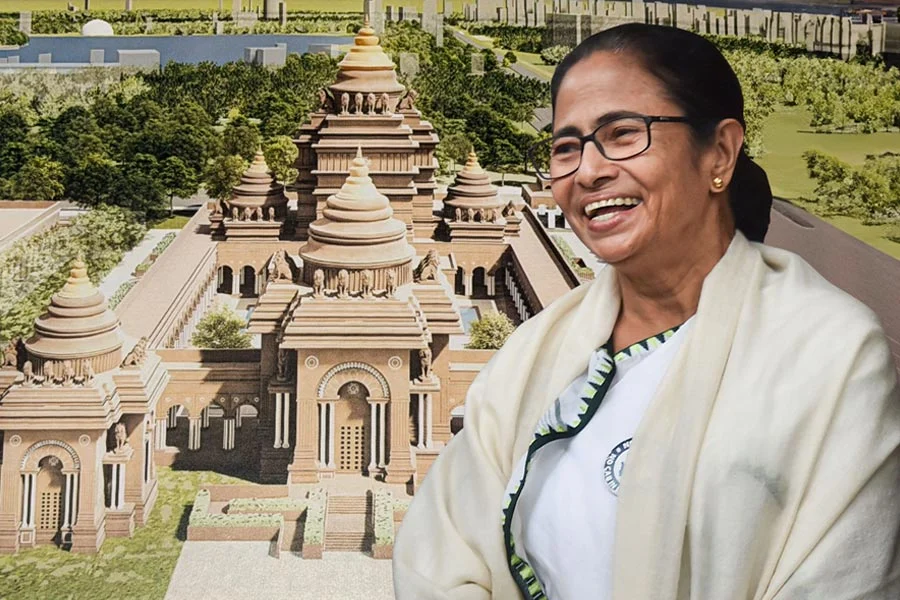
These initiatives have drawn sharp reactions from the BJP, which has accused the Trinamool Government of cynically exploiting religious sentiment for electoral gains. The Durga Angan project, whose foundation stone was laid in late December 2025, spans 4.5 acres and is designed to accommodate one lakh visitors daily. At the foundation laying ceremony, Banerjee positioned the project as a cultural response to UNESCO’s recognition of Durga Puja as an intangible cultural heritage. “Durga Puja was recognised by UNESCO as an intangible cultural heritage. At the Durga Angan, the culture and spirituality of Bengal will come together,” she said. The elaborate complex will feature 1,008 pillars, a 54-metre sanctum sanctorum, 108 idols of various deities and 64 statues of lions.
Banerjee positioned these projects not merely as religious sites but as economic drivers. “In 2025, West Bengal was in second place in terms of receiving foreign tourists. In 2026, we will be number one,” she declared, citing the growing economy around the Jagannath temple in Digha.
However, the BJP has dismissed these initiatives as transparent electoral calculations. Amit Malviya, the BJP’s in-charge for Bengal, claimed in a statement that “After making a spectacle of the Messi event, Mamata Banerjee has now turned her gaze to defiling the sanctity of Maa Durga. Her so-called Durga Angan project is steeped in appeasement and fakery, the very hallmarks of her politics”. The saffron party has accused the Chief Minister of shifting the Durga Angan site following protests from Muslim residents, a charge Banerjee has not directly addressed. The BJP alleges this demonstrates what it calls her pattern of minority appeasement—a central plank of the party’s campaign strategy for 2026.
Defending her approach, Banerjee responded: “Many people blame me for appeasement politics. I am a true secularist, I believe in the peaceful coexistence of all religions. You can’t show me a religion whose celebrations I don’t attend. I cover my head when I visit Gurudwaras. Why do you complain when I attend Rozas?”. The Chief Minister also highlighted other religious infrastructure projects her government has undertaken, including the skywalk at Dakshineswar, beautification of Kalighat, development of Kapil Muni ashram in Gangasagar, and the preservation of sites associated with Swami Vivekananda and Sister Nivedita.
On the BJP’s side, the party has intensified its Hindu consolidation strategy, with Ram Navami celebrations becoming a major political mobilization tool. In December, the party organized a massive Gita recital event at Kolkata’s Brigade Parade ground, which BJP MP Sukanta Majumdar described as a symbol of “unity” of Hindus. Majumdar stated: “In the land of Lord Krishna, it is obvious that Gita will be recited. Partition took place on religious lines and West Bengal is the place for Hindus. It has nothing to do with politics”. The statement drew immediate criticism from TMC leaders who called it a blatant political move disguised as religious activity.




