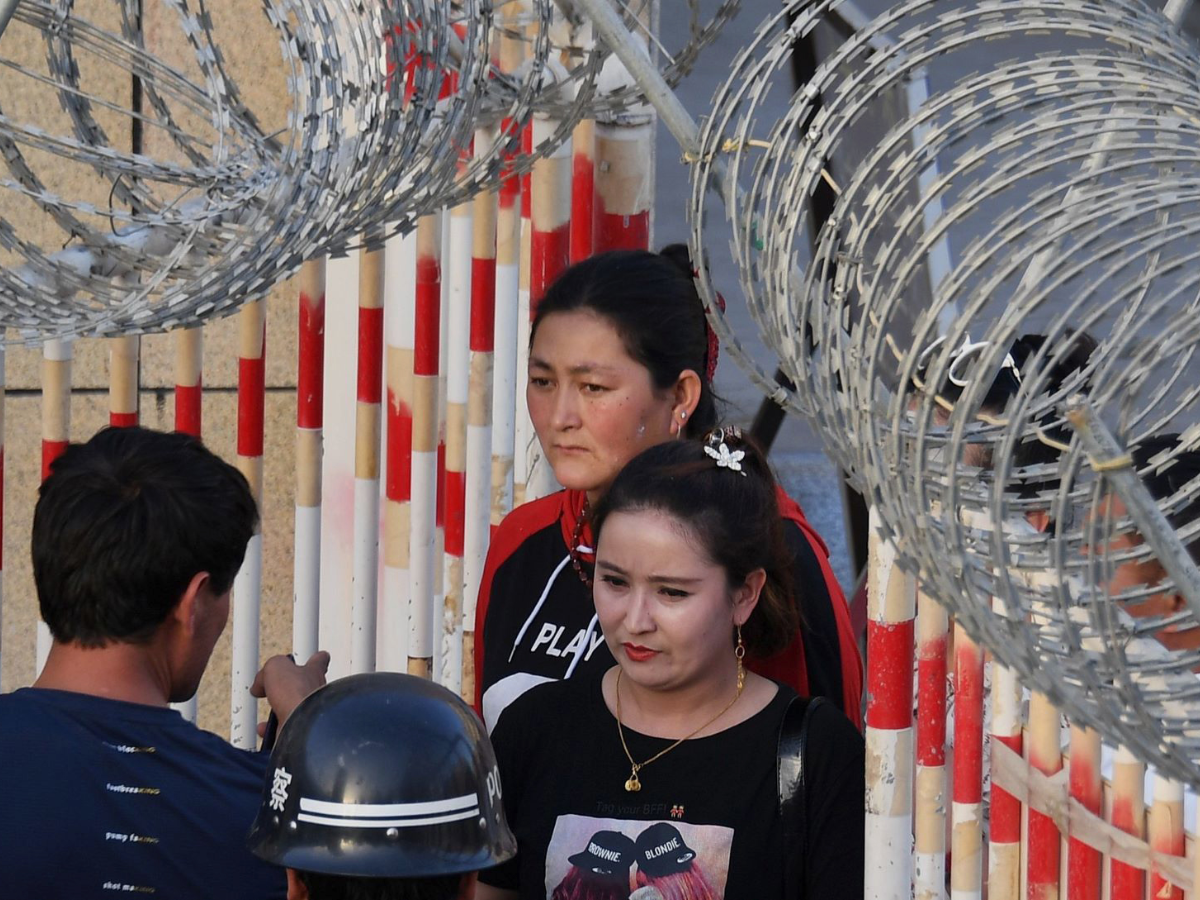
Beijing’s systematic repression of Uyghurs in Xinjiang is not merely a humanitarian catastrophe. It is a strategic challenge with profound implications for India’s national security. The Chinese Communist Party’s campaign of mass detention, coercive labour, and demographic engineering extends well beyond cultural genocide: it creates spillover risks of radicalisation, embeds forced labour into global supply chains, and militarises infrastructure corridors that cut directly across India’s disputed frontiers.
In August 2022, the Office of the UN High Commissioner for Human Rights (OHCHR) released its long-awaited report on Xinjiang. After an extensive review of documentary evidence and testimonies, the report concluded that China’s actions “may constitute international crimes, in particular crimes against humanity.”
The report found credible evidence of arbitrary detention affecting over one million people, systematic torture, sexual violence, and coercive birth control policies aimed at suppressing Uyghur population growth. Former detainees described internment camps disguised as “Vocational Education and Training Centres,” where they were forced to drink alcohol, eat pork, and undergo political indoctrination. Women testified to invasive examinations, sexual violence, and involuntary sterilisation. The OHCHR documented an “unusually sharp rise” in IUD insertions and sterilisations—evidence of a state-directed attempt to erase community identity.
Repression in Xinjiang extends into the global economy through coerced labour. The Australian Strategic Policy Institute documented the transfer of more than 80,000 Uyghurs to factories across China between 2017 and 2019 under conditions consistent with the International Labour Organisation’s definition of forced labour. Marketed as “poverty alleviation” or “vocational training,” these programmes amount to systematic exploitation.
The scale is staggering. Xinjiang produces 84 percent of China’s cotton, embedding forced labour into global textile supply chains. Uyghur workers, subject to movement restrictions and surveillance, are compelled into agricultural and industrial production that underpins Beijing’s economic interests. This dual strategy of repression and exploitation simultaneously destroys indigenous communities and integrates their labour into China’s economic rise.
Xinjiang’s strategic relevance for India is sharpened by the China-Pakistan Economic Corridor (CPEC). This $62 billion network of roads, pipelines, and railways links Xinjiang to Pakistan’s Gwadar Port, running through Gilgit-Baltistan, which is Indian territory illegally occupied by Pakistan.
CPEC provides Beijing with a direct land route to the Arabian Sea, bypassing the Malacca Strait chokepoint and embedding China in South Asia’s strategic geography. Gilgit-Baltistan, described as the “lifeline of CPEC,” borders Xinjiang and Ladakh, offering Beijing unprecedented access to disputed territories adjacent to Indian deployments.
The military implications are stark. Reports suggest plans to deploy 400,000 Chinese construction workers to Gilgit-Baltistan, displacing local labour and creating a quasi-permanent Chinese presence. Infrastructure corridors designed for trade double as potential military supply lines, laying the groundwork for joint Sino-Pakistani manoeuvres along India’s western and northern frontiers.
CPEC’s alignment through Gilgit-Baltistan raises the spectre of coordinated Chinese and Pakistani pressure on India. The region’s proximity to Ladakh, separated only by the Siachen Glacier, gives Beijing the option of deploying forces that could complicate any future standoff. As India’s former Chief of Defence Staff observed, Pakistan’s manoeuvres in Gilgit-Baltistan amount to “textbook misadventures” that could force India into a two-front conflict.
The risks extend beyond territory. By granting China exclusive mining rights and economic dominance in Gilgit-Baltistan, Pakistan has effectively created a Chinese client enclave on India’s doorstep. This deepens Beijing’s strategic depth along India’s borders while strengthening Islamabad’s ability to sustain military pressure.
Beijing’s repression in Xinjiang also carries unintended security consequences. The systematic persecution of more than 11 million Uyghurs and Turkic Muslims creates fertile ground for radicalisation. Groups such as the East Turkestan Islamic Movement (ETIM), long committed to independence for Xinjiang, draw legitimacy from such grievances and operate across Afghanistan, Pakistan, and Central Asia.
The Taliban’s accommodation of ETIM in Afghanistan compounds the danger. As China escalates repression in Xinjiang, displaced militants may seek refuge across porous frontiers, potentially forging links with groups hostile to India. The interlinked nature of regional jihadist networks means that Beijing’s domestic policies could inadvertently strengthen anti-India terrorism capabilities.
Xinjiang’s silent suffering is not only a moral tragedy but also a strategic reality for India. The region’s transformation into a militarised corridor, the demographic engineering of Gilgit-Baltistan, and the integration of forced labour into China’s economic rise all converge to shape India’s security environment.
India’s deployments along the Line of Actual Control (LAC) address immediate territorial risks, but the crisis in Xinjiang demands broader responses: coordinated diplomacy, economic vigilance over supply chains tainted by forced labour, and intelligence cooperation with partners facing similar challenges.
Above all, India must recognise that Beijing’s repression is not incidental—it is instrumental. The dismantling of Uyghur society, the exploitation of coerced labour, and the militarisation of CPEC corridors all serve China’s broader strategy of projecting power against India.
Xinjiang’s silent suffering thus reverberates directly in New Delhi’s strategic calculus, underscoring the need for sustained vigilance against a regime that weaponises human rights abuses as tools of geopolitical advantage.
(Ashu Mann is an Associate Fellow at the Centre for Land Warfare Studies. He was awarded the Vice Chief of the Army Staff Commendation Card on Army Day 2025. He is pursuing a PhD in Defence and Strategic Studies at Amity University, Noida. His research focuses on the India-China territorial dispute, great power rivalry, and Chinese foreign policy.)
