There are also signals that RSS will have greater influence over key appointments.
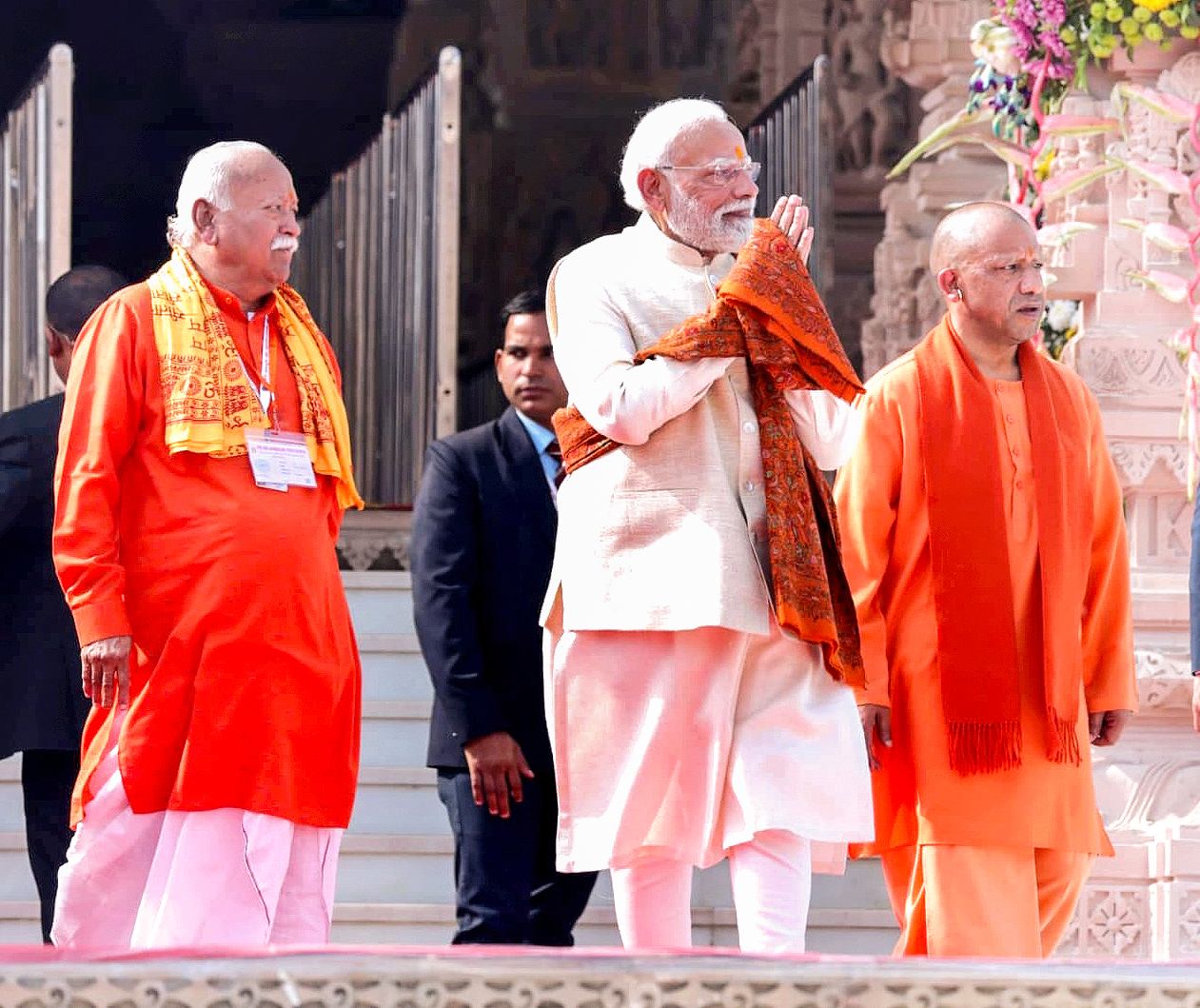
Prime Minister Narendra Modi, Uttar Pradesh Chief Minister Yogi Adityanath and Rashtriya Swayamsevak Sangh (RSS) chief Mohan Bhagwat during the Dhwajarohan Utsav at Shri Ram Janmabhoomi Mandir, in Ayodhya on 25 November (Photo: @myogiadityanath X/ANI)
NEW DELHI: After the BJP's landslide victory in Bihar, the relationship between Prime Minister Narendra Modi and the RSS is getting stronger by the day. Indications are that the BJP may soon have a consensus national president in the new year, with sources saying that RSS chief Mohan Bhagwat is all set to approve the name that the BJP suggests.
There are also strong signals that the RSS will have greater influence over key appointments, both in the Union Cabinet and in several state cabinets. With the poor performance of the Chief Ministers in some Hindi-speaking states, internal discussions on leadership changes are expected.
However, it remains uncertain when exactly the new BJP national president will be elected or when any reshuffle will take place. Most political watchers believe that clarity will emerge only by February.
The Hindu calendar's Khar month begins on December 16 and ends on January 14, during which no auspicious work is typically undertaken. As a result, it is widely expected that any decisions or announcements will be made only after January 15.
During this period, J.P. Nadda will create a new record as BJP president. He will become the first national president of the party to complete six continuous years in office. Nadda became BJP national president on January 20, 2020, with his original term set to end in January 2023. But successive Lok Sabha and state elections led to repeated extensions, keeping him in the role.
As things stand, Nadda appears likely to complete yet another extended term—an unprecedented development. Party insiders say the RSS is a major factor behind this extended tenure.
Tensions between Nadda and the RSS surfaced during the 2024 general elections, particularly after Nadda remarked that the party no longer needed the Sangh. Though he later attempted damage control, the BJP suffered electoral losses and, for the first time, failed to secure a majority.
The bitterness led to repeated postponements in electing a new national president, with the RSS and BJP unable to agree on a consensus candidate. The RSS wanted a leader of its preference to lay the foundation for reshaping the BJP, while the BJP leadership wanted a candidate of his own choosing.
However, after the BJP's poor performance in the Lok Sabha elections, the RSS took charge of organisational strategy in several states and helped the BJP sweep state elections in Haryana, Maharashtra, Delhi, and achieve a stunning victory in Bihar. The Sangh played a key behind-the-scenes role, and the BJP largely followed its guidance.
Meanwhile, several direct meetings took place between Bhagwat and Modi. The Prime Minister publicly praised the RSS multiple times, beginning with his Independence Day address from the Red Fort. The Sangh also backed the government on key issues, including infiltration—something that resonated strongly in Bihar's election results, where the BJP and JDU won record victories.
With renewed coordination, the BJP and RSS intend to replicate the Bihar formula in other poll-bound states. But before that, internal restructuring is expected. Uttar Pradesh is the next major target for both organisations, as the state heads for elections in about 13 months. Once 2026 begins, the state will effectively enter election mode.
The BJP will also need to appoint a new state president in Uttar Pradesh, and insiders agree that once the new national president is selected, the UP unit will soon get a new chief as well. Parallel organisational preparations have begun in West Bengal, Kerala and Assam, all headed for elections in the next four months.
