
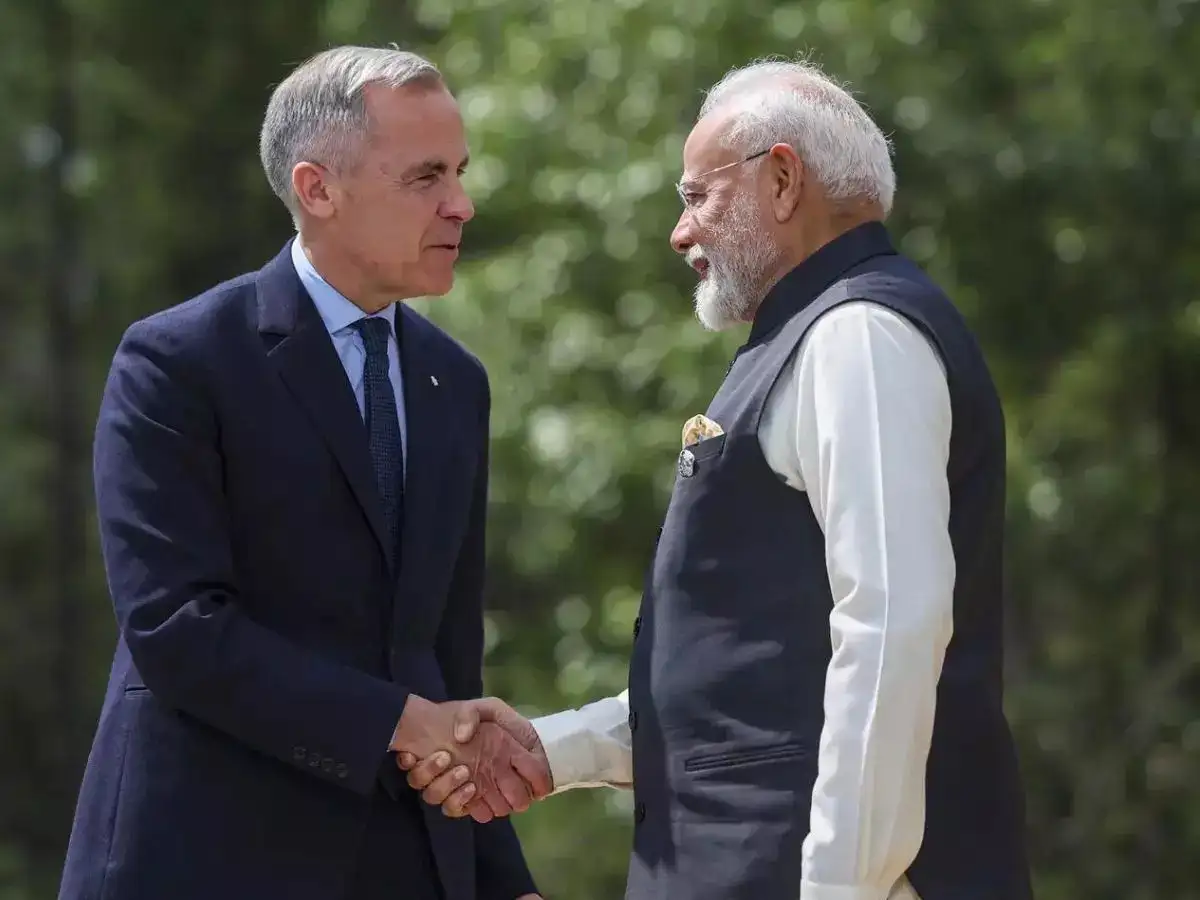
NEW DELHI: During his ongoing four day visit to India, Canadian Prime Minister Mark Carney will carry a balance sheet shaped by diplomatic rupture, a sharper-than-expected contraction in Canada’s largest service export, and rising uncertainty in Ottawa’s most important economic relationship with the United States. As per officials following the development, while the visit is formally about restoring political dialogue after tensions under his predecessor Justin Trudeau, but the economic arithmetic behind it is considerably more consequential.
The deterioration began in 2023 after Ottawa alleged Indian involvement in the killing of Hardeep Singh Nijjar, a known Khalistani terrorist. The trial in his case is expected to begin in August in which four Indian nationals have been arrested.
Diplomatic expulsions followed, trade talks were paused and visa processing slowed. The most significant shock emerged in international education, a sector that functions as one of Canada’s largest export industries.
In 2023, Canada hosted approximately 1.04 million international students. Indian nationals accounted for roughly 427,000 of them, or about 41 percent of the total. International education contributes approximately CAD 37 to 40 billion annually to Canada’s GDP, equivalent to roughly Rs 2.29 to 2.48 lakh crore at an exchange rate of 1 Canadian dollar to Rs 62. On a proportional basis, Indian students represented approximately CAD 20 to 22 billion in annual economic activity, or about Rs 1.24 to 1.36 lakh crore, making India the single largest pillar of Canada’s international education export model.
Initial estimates assumed a 30 to 40 percent contraction in Indian enrolment flows would expose Canada to a CAD 6 to 10 billion annual shortfall, equivalent to roughly Rs 37,200 to 62,000 crore.
However, updated government data through late 2025 indicates the decline was far steeper. Indian study permit issuances fell approximately 67.5 percent compared with 2023 levels, with some monthly cycles showing declines approaching 90 percent. New permits declined from roughly 278,000 in 2023 to a projected 90,000 in 2025. Modeled proportionally against the CAD 20 to 22 billion baseline, a contraction of this magnitude implies annualized exposure in the range of CAD 13 to 15 billion, or roughly Rs 80,600 to 93,000 crore. Even allowing for lag effects in enrolment stock, the forward revenue pipeline is materially impaired. The effects are visible across provincial systems.
Colleges and universities in Ontario and British Columbia that structured budgets around high international enrolment face revenue compression.
Rental markets in student-dense corridors such as Brampton, Surrey and parts of Toronto have adjusted at the margins.
Labour supply in logistics, retail, hospitality and certain care services, sectors that relied heavily on international students working part-time, has tightened.
In an ageing economy where population growth reached roughly 3.2 percent in 2023 and depended significantly on temporary residents, the reduction in Indian inflows weakens both short-term consumption and medium-term workforce replenishment.
Bilateral trade presents a more complex picture. Merchandise trade between Canada and India stood at approximately CAD 13.3 billion in 2024, equivalent to roughly Rs 82,460 crore. Canadian exports were about CAD 5.3 billion, or roughly Rs 32,860 crore, while imports from India were approximately CAD 8.0 billion, or roughly Rs 49,600 crore. When services are included, total bilateral trade reached roughly USD 23.56 billion by end 2024, equivalent to approximately CAD 32 billion or about Rs 1.98 lakh crore, supported in part by an 18.2 percent increase in services trade.
Trade flows have expanded in aggregate despite strained political ties, but it did so without new architectural support.
Negotiations toward an Early Progress Trade Agreement and a broader Comprehensive Economic Partnership Agreement were paused following the diplomatic rupture.
Projections associated with resuming talks suggest that a concluded agreement could increase bilateral trade by CAD 6 to 8.8 billion by 2035, equivalent to roughly Rs 37,200 to 54,560 crore. For a trade-dependent economy seeking diversification, the opportunity cost of delay lies in foregone acceleration rather than immediate decline, something that Carney seems to have realised.
Investment exposure adds another dimension. Canadian institutional capital in India has grown despite headwinds.
The Canada Pension Plan Investment Board alone holds approximately CAD 30 billion in Indian assets as of late 2025, equivalent to roughly Rs 1.86 lakh crore, up from CAD 10 billion in 2020. On a portfolio of that size, even a 50-basis point increase in perceived political risk represents approximately CAD 150 million annually, or roughly Rs 930 crore, in value sensitivity. A 100-basis point adjustment doubles that figure. Over multi-decade infrastructure assets, such shifts materially influence return profiles and capital allocation decisions.
As per officials, the United States angle complicates and intensifies the calculation for Canada. Roughly 75 percent of Canada’s merchandise exports flow to the United States, a corridor exceeding CAD 900 billion annually. Recent statements by Donald Trump that were widely interpreted in Ottawa as adversarial toward Canada have underscored the structural vulnerability created by such concentration. Even marginal shifts in US tariff policy, industrial subsidies or border measures transmit directly into Canadian GDP and employment. Diversification is therefore not abstract strategy but risk management.
For Canada, engagement with India represents incremental diversification rather than displacement of US centrality. The challenge for Carney is to deepen economic ties with India without signalling strategic drift from Washington, particularly given Canada’s integration within US-centred defence, intelligence and supply chain frameworks.
Education flows illustrate the competitive dynamic.
As Canadian study permit flexibility tightened, early fall-semester US enrolment of Indian students reached record levels exceeding 268,000 in 2023-24. Demand reallocated rather than disappeared. If Canada’s policy environment remains restrictive or politically unstable, Indian students will continue shifting to American and European institutions, redirecting tuition revenue and future skilled labour southward.
Carney’s economic incentives are therefore concrete.
Restoring even half of the lost Indian student volume could recover approximately CAD 5 to 7 billion annually, equivalent to roughly Rs 31,000 to 43,400 crore. Reactivating trade negotiations could unlock projected medium-term gains of CAD 6 to 8.8 billion by 2035. Stabilizing diplomatic relations would protect return assumptions on approximately CAD 30 billion in Canadian pension exposure, limiting risk-premium drag measured in hundreds of millions annually.
The visit is therefore less about symbolism than about arithmetic. Against a backdrop of US volatility, recalibrating ties with India has become both an economic recovery exercise and a strategic hedge for the Canadian government.




