
1.5K
RSS continues to work on its goals for cultural, social, national development as it completes 100 years
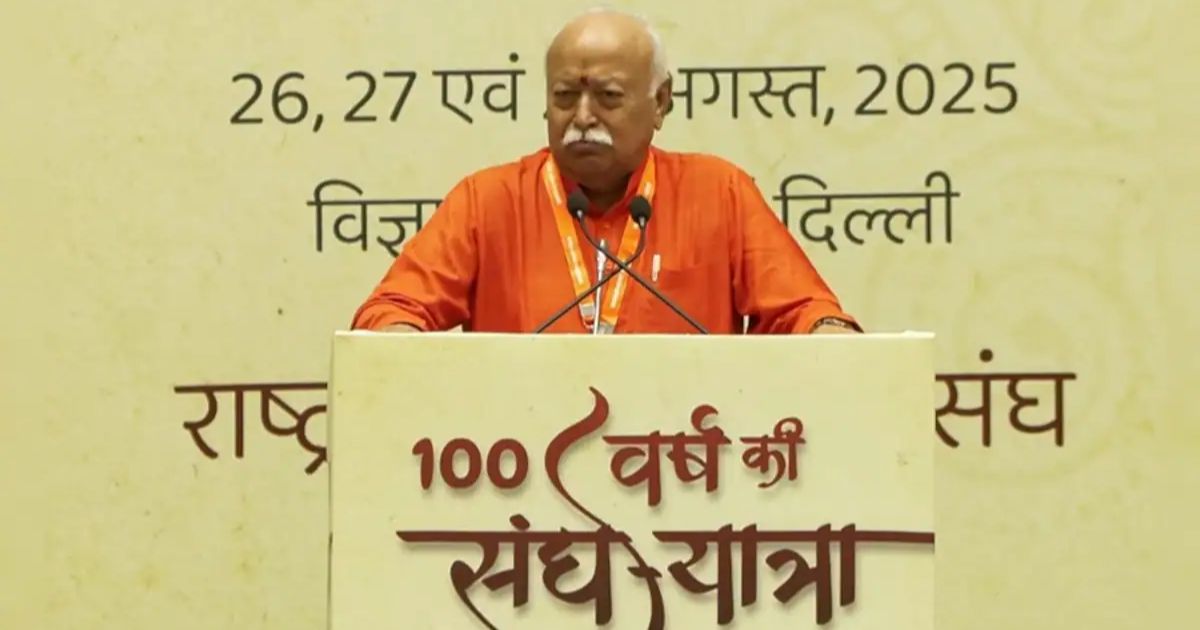
New Delhi: As the Rashtriya Swayamsevak Sangh (RSS) marks its centennial year, it appears more successful, transparent, and eager to bring about change in alignment with its organization goals. RSS Chief Mohan Bhagwat clarified numerous important issues during a three-day dialogue programme in Delhi, addressing key points about the RSS’s relations with the Bharatiya Janata Party (BJP), Prime Minister Narendra Modi, controversies over retirement age, Hindu nationalism, religious beliefs, the existence of Islam, the Kashi-Mathura movement, and other issues that have caused confusion among opponents and supporters alike.
The RSS has encountered various ups and downs in its 100 years, facing numerous challenges. Working in the social and cultural fields over such a long period is undoubtedly difficult. From this perspective, it can be considered a unique organization on the global stage. Interestingly, for many years, the RSS kept its activities confidential and refrained from publicizing them.
From my childhood, I observed RSS activities in cities such as Ujjain, Shajapur, and Indore, and later in the national capital, Delhi. I attempted to understand and follow its workings. In my early years, I worked as a part-time reporter with Hindustan Samachar and then as a full-time journalist from 1971 to 1975. During this time, I also collected political news, giving me opportunities to meet leaders from RSS, the Bharatiya Janata Party (BJP), Socialists, Congress, and Communist parties.
Early Restrictions
For many years, the RSS kept its activities under wraps. The organization did not maintain formal membership records or official documentation. In those days, senior RSS officials would meet in informal settings, and there was little to no public outreach. There were no membership forms, and contact information was maintained in private diaries or registers.
Evolution of RSS’s Media and Outreach Strategies
The RSS began publishing newspapers and magazines in cities like Nagpur, Pune, Indore, Gwalior, Lucknow, Ahmedabad, and Delhi to spread its ideology. Prominent RSS leaders like Pandit Deendayal Upadhyaya, Atal Bihari Vajpayee, Lal Krishna Advani, and others contributed to the writing and editing of these publications.
Impact of the Emergency
During the Emergency (1975-77), the RSS was banned, leading to arrests across the country. Despite this, many dedicated RSS workers and volunteers continued underground activities, distributing information and spreading ideas. Among these was a young Narendra Modi, who operated clandestinely to share news and information while remaining an active RSS volunteer.
In the 1990s, the RSS began to focus on developing its publicity machinery. Key figures such as M.G. Vaidya, Ram Madhav, Madan Mohan Vaidya, and Sunil Ambekar became central to promoting RSS activities. With the rise of the BJP in power, media coverage of the RSS also increased, both in support and opposition.
RSS in the Digital Age
Following the information revolution, the RSS’s activities began to receive coverage across print media, television, websites, YouTube, Facebook, and Twitter. Today, the RSS’s publicity network has spread far beyond India, reaching countries around the world.
RSS’s Influence on BJP Government’s Achievements
Under Prime Minister Narendra Modi’s leadership, the RSS’s objectives—such as the construction of the Ram Mandir in Ayodhya, the revocation of Article 370 in Kashmir, India’s nuclear power status, and the promotion of Hindu culture and religious unity—have been realized. These milestones reflect the ideological influence the RSS has had on the BJP government.
Mohan Bhagwat on RSS’s Relationship with Politics
In September 2018, RSS Chief Mohan Bhagwat made it clear that the RSS had deliberately chosen not to engage in day-to-day politics. While RSS leaders, including Prime Minister Modi, have been volunteers, their political actions are independent. Bhagwat emphasized that RSS’s role is to provide ideas for the national welfare, not to interfere with political decisions.
RSS’s Vision of Hindu Nationalism
RSS leaders have consistently stated that nearly 98% of India’s population, including Muslims, Sikhs, Christians, Buddhists, and others, are part of the Indian Hindu family. RSS Chief Dr. Rajendra Singh (Rajjubhaiya) once expressed in an interview: “We believe that most of the Muslims in India are the descendants of indigenous people, and we want them to feel that they are Indian Muslims.” This inclusive view of Indian identity has been a hallmark of RSS’s vision.
Challenges Posed by Extreme Leaders
While the RSS has espoused a message of inclusivity, some extremist elements within the organization have used harsh language, which has tarnished the image of both the RSS and the Modi government on the global stage.
RSS’s Future Goals and Expansion
RSS aims to expand its branches to 100,000, with current figures at 68,651. Under the leadership of Prime Minister Modi, the visibility and acceptance of RSS have grown significantly, alongside the BJP’s political success. The RSS continues to work on its goals for cultural, social, and national development, hoping to shape the nation’s future.




