
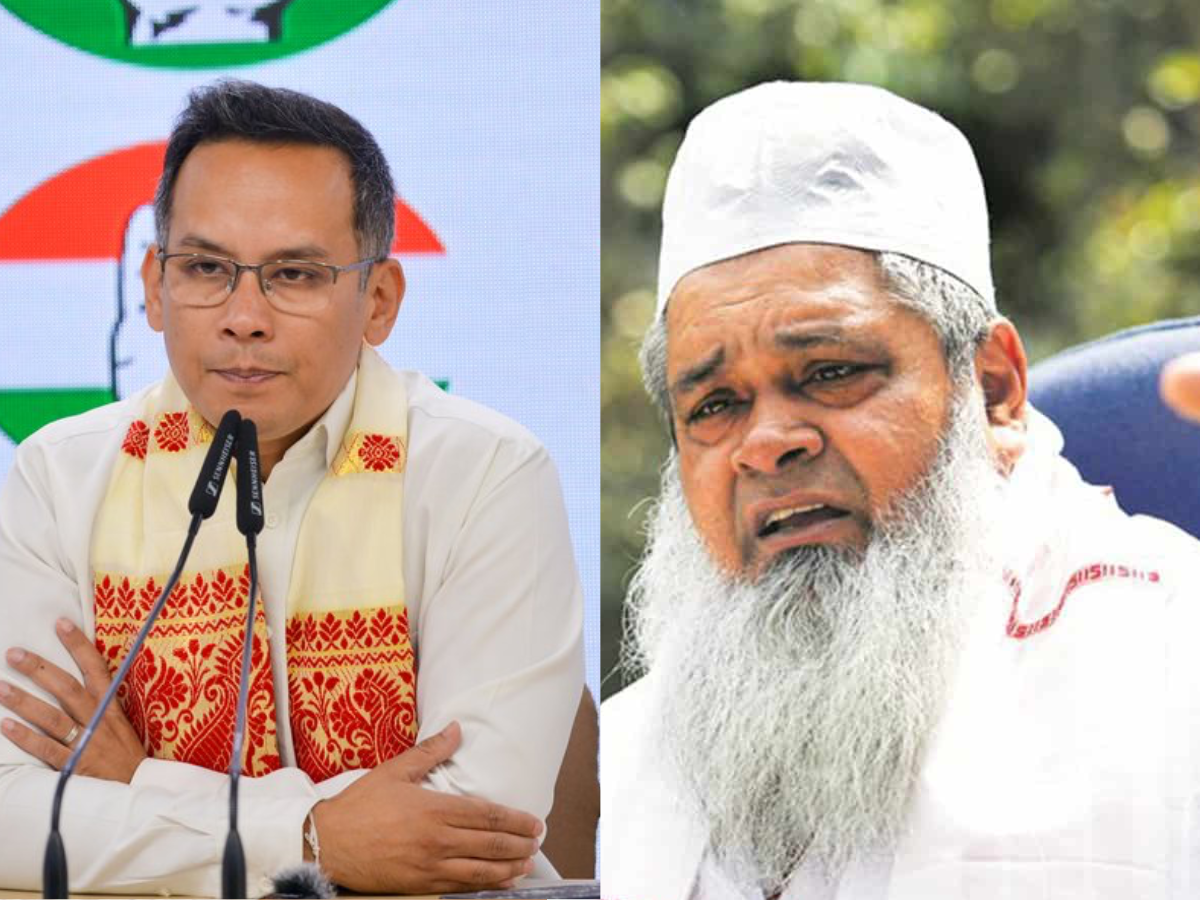
NEW DELHI: With just two months remaining before the Assam Assembly elections, the Congress has made a major strategic shift by ending its long-standing alliance with the All India United Democratic Front (AIUDF) and opting to contest the polls independently. Instead, the party is placing greater emphasis on coordination with regional forces such as the Raijor Dal and the Asom Jatiya Parishad (AJP). The move formalises a split that had been developing for months and was earlier reported by The Sunday Guardian.
As a result, the Congress will enter the elections without two of its key allies from the 2021 Assembly polls—AIUDF and the Bodoland People’s Front (BPF). While the BPF has since aligned itself with the BJP, the exclusion of AIUDF is a deliberate political decision. In the last Assembly elections, the two allies together contributed close to 43 per cent of the total vote share.
Assam Congress president Gaurav Gogoi recently ended all speculation by firmly ruling out any alliance with AIUDF. Speaking to the media, he said the Congress would fight the elections on its own strength and concentrate on reviving the party at the grassroots level. He made it clear that there is no understanding with AIUDF, either at present or in the future.
The decision carries particular significance in a state where Muslims account for around 34 per cent of the population. While AIUDF has traditionally projected itself as a Muslim-centric party, Congress leaders believe that distancing themselves from it could help the party widen its appeal among anti-incumbency and anti-BJP voters who are wary of identity-based politics.
According to the Congress’s internal assessment, AIUDF has been steadily losing credibility among Muslim voters, with growing dissatisfaction over party chief Badruddin Ajmal’s inability to convert numerical strength into effective political representation. This decline was evident in the 2024 Lok Sabha elections, when Congress candidate Rakibul Hussain defeated Ajmal in Dhubri by a margin of more than 40 per cent, dealing a serious blow to AIUDF’s claim of being the primary representative of Muslim voters in Assam.
Congress leaders also argue that a formal alliance with AIUDF could trigger reverse polaristion in an already charged political environment, ultimately benefiting the BJP. By keeping AIUDF out, the party hopes to protect its traditional support base in Upper Assam, where regional identity and local issues strongly influence voting patterns.
At the same time, the Congress is increasingly looking towards regional outfits such as the Raijor Dal, led by peasant leader Akhil Gogoi, and the Assam Jatiya Parishad (AJP), headed by Lurinjyoti Gogoi. Both leaders rose to prominence during the anti-Citizenship Amendment Act (CAA) movement and command support among Assamese youth, students and rural voters, particularly in Upper Assam.
While neither Raijor Dal nor AJP has the organisational depth to win a large number of seats independently, Congress leaders believe their influence could prove decisive in closely contested constituencies by consolidating anti-BJP votes. A senior leader said that effective coordination with these parties could pose a serious challenge to the BJP.
Party insiders also feel that these alignments could help the Congress move beyond its traditional minority-centric support base and reconnect with sections of Assamese voters who have drifted away in recent years. However, they caution that delays and weak seat-sharing arrangements—as seen in earlier elections such as Bihar—could undermine this strategy if repeated in Assam. Political analysts following Assam politics told The Sunday Guardian that the Congress’s decision to fight alone, while selectively engaging with regional forces, is a high-risk attempt to recalibrate its electoral strategy in a deeply polarised environment.
They warn that while the break from AIUDF is a calculated move, it remains uncertain whether it will strengthen the party or further fragment the opposition vote. Analysts also point out that the Congress faces an uphill task in the state, as erosion of its support base, low leadership visibility, and a weak organisational presence on the ground have weakened its voter connect, giving the BJP a clear advantage as Assam enters election mode.




