
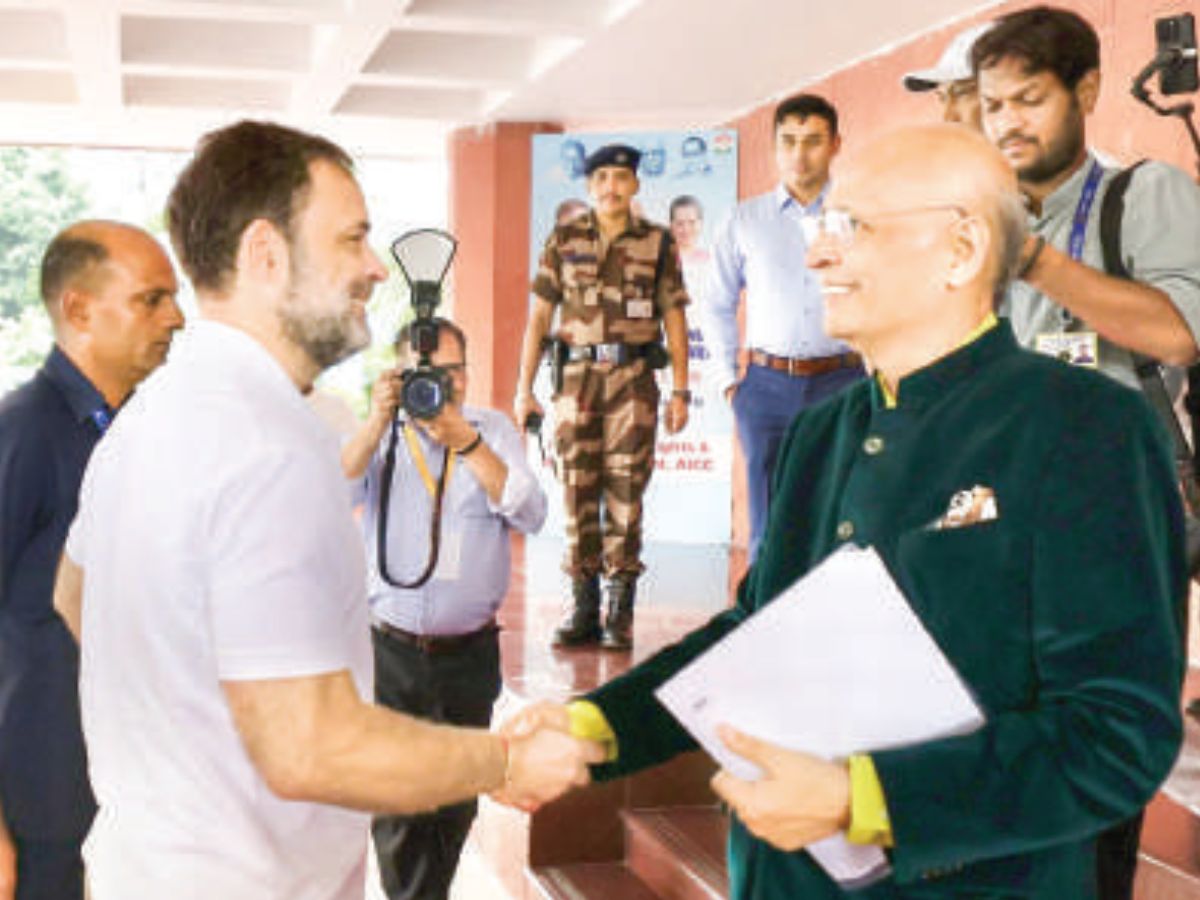
New Delhi: Senior Congress leader and jurist Dr Abhishek Manu Singhvi on Saturday warned of a “systematic dismantling” of India’s constitutional order, asserting that the Congress party must once again rise to protect and revive the founding principles of the Republic.
His remarks came at the National Conclave of the AICC Department of Law, Human Rights and RTI, held at Vigyan Bhawan, New Delhi.
The event was attended by Congress President Mallikarjun Kharge, Leader of Opposition Rahul Gandhi, three Congress Chief Ministers, MPs, general secretaries, PCC presidents, and over 2,000 lawyers and rights activists from across the country. A message from former Congress president Sonia Gandhi was also read out by former Union Law Minister Salman Khurshid.
Dr Singhvi, who is Chairman of the Congress Department on Law, Human Rights and RTI, and a four-term MP, said the conclave’s theme—“Constitutional Challenges: Perspective and Pathways”—was urgent and timely.
“We are living through a moment where the Constitution is not merely ignored; it is being twisted into a tool of domination. The very values that gave us democratic breath—liberty, fraternity, equality, justice—are now gasping for air,” Singhvi said in his address.
He described the Constitution as “not an administrative manual” but a “moral mission,” and asserted that the Congress party was the “constitutional conscience-keeper” of India. “It was the Indian National Congress that envisioned it, enabled it, and enacted it through the vision of Nehru, the resolve of Patel, the intellect of Ambedkar and the moral compass of Gandhiji,” he said.
He accused the ruling establishment of replacing “checks and balances” with “cheques and bulldozers,” and criticised what he described as an ideological project aimed at converting democracy into dominance and the Constitution into convenience. “They hold elections but erode institutions. They appoint judges but question judicial independence. They sing patriotic songs but jail young voices. They lay claim to Ambedkar but bulldoze the very rights he stood for.”
Addressing the role of key institutions, Singhvi said governors now behave like agents of the ruling party, Speakers suspend opposition legislators en masse, investigative agencies act as instruments of political vendetta, and the judiciary “too often whispers when it should roar.” He warned, “A democracy dies not only when tanks roll out; it dies when institutions cave in.”
He also raised concerns over the state of federalism, accusing the Centre of treating states as “colonies of compliance.” “Schemes are launched without consultation, funds are withheld with political bias, and elected governments are overthrown through money, muscle, and manipulation,” he said.
The event comes at a time when the Congress party is actively questioning the impartiality of the Election Commission of India, particularly in light of the ongoing Special Intensive Revision (SIR) of electoral rolls in Bihar. Party leaders have alleged that the revision process is being misused to delete voters linked to the opposition, raising concerns about electoral fairness ahead of the assembly elections.
Singhvi called for a renewed political and institutional resolve to restore constitutional order. “We must reclaim Parliament, not as a place for paper bills, but as a theatre of true debate. We must demand from our judiciary not just interpretation, but intervention. We must protect the media, not by controlling it, but by freeing it from fear and favour.”
Emphasising that rights must be realised by all sections of society—not just debated by lawyers and academics—Singhvi declared, “The fight to save the Constitution is not a legal battle alone, it is a moral struggle. It is time we fought it not with caution, but with conviction. Not with whispers in drawing rooms, but with roars on the streets.”
He concluded, “Let it be said in the annals of history: When the Constitution wept, it was the Congress that wiped its tears. When democracy bled, it was the Congress that bandaged its wounds. And when the Republic trembled, it was the Congress that stood firm like a rock.”




