
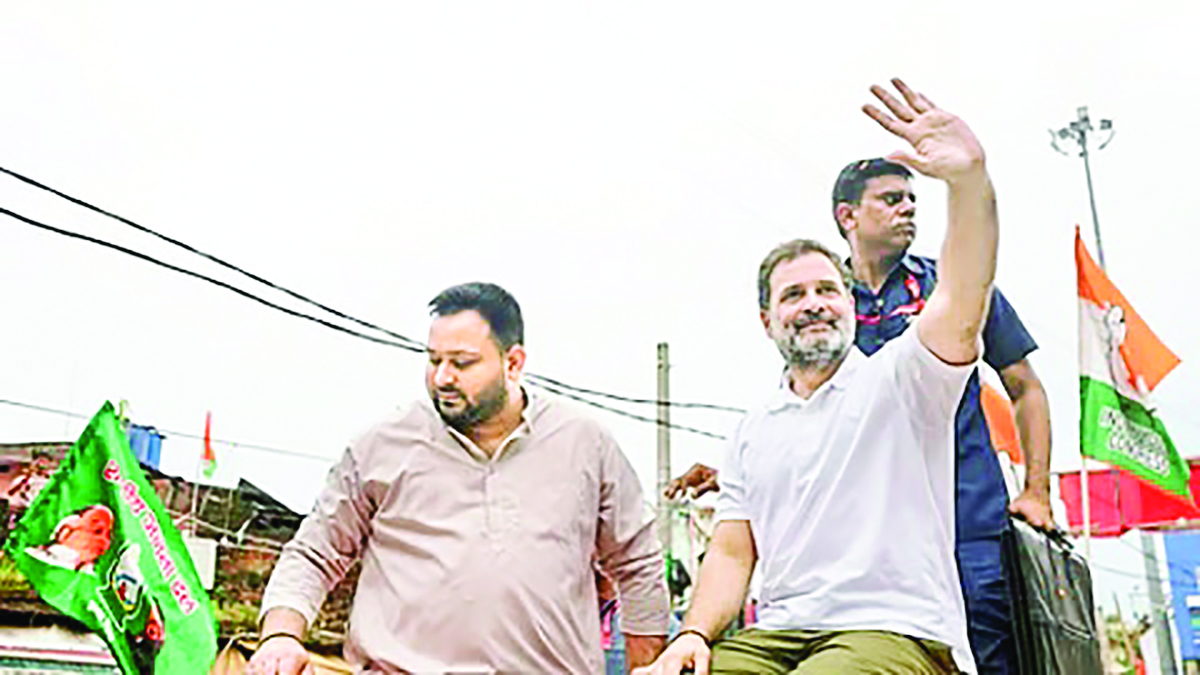
The opposition Grand Alliance in Bihar is avoiding naming a Chief Ministerial candidate, unlike in 2020.
New Delhi: With the Bihar elections less than two months away, the Grand Alliance is unlikely to formally declare RJD leader Tejashwi Yadav as its Chief Ministerial face, unlike in 2020. The ruling National Democratic Alliance (NDA), by contrast, will project sitting Chief Minister Nitish Kumar as its CM face, though senior leaders across the spectrum admit it is highly likely that Kumar would be replaced with another leader if the NDA retains power.
The Congress’s decision—and by extension that of the Grand Alliance—to avoid naming Tejashwi at this stage is shaped by a multiple-fold strategy: to expand beyond the RJD’s Muslim–Yadav core, bring in the other communities especially the forward and the backwards to its fold and to quietly test Congress’s own organizational stamina before high-stakes seat negotiations.
Congress leader Rahul Gandhi’s ongoing 16 days Bihar program, focused on allegations of voter manipulation and disenfranchisement, is being read internally not just as grievance politics but as a litmus test of party muscle. Senior leaders acknowledge that the exercise is designed to measure the strength of district units, the grip of local leaders, and whether voters—both “backward” and “forward” castes—still see Congress as relevant in a state where it has long ceded space but is now working on a specific blueprint to re-emerge as a credible voice in the state by 2029 general elections.
“The program is not merely about pushing the issue of manipulated votes—it is about testing the waters, seeing how much interest and alignment remains with Congress,” a party insider said. According to party assessments, the feedback with regard to Rahul’s program has been positive, “even better than expected.”
The decision to keep the CM question open also explains why a planned mega rally on 1 September at Patna’s Gandhi Maidan to conclude Rahul’s yatra was scaled down to a roadshow. Party managers feared that a large crowd—heavily populated by vocal RJD cadres—might generate pressure to project Tejashwi Yadav as the opposition’s CM candidate, a move Congress wants to avoid before results. By opting for a roadshow, the party retained visibility while keeping control over messaging. For Congress, keeping the chief ministerial face open serves multiple objectives. Leaders argue that by not declaring any CM candidate it allows possible allies such as the Lok Janshakti Party (LJP), led by Union minister Chirag Paswan, to adopt a flexible approach. Congress strategists believe Paswan wants to expand his role in Bihar and could be drawn into the Grand Alliance if offered a commensurate position in a post-poll arrangement.
Even the RJD, which is the strongest of all the allies in the grand alliance, insiders say, has reconciled itself to this line of thinking. “The main aim is to come to power—the CM face is secondary,” one RJD figure admitted.
Another factor shaping Congress’s caution is the lingering “jungle raj” moniker—the opposition tag still attached to RJD’s earlier tenure in Bihar. Party strategists fear that an early projection of Tejashwi could revive those memories, giving the BJP an easy handle and unsettling forward and non-Yadav backward communities that Congress hopes to attract. By walking a balanced rope—staying close to RJD without conceding the campaign’s defining face—Congress aims to preserve both its negotiating leverage and broader acceptability.
Meanwhile, the NDA appears to be struggling on the narrative front. Leaders across party lines acknowledge that corruption charges against top NDA figures and the growing perception of the alliance as anti-forward, anti-Brahmin are beginning to have traction on the ground. A top BJP leader had recently admitted to The Sunday Guardian that “if elections were held now, the Grand Alliance would have the edge.”
Congress has already reached internal consensus on around 55 seats, as earlier reported by The Sunday Guardian. Rahul Gandhi’s Bihar program is meant not only to demonstrate relevance to allies but also to send a signal to voters that Congress is seeking to revive its own space, not merely play second fiddle. The underlying strategy reflects a clear recognition: RJD’s Muslim–Yadav arithmetic alone has not been enough to return it to power. By courting other backward and forward groups, keeping the leadership question open, and distancing itself from the pitfalls of past baggage, Congress hopes to broaden the alliance’s appeal.




