
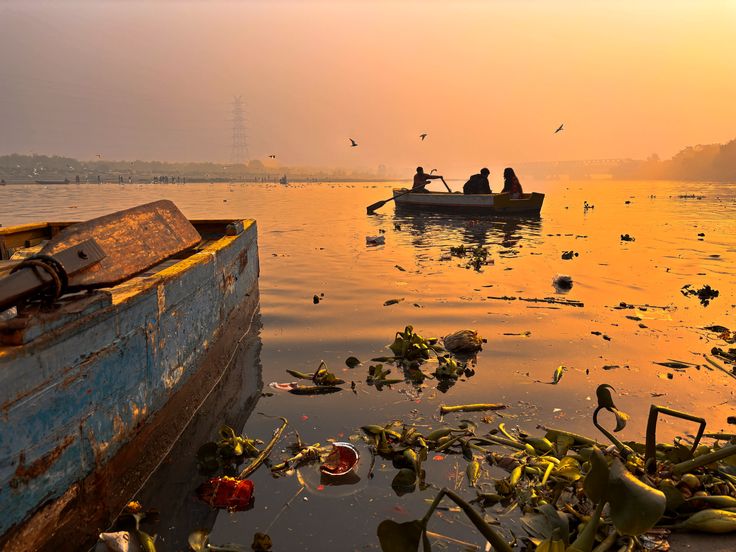
NEW DELHI: The BJP-led Delhi government, which assumed office after pledging to clean the Yamuna and restore its lost glory, has reiterated its resolve to revive the river. Underscoring its importance, Chief Minister Rekha Gupta said the Yamuna is not merely a river but the lifeline of the national capital, and that the government is steadily working on its rejuvenation through scientific planning, clearly defined timelines and close coordination with neighbouring states.
Earlier this week, the Chief Minister chaired a high-level meeting review to assess the current condition of the river. The meeting reviewed sewage treatment arrangements, the cleaning of major drains, and the progress of sewer line work in unauthorised colonies and JJ clusters. CM Gupta directed officials to roll out a concrete, mission-mode action plan to ensure time-bound and measurable outcomes.
Emphasising the need for cooperation with neighbouring states, the Chief Minister said inter-state coordination is crucial for effectively cleaning the Yamuna. Officials informed her that six drains from Haryana merge into the Najafgarh drain, contributing nearly 33 percent of the polluted water entering the river, while four major drains from Uttar Pradesh discharge into the Shahdara drain, accounting for around 40 percent of the pollution load.
CM Gupta said she would personally raise the issue with the Chief Ministers of Haryana and Uttar Pradesh to work towards a lasting solution.
The Chief Minister also directed the Delhi Development Authority (DDA) to prepare a comprehensive plan for developing permanent and well-designed ghats along the Yamuna. She stressed the need for seamless coordination among all concerned departments, including the Delhi Jal Board (DJB), Public Works Department (PWD), Municipal Corporation of Delhi (MCD) and the DDA. To prevent delays in sewer projects and ensure timely restoration of roads, she ordered the formation of a special committee. As part of strengthened monitoring efforts, drone mapping of 22 major drains flowing into the Yamuna will be undertaken, along with monthly water quality testing to check track pollution levels. The Chief Minister also underscored the need to curb industrial pollution, ordering regular inspections of common effluent treatment plants in planned industrial areas and strict action against polluting units in unplanned zones. The DPCC and MCD have been instructed to impose penalties on violators.
Detailing the city’s sewage infrastructure, CM Gupta said Delhi currently operates 37 sewage treatment plants (STPs) with a combined capacity of 814 million gallons per day (MGD), which is adequate to meet current requirements. To address future needs, the government plans to scale up capacity to 1,500 MGD. This will include an additional 86 MGD through the upgradation of existing plants by December 2027, 170 MGD through 35 new decentralised STPs, and a further 460 MGD by setting up large treatment plants near major drains by December 2028.
She said the expansion would ensure that untreated sewage no longer flows into the Yamuna, leading to cleaner water, reduced pollution and odour, and the gradual revival of the river’s ecosystem. In the long term, it will also help protect drinking water sources, improve public health, and create a sustainable sewage management system for Delhi’s growing population.




