
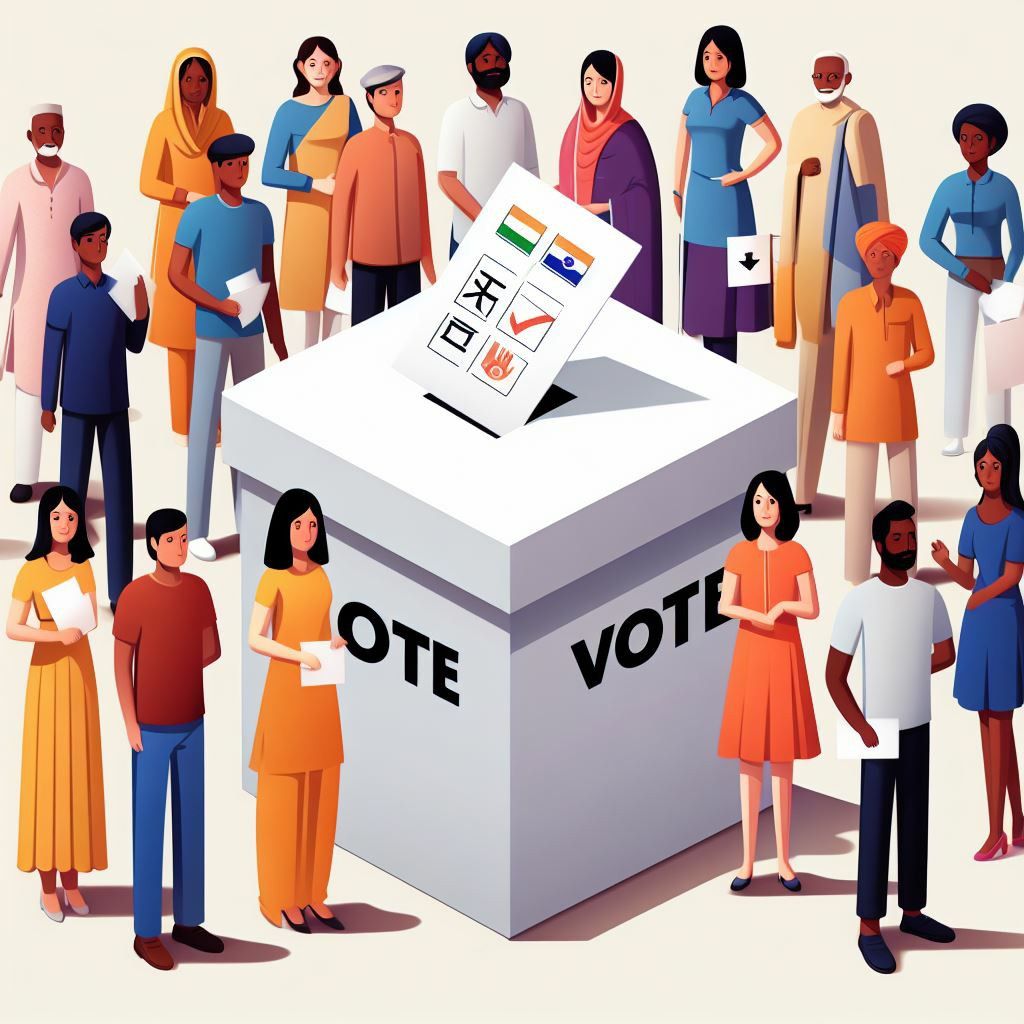
New Delhi: Delhi’s political circles heated up after the Election Commission announced the launch of the Special Intensive Revision (SIR) for the capital. While the ruling BJP welcomed the move, both the Congress and the Aam Aadmi Party (AAP) strongly criticized it.
A letter from the Delhi CEO earlier this week confirmed that preparations were underway for the exercise, which will verify voter details with a focus on identifying “foreign illegal migrants” through place of-birth records. The 2002 voter list has been uploaded on the CEO Delhi website, along with a mapping of current constituencies.
During the house-to-house verification drive, Booth Level Officers (BLOs) will distribute forms. Citizens whose names appear in both the 2002 and 2025 rolls will only need to submit the form, while those absent from the 2002 list but whose parents were listed must provide additional proof. Delhi BJP president Virendra Sachdeva welcomed the SIR, saying it was necessary to clean voter rolls of fake and “infiltrator” entries. He alleged that lakhs of dubious voters were added in previous elections, including cases of 60–100 voters registered at a single address. He also pointed to sudden spikes of 13 lakh voters before the 2015 polls and 8 lakh before 2020, claiming they included ineligible individuals. He assured that BJP workers would assist citizens in the process, stressing that fraudulent votes weaken democracy.
On the other hand, Delhi Congress president Dev ender Yadav called the SIR a ploy to delete opposition votes while adding BJP supporters. Citing the Bihar exercise, he alleged collusion between the EC and BJP to enable “vote theft.” Yadav rejected BJP’s claims about Congress registering illegals, arguing that the BJP has controlled both the Centre and EC since 2014. He also raised concerns over the CEO’s order requiring proof from those missing in the 2002 rolls, saying it would unfairly exclude minorities, backward classes, and the poor.
Similarly, AAP Delhi chief Saurabh Bharadwaj accused the BJP and EC of a long-running conspiracy to delete opposition votes. He recalled Arvind Kejriwal’s December 2024 exposé of mass deletions, months before Rahul Gandhi raised the issue. Bharadwaj highlighted the removal of over 42,000 names in New Delhi constituency alone, with thousands more deleted through fraudulent applications. He alleged systematic profiling of voters by caste, class, and political leanings, particularly targeting marginalized communities.
“This practice has been happening since 2013–14, yet the EC turned a blind eye,” he said. The nationwide SIR aims to improve voter roll accuracy but faces the challenge of avoiding disenfranchisement. The Bihar exercise earlier drew sharp criticism over mass deletions, after which the Supreme Court directed the EC to ensure no genuine voter is excluded and allowed Aadhaar as valid stand-alone ID proof. With BJP backing the process and opposition parties calling it manipulative, the SIR is set to remain a major political flashpoint ahead of the elections.




