
KolKata: With the Election Commission of India (ECI) bracing for a complex Special Intensive Revision (SIR) of electoral rolls ahead of the 2026 Assembly polls, West Bengal has emerged as the biggest challenge. The State is facing an acute short age of booth-level officers (BLOs)—the personnel who form the nerve centre of the mammoth voter verification drive.
Alarm bells are ringing in Nirvachan Sadan as the State’s electoral machinery stares at a potential man power crisis.
With nearly 80,681 polling stations on the ground and a proposal to add 13,817 new booths, taking the total close to one lakh, the EC requires an army of trained personnel to conduct the verification exercise. But with Government employees overstretched and many unwilling to take on additional duties, the Commission is being forced to consider unconventional options such as roping in ASHA workers and Anganwadi staff—a first in Bengal’s electoral history.
Every voter verification drive relies on BLOs, typically drawn from the State’s teaching and clerical cadres.
They conduct house-to house verification of electors, ensure correction of errors, and guard against duplicate and illegal entries.
In Bengal, however, this model is under severe strain. With more than one lakh BLOs required, the State’s pool of regular Government employees is simply not enough. Teachers and education staff, once pressed into such service, have increasingly resisted deployment citing academic disruptions and security fears. Compounding the crunch, many departments have already expressed their inability to release staff, arguing that schemes and class rooms are already short of manpower.
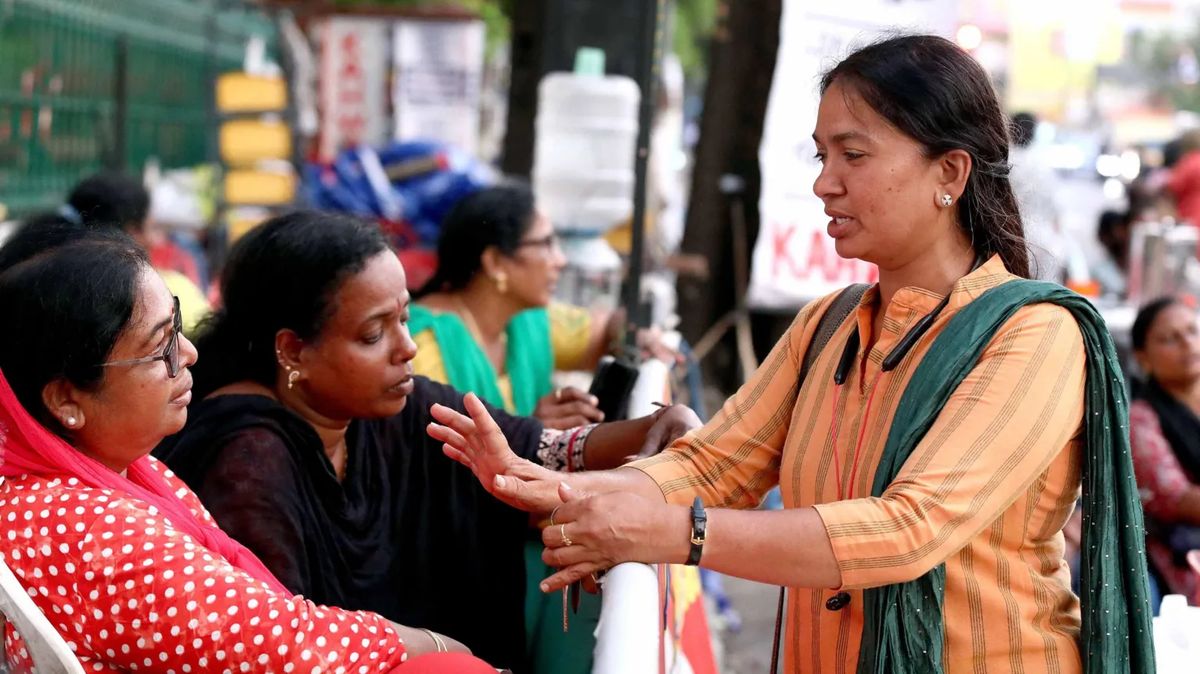
Faced with this structural gap, the State’s Chief Electoral Officer Manoj Kumar Agarwal has written to the ECI proposing that ASHA health workers and Anganwadi functionaries be drafted for roll revision. Both groups, predominantly women, are accustomed to door-to-door interaction, making them suitable for voter list verification. Officials estimate that one- fourth of Bengal’s BLO requirement could realistically be met by drawing from this pool. The election Act does provide leeway for such measures. It explicitly allows that where Government employees are insufficient, BLOs can be appointed from among education workers, Anganwadi staff, or even para-teachers paid from Government funds. Central Government employees may also be tapped with the Com mission’s permission.
Yet, deploying community health activists and Anganwadi staff raises serious questions about safety and training. In past Bengal elections, teachers manning booths have complained of intimidation and violence. Trade unions representing these workers have already begun voicing concern. “ASHA workers are not trained for confrontational or politically sensitive duties. Who will take responsibility if they face threats?” a senior union leader asked.
Beyond BLOs, the EC is battling another short fall—data entry operators essential for digitising the vast updates that SIR generates. The CEO’s office has formally asked for around 800 operators and another 1,000 Government employees to meet the demand. As with BLOs, doubts persist over whether departments can actually spare such numbers.
Officials point to the Bihar pilot earlier this year where volunteers had to be temporarily engaged to plug similar shortfalls in digital man power. “The Bengal SIR may see a repeat,” an insider said. The Commission is keenly aware of pitfalls. The recent Bihar SIR, which used the 2003 electoral roll as the base document, has already generated controversy. Opposition parties accused the EC of disenfranchising crores by insisting on stringent proof-of-birth documentation, particularly for applicants suspected to be migrants. The matter reached the Supreme Court, which directed the EC to ensure no genuine citizen was excluded.
These legal and political storms are fresh in memory as Bengal prepares for its SIR, expected later this year. Officials acknowledge it will be “one of the toughest assignments” given the State’s migrant-linked demographics, porous borders with Bangladesh, and history of political violence.
The Commission has linked SIR directly to its constitutional duty of ensuring an error-free electoral roll. At the heart of the exercise is the scrutiny of voter identities in order to weed out il legal migrants—a politically explosive issue in Bengal.
Under new rules, applicants will have to furnish a declaration form if shifting from outside the state or claiming Indian citizen ship. Those born before July 1, 1987, must offer any proof of Indian birth, while those born between 1987 and 2004 must provide parental documents establishing citizenship. Critics argue this places a disproportion ate burden on the poor and marginalised who may lack documentary trails.
The urgency behind the EC’s hunt for staff also stems from Bengal’s patchy track record in maintaining clean rolls. In July, the Commission suspended four electoral registration officers (EROs) and assistant EROs after evidence surfaced of tampering with lists. A data entry operator was also placed under suspension. While the State Government initially resisted, it eventually complied, highlighting a tense relationship between the EC and Nabanna – the seat of Mamata’s governance.
Sources say further sus pensions are possible if irregularities are discovered during SIR. “We will not tolerate any fraud or lack of transparency,” an EC official reiterated. “Those in charge must understand this is a statutory responsibility.”




