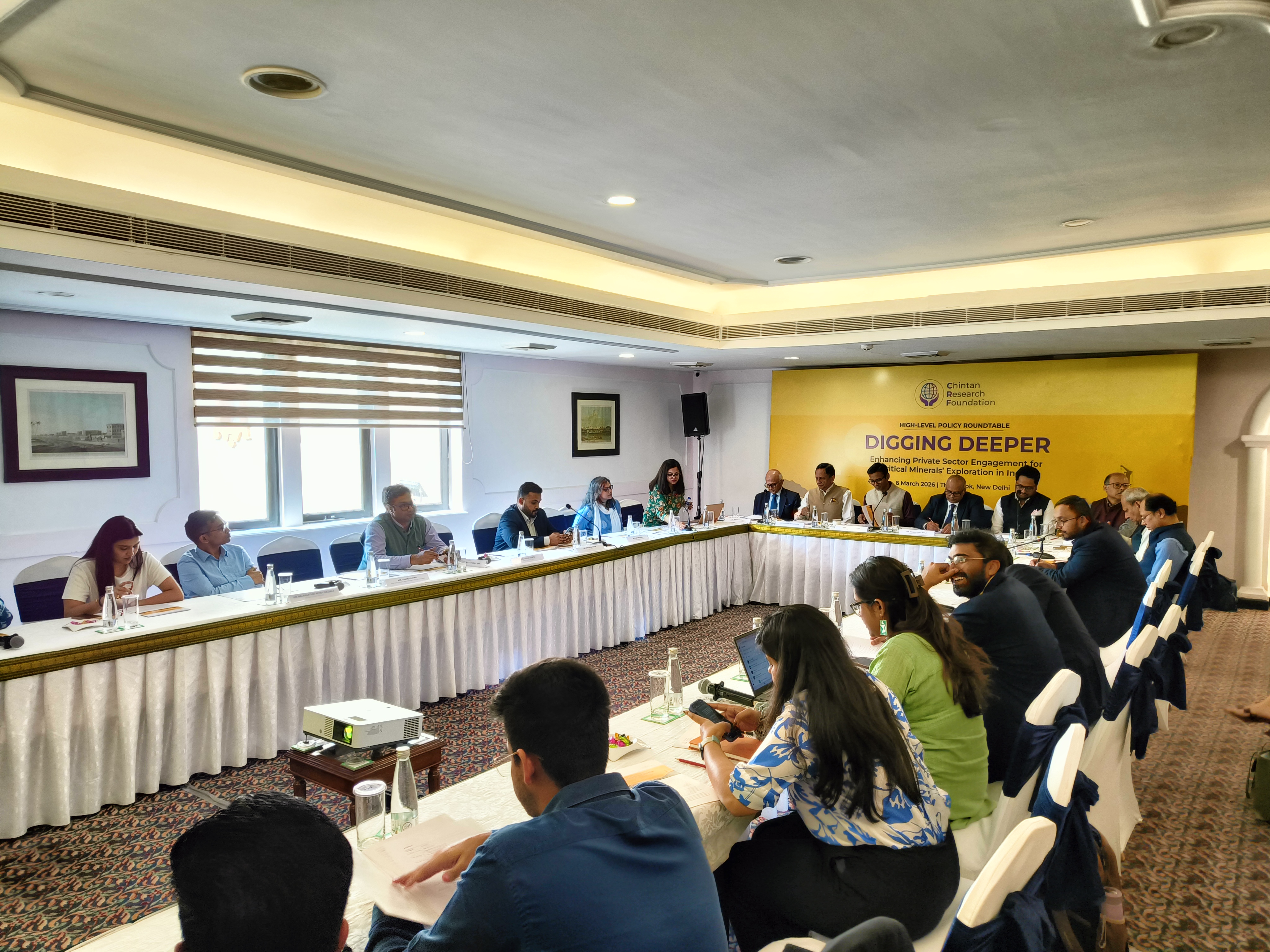
NEW DELHI: Greater private sector participation will be essential for expanding India’s exploration of critical minerals and strengthening supply chains for emerging technologies, experts said at a roundtable discussion held in the capital on Friday.
The discussion brought together diplomats, policymakers and industry representatives to examine the opportunities and constraints shaping private sector involvement in the sector.
As the world moves toward sustainable energy, critical minerals such as lithium, cobalt, nickel, copper, graphite, and rare earth elements have become strategically important. Global geoeconomics and geopolitics are increasingly being shaped by control over these resources.
In his keynote address, Sandeep Kadam, Joint Secretary at the Ministry of Mines, Government of India, highlighted the objectives of the National Critical Minerals Mission (NCMM), which aims to strengthen India’s mineral supply chains.
“India’s exploration intensity remains significantly lower compared to countries such as Australia, Canada and China,” Kadam said, adding that greater private investment and technological capability would be required to scale up exploration activities.
Speaking at the event, Shishir Priyadarshi, president of the Chintan Research Foundation, which organised the discussion, said India’s growing demand for these minerals requires a stronger domestic exploration ecosystem. “Some countries have leveraged their dominance in critical minerals to expand their global influence,” he said, referring particularly to China. “India will need to scale up exploration efforts, and the private sector can play an important role in that process.”
Underscoring the geopolitical implications of mineral strategies, Ranjan Mathai, former Foreign Secretary of India, said critical minerals are increasingly central to global economic competition. “Countries are now treating mineral strategies as part of their broader geopolitical and geoeconomic planning,” he said, adding that India will need to combine international partnerships with stronger domestic capabilities.
Additionally, the industry experts underscored the importance of India’s vast mineral reserve and the need for private sector engagement in developing the mineral ecosystem. Participants and policymakers also pointed to the fact that for India to improve its standing in the world, particularly critical mineral supply chain, collaboration and cooperation between government organisations, businesses, and local communities is essential.
