Ruling party foregrounds voter revision controversy to blunt governance criticism before elections.
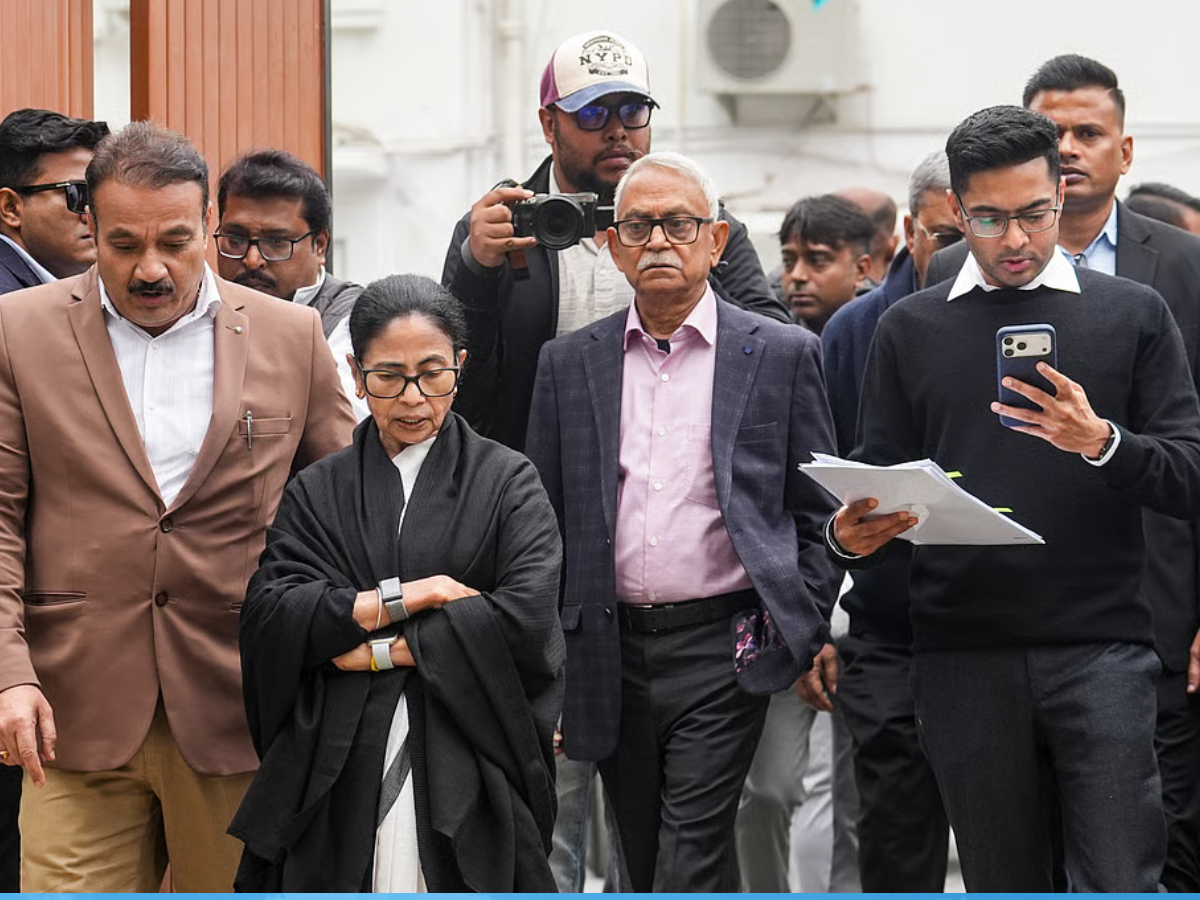
Chief Minister Mamata Banerjee meets Chief Election Commissioner in Delhi to protest the Special Intensive Revision of electoral rolls ahead of 2026 polls (Photo: X)
NEW DELHI: With the West Bengal Assembly elections scheduled for 2026, the state has emerged as the focal point of one of the country’s most closely watched political battles. The contest between the ruling Trinamool Congress (TMC) and the Bharatiya Janata Party (BJP) has intensified, with both sides escalating attacks and stepping up grassroots mobilisation across the state.
The BJP has anchored its campaign around allegations of corruption, administrative failure and rising anti-incumbency against the Mamata Banerjee-led government. In response, the TMC has accused the Centre of politicising institutional and investigative institutions such as the Enforcement Directorate (ED), the Central Bureau of Investigation (CBI) and the Election Commission of India (ECI), particularly in relation to the ongoing Special Intensive Revision (SIR) of electoral rolls.
Sources within the ruling party said the TMC is aggressively projecting the SIR exercise as a form of voter harassment. A senior party leader told The Sunday Guardian that the leadership believes resentment is building among citizens who are being asked to verify their identities by standing in long queues outside their residences.
A senior journalist who has covered West Bengal politics for more than two decades said the ruling party is deliberately amplifying the SIR narrative to counter anti-incumbency and divert attention from criticism of governance under Mamata Banerjee. “The effort is to convert public inconvenience into a political rallying point,” the journalist observed.
He added that the TMC has faced an especially difficult phase over the past few years, with the opposition repeatedly highlighting what it describes as serious governance failures. Incidents such as Sandeshkhali, the R.G. Kar College controversy, the law college case and the Dungapur college episode, he said, have been used by the opposition to underscore the state government’s alleged inability to ensure safety and security for women and female students. The Murshidabad violence has also been projected as another instance of administrative failure.
The journalist further pointed to the recent controversy involving Humayun Kabir as a significant setback for the Trinamool Congress. Kabir’s decision to float his own party and his announcement that he will contest elections in minority- and Muslim-dominated constituencies—considered a core TMC voter base—has compounded the ruling party’s concerns.
Anticipating that the 2026 Assembly elections could be among the toughest challenges it has faced so far, the TMC has launched a political counter-offensive against the BJP, seeking to regain momentum and rebuild voter confidence by placing the SIR issue at the centre of its campaign.
Chief Minister Mamata Banerjee has personally taken the lead in opposing the SIR exercise, accusing the Centre of undermining electoral fairness in West Bengal.
As part of this pushback, Banerjee recently travelled to Delhi to meet Chief Election Commissioner Gyanesh Kumar to formally raise her objections. The Special Intensive Revision is currently being carried out across 12 states and Union Territories to update electoral rolls.
However, no other Chief Minister among these states has opposed the exercise as forcefully as Banerjee, who believes that taking a firm stand will help the TMC counter the BJP’s expanding footprint in the state.
The BJP, meanwhile, has sharpened its offensive by reiterating allegations of widespread corruption, poor governance and demographic changes during the TMC’s tenure.
A senior BJP leader told The Sunday Guardian that Mamata Banerjee’s protests and outreach would not derail the SIR process, asserting that public sentiment in Bengal is firm on the slogan “No SIR, No Voter.”
He added that attempts to block central agencies would not prevent the Trinamool Congress from facing electoral defeat.
The BJP leader also questioned why opposition to SIR is confined to West Bengal when the exercise is proceeding smoothly in 12 other states, describing the resistance as a sign of fear. He accused Banerjee of hypocrisy, pointing out that she had herself sought voter list purification in 2005. He further alleged that the TMC wants illegal Bangladeshi and Rohingya names to remain on electoral rolls and blamed the state government for weakening border security and pursuing appeasement policies. In support of his claims, he cited fake voter cards, seizures of counterfeit currency, threats to Hindus, and rising cases of what he described as love jihad and land jihad affecting tribal communities.
