BJP's state observer, co-observer land in Kolkata as BJP, TMC gear up for polls
BJP's Bhupender Yadav and Biplab Deb arrive in Kolkata post-Durga Puja to strategize for the 2026 Assembly elections in West Bengal.
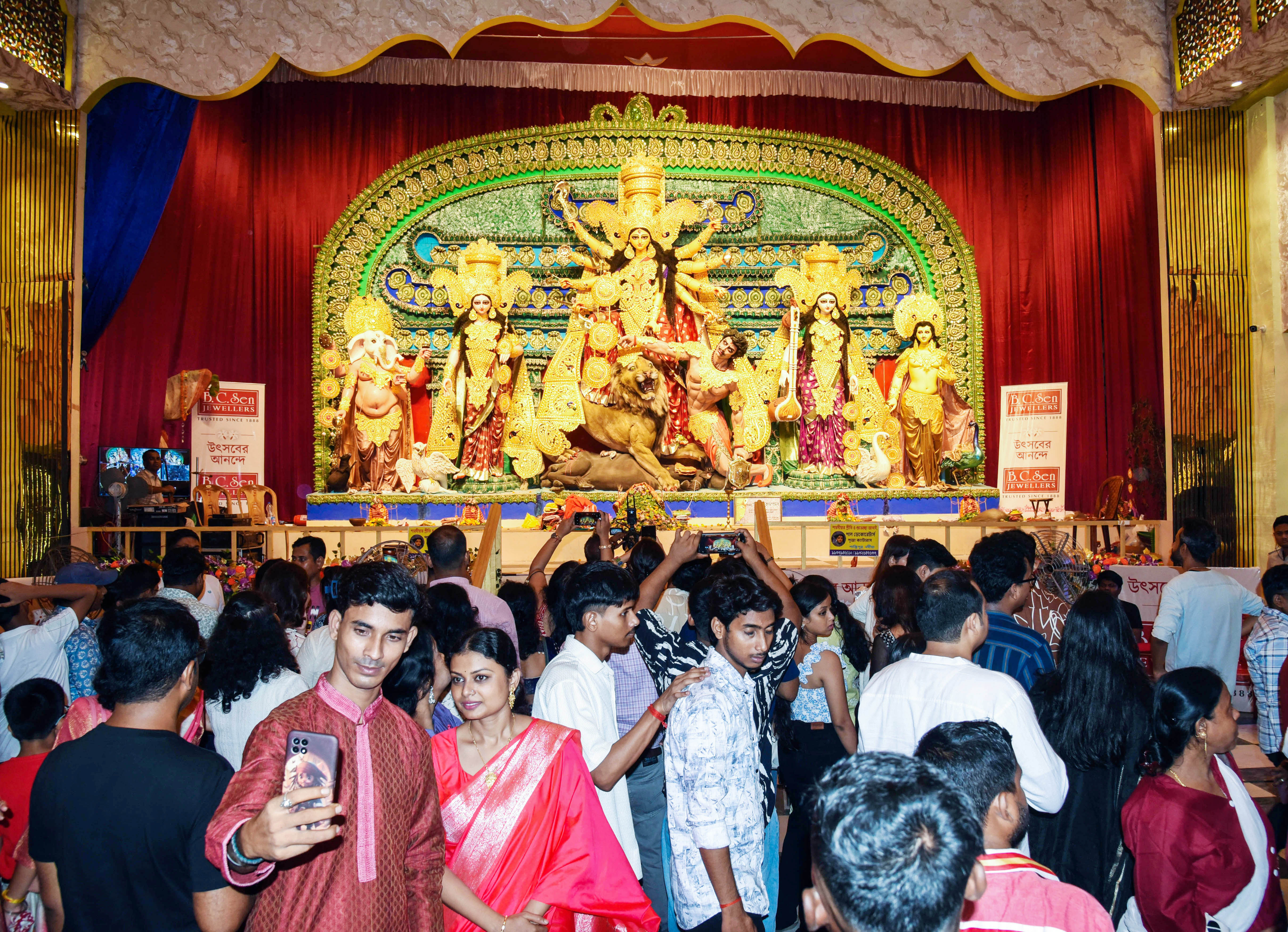
KOLKATA: The lights at Durga Puja pandals may still be flickering across West Bengal, with many idols yet to be immersed, but the State's political leaders are already hunkering down for a long and potentially bruising electoral battle. With roughly seven months to go before the Assembly polls, Bengal appears set for yet another polarising political duel.
Barely a day after Vijaya Dashami officially marked the end of Bengal's grandest festival, the ruling Trinamool Congress (TMC) and its challenger, the Bharatiya Janata Party (BJP), have shifted decisively into campaign mode for the 2026 Assembly election.
On Friday morning, central BJP heavyweights Bhupender Yadav and Biplab Kumar Deb touched down in Kolkata. Designated as the party's observer and co-observer for the Bengal polls, their presence so soon after the Puja break underscored the urgency of the saffron camp's preparations. They were received at the airport by state BJP chief Shamik Bhattacharya, MP Jyotirmoy Singh Mahato, and others before diving into back-to-back strategy meetings.
At the BJP's Salt Lake office, Yadav and Deb joined the BJP's Bengal brain trust, including Suvendu Adhikari, Sukanta Majumdar, Locket Chatterjee and key organizational figures, in a closed-door huddle. According to insiders, discussions zoomed in on constituency-level arithmetic, particularly seats where the party lost narrowly in 2021 and pockets where it performed strongly in the 2024 Lok Sabha elections. "The focus is entirely on electoral gains and losses. Every reshuffle of district units, every assignment of responsibility will now be made after analysing the math," a senior BJP functionary said after the session.
The BJP's central leadership has also pressed its state unit to engage vigorously with the Election Commission's Special Intensive Revision (SIR) of electoral rolls, scheduled after the Puja season. One observer insisted the revision itself could prove decisive: "If implemented effectively, names of countless ineligible voters will be struck off; that alone could deal a blow to Mamata Banerjee's chances of a fourth term," he told The Sunday Guardian. Though Yadav and Deb will front campaign planning, sources stressed that Sunil Bansal, BJP's powerful national general secretary for organization, remains the final word. "No major move bypasses Bansal," another insider remarked.
The BJP's post-Puja focus comes soon after Union Home Minister Amit Shah lit up Kolkata's festive firmament by inaugurating the Santosh Mitra Square puja pandal, themed on "Operation Sindoor". His fiery address doubled up as a campaign launch. "I prayed to Maa Durga for regime change in Bengal so the dream of a Sonar Bangla, envisioned by Rabindranath Tagore, may be fulfilled," Shah declared, linking cultural pride with the BJP's slogan of peace, safety and prosperity.
Shah's comments instantly set off a political fireworks display. TMC leaders mocked his visit as "political tourism". Party spokesperson Kunal Ghosh quipped: "Another tourist has come, there will be no electoral impact". Mayor Firhad Hakim dismissed "
Sonar Bangla" as already achieved under Mamata Banerjee, while Education Minister Bratya Basu reminded Shah that he had sold the same dream in 2021, only to be rejected by the people.
TMC national general secretary Abhishek Banerjee sharpened the attack further, demanding answers regarding the Centre's withholding of funds for West Bengal. He questioned whether Shah's party had created "Sonar Gujarat, Sonar Maharashtra, and Sonar Uttar Pradesh" before pitching for Sonar Bangla. Still, the optics were unmistakable: the BJP wants to pull Bengal's cultural consumption into its nationalist idiom, ensuring Bengal's glorious past is woven into its promise of a saffron future.
If the BJP looked to Delhi's high command for muscle, the TMC's counter-strategy was anchored on grassroots sentiment and harnessing the afterglow of Durga Puja. The party's national general secretary Abhishek Banerjee announced a statewide program of Bijaya Sammelanis (post-festival gatherings) that kick off on Sunday, coinciding with the Red Road Puja Carnival led by Chief Minister Mamata Banerjee. At least 50 Ministers, MPs, and MLAs have been assigned to travel across districts, blocks, and villages meeting citizens, felicitating local clubs, explaining welfare schemes, and setting the tone for booth-level preparedness. "These are not just courtesy calls. The Sammelanis will sharpen cadre energy and connect schemes directly with emotion," a TMC insider said.
For Abhishek Banerjee, who had been seen pandal hopping casually in Kolkata during the Puja—eating street food with his daughter and mingling with migrant workers—the push signals a calibrated shift. "The choice of pandals, the themes of migrant labourers or freedom struggle—it's all narrative building," a party strategist admitted. "It positions TMC as embedded in Bangaliyana while painting BJP as outsiders".
The battle lines remain consistent with 2021, when Mamata Banerjee won 215 seats by positioning the BJP as an "outsider" intent on undermining Bengali identity. TMC strategists are leaning once again on the emotive appeal of Bangalipana—Bengali pride—particularly by highlighting instances of alleged harassment of Bengali migrant workers in BJP-governed States, where they were branded as Bangladeshis.
In contrast, the BJP will double down on its Hindutva-inflected nationalism, interlacing Bengal's cultural glories with the larger project of a resurgent India. Shah's temple visit to Kalighat, his homage to Vidyasagar, and even the military symbolism of "Operation Sindoor" are evidence of that pitch.
For the BJP, the immediate challenge is organizational coherence. The party has been riven with factional strife between leaders and suffered setbacks in urban constituencies in the recent polls. Central observers have been tasked to iron out these rifts while sustaining momentum generated by a jump from three Assembly seats in 2016 to 77 in 2021. For the TMC, the risk lies in anti-incumbency after more than 14 years in power. Urban middle-class discontent—visible in BJP's gains in parts of Kolkata and Howrah in 2024—is a warning sign. There is also "institutional fatigue," as one TMC strategist conceded, which the Sammelanis hope to overcome by deepening connect with voters at the block level.
