
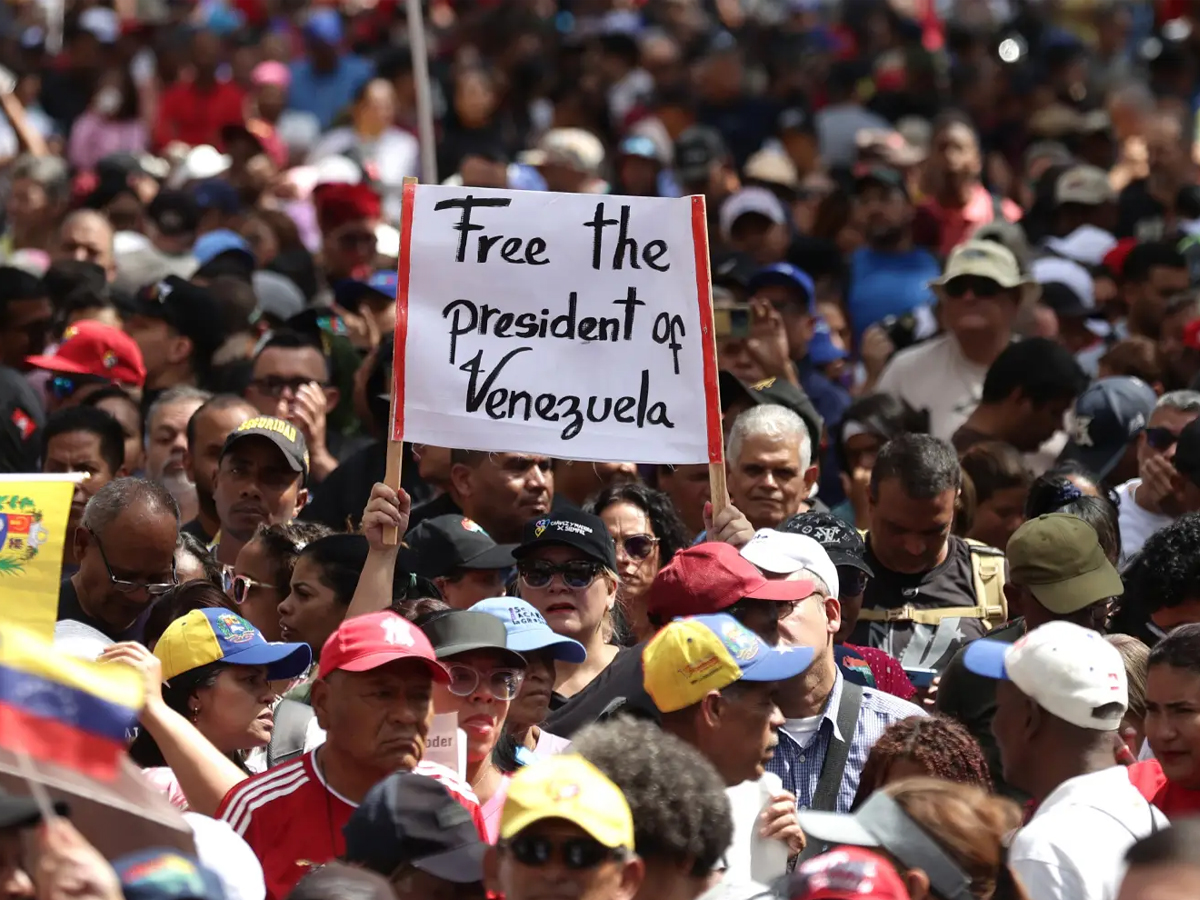
Nearly 2,000 people took to the streets of Caracas on Sunday to demand the release of Nicolás Maduro and his wife following their capture by U.S. forces. The rally came a day after a dramatic military operation in which American troops removed Maduro from power, triggering political uncertainty and unrest across Venezuela.
Supporters included pro‑Maduro paramilitary groups and bikers, all waving Venezuela’s red, blue, and yellow flag. Many sought to show solidarity with their ousted leader, shouting slogans and holding signs demanding his freedom.
‘Free Our President’: What Protesters Chanted
At the heart of the demonstration were protesters holding signs with messages such as “Free our president” and “Venezuela is no one’s colony.” These slogans reflected anger at the U.S. intervention and resentment toward foreign involvement in Venezuelan affairs.
One sign bore an image of Hugo Chavez, Maduro’s predecessor and political mentor, reinforcing the emotional and historical ties many supporters feel with the Bolivarian leadership.
It’s pretty awesome how dancing makes robots less intimidating. Looking forward to seeing more nontrivial Machine Learning on these robots. Credit: Boston Dynamics. pic.twitter.com/wnB2i9qhdQ
— Reza Zadeh 🇺🇸 (@Reza_Zadeh) December 29, 2020
On Monday, Maduro is scheduled to appear before a federal judge in New York, where he will be formally notified of “narcoterrorism” charges related to alleged cocaine trafficking into the United States.
The accusations stem from long‑standing U.S. legal actions seeking Maduro’s arrest. His son, Nicolás Maduro Guerra, is also among those accused by U.S. authorities.
Calls from Maduro’s Son Fuel Street Action
Maduro’s son took to social media with a powerful message urging Venezuelans to rise. “You will see us in the streets, you will see us by people’s sides, you will see us fly the flag of dignity,” he said in an audio message shared online.
He also claimed that his father’s capture was facilitated by betrayal from within Maduro’s inner circle. “History will tell who the traitors were,” he said, adding fuel to the protesters’ suspicions.
Many protesters echoed the son’s message, accusing unnamed insiders of betraying Maduro and weakening his security despite heavy protection. Some questioned how U.S. special forces managed to reach and abduct him.
Their frustration was heightened by reports that Venezuela’s air defenses did not respond effectively before Maduro’s capture, a point protesters repeatedly raised.
Domestic Political Shift Following U.S. Operation
In the wake of Maduro’s removal, Venezuela’s Supreme Court appointed Vice President Delcy Rodríguez as interim president. This move aims to fill the power vacuum but has drawn mixed reactions domestically and internationally.
Rodríguez has called for diplomatic dialogue with the U.S. and emphasized a desire for peaceful coexistence, even amid ongoing tensions.
The U.S. action sparked protests and criticism beyond Venezuela. In cities across the United States, people marched against what they described as an illegal military intervention and violation of international law.
Some governments, including China, condemned the capture and demanded Maduro’s release, calling the operation a breach of sovereignty.
Demonstrations have also taken place in support of Maduro’s ouster, particularly among Venezuelan communities abroad, highlighting deep divisions over the nation’s future.
What Protesters Want Now
For many in Caracas, the rally was more than a protest; it was a declaration of resistance. Supporters made clear they reject external control or foreign governance. They demand that Maduro and his wife be freed and returned to Venezuela.
As the country faces political fragmentation and global scrutiny, these street demonstrations show that support for Maduro’s leadership remains deeply rooted among significant sections of the population.




