
728
Most of the battles described in the book give out one singular message: victory favours the one who employs mobility in warfare and innovates concepts.
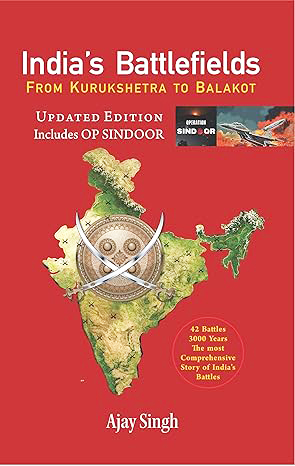
New Delhi: Colonel Ajay Singh had written what can be considered as the most comprehensive account of India’s battles, covering 42 of India’s most significant battles over 5,000 years right from the epic battle at Kurukshetra to Balakot in 2019. The updated edition of this book has now been published by Pentagon Press which includes Operation Sindoor, providing a comprehensive overview of the four-day encounter between India and Pakistan, right from the background, the conduct of operations and the aftermath.
Each battle comes alive as an individual story, complete with maps and pictures. The story of Indian warfare can be read at various levels, the first being an account of the battles and more importantly is the thread that runs through these battles drawing out lessons relevant even today.
Ajay makes it clear in the preface itself, “Indian warriors were invariably skilful and individually very brave and courageous. But military leaders neglected the organizational structure of their armies. They did not adapt to new concepts of warfare and often remained rooted in the past. Nor did they embrace technology…. They were always too busy battling each other instead of an outsider. And that was the cause of their defeat and for the centuries of subjugation that followed.”
Most of the battles described in the book give out one singular message: victory favours the one who employs mobility in warfare and innovates concepts. Employment of tanks at Zoji-La in 1948, the move towards Dhaka in 1971, and the Balakot strike highlight this truth. In Kurukshetra, the two supreme commanders met and framed “rules of ethical conduct”, “Dharmayuddha”. Yet, all the participants broke the rules of dharma, and twisted it to suit their ends. However, the “the concept of dharma and of fighting only righteous wars” remained in the Indian psyche for centuries thereafter.
The book skilfully traces multiple themes across centuries. Alexander faced his most formidable foe Porus in 326 BC. The book talks about how Indians actually broke the formidable Greek phalanx and fought them to a standstill. Even the Greeks called them “the most courageous foe we faced.”
The defeat at Tarain in 1192, a turning point in Indian history, came from Prithviraj Chauhan’s overconfidence after his victory in the first battle, in which the Rajputs used their superior fighting skills to defeat the army of Mohammed Ghori. Yet, just a year later, they lost at Tarain, overcome by fast moving fire and manoeuvre.
Babur too used manoeuvre and the technology of gunpowder to carve an empire. In six hours of battle, he defeated Ibrahim Lodhi’s vast force at Panipat. Again in 1527, Mughal cannons and mortars countered Rajput charge “with a storm of fire that valour and individual skill could do little against”.
Turning points also play a great part in the outcome of a battle; Hemu’s blinding at Second war of Panipat in 1556, sudden rainfall during the Battle of Palashi’ in June 1757 favouring the British, or Manekshaw waiting out monsoons to launch the offensive in 1971 are some battles where role of weather in battles provides important lessons.
Treachery and internal weakness emerge as recurrent motifs. From the “Battle of Talikota” in 1565 where Gilani brothers Noor Khan and Bijli Khan betrayed Rama Raya of Vijayanagara, Khalil Ullah Khan a trusted general of Dara in “Samugarh” betraying him in 1658 to Mir Jafar’s betrayal in “Palashi” and later conspiracies during the Anglo-Sikh Wars shows how the weakness within has always been exploited by the adversary with devastating consequences. Yet, courage and resilience often counterbalanced these setbacks. Rana Pratap’s stand at Haldighati, Tanaji’s audacious capture of Sinhgarh in 1670, and modern feats like the capture of Haji Pir Pass in 1965 or Bana Singh’s Siachen climb in 1987 to Quaid Post demonstrate the enduring value of bold, unexpected actions leading to victory.
The author also emphasizes on manoeuvre warfare. It enabled the Marathas under Shivaji and later Peshwa Baji Rao I to defeat larger enemies by moving light and fast. The Marathas travelled light, with no excess baggage whatsoever. It was ironic that they would forget these very tenants of mobility and speed, which contributed to their defeat at Panipat in 1761.
What stands out throughout is the human element. In 1897 at Saragarhi, where 36 Sikh, in collective valour against impossible odds, fought to the last man. In 1947, 1 Sikh under Col Ranjit Rai, shaped the map of India and his gallant leadership prevented the fall of Srinagar. The valiant stand and bravery of Major Somnath Sharma of 4 Kumaon at Badgam and Major Shaitan Singh of 13 Kumaon at Rezeng La in 1962 again illustrated the ethos of “fighting till the last man and last round”.
The book talks about “Unrestricted Warfare” a book by two Chinese Colonels; ‘where there are no rules and nothing is forbidden’ aptly describes British rule. It also doesn’t shy away from critical reflection. The Liberation of Goa in 1961 marked India’s first use of land, sea, and air together. But this easy victory gave India an ‘inflated sense of its capabilities’ and we suffered a humiliating defeat in 1962 against the Chinese.
Finally, the treatment of the 1965 and 1971 wars is exemplary. The book captures not only the operational sweep like Pakistani offensive coming to a grinding halt at Asal Uttar but also the heroics when the First Armoured Division under General Sparrow advanced towards Shakargarh which was the largest tank battle after World War II. The book lays great emphasis on the 1971 War—covering not only the overall War, but also individual actions like Longewal, Basantar, Garibpur, the naval raid on Karachi and the Air War. Perfect synergy of land, sea, and air made it the watershed of Indian military history.
About Operation Sindoor he writes that “Pakistan’s policy of using state sponsored terrorism remains undiminished” and that India’s “lack of response emboldened the Pakistani establishment that it could continue the policy without fear of retaliation”. Though Balakaot changed the equation but its deterrence “was wearing off”.
In the response to the Pahalgam terror attack and the suspension of the Indus Water Treaty ‘it does not mean water can be shut off like a tap’, but it will ‘enable India to proceed with projects ‘providing “much needed hydroelectricity and irrigation to J&K”.
He further draws lessons from our intense “non-contact war” which saw the use of aircraft, drones and precision strike weapons striking deep into enemy territory. But says our “surveillance and air defence capabilities need to be enhanced and integrated even further because subsequent attacks could be of greater sophistication”. However, the dissemination of our narrative was slow in the information domain.
Well written, and researched, “India’s Battlefields” is an excellent book. The viewing of the battles through an Indian perspective—is what gives them a different outlook. He is scathing in criticism and warm in praise and still brings out the battle in an objective and unbiased manner.
* Maj Gen Jagatbir Singh, VSM retired from the Indian Army.




