At IPRD 2025, Israel’s Rear Adm. Shaul Chorev proposed “blue diplomacy” — using maritime cooperation, renewables & trade to foster post-Gaza peace and stability.
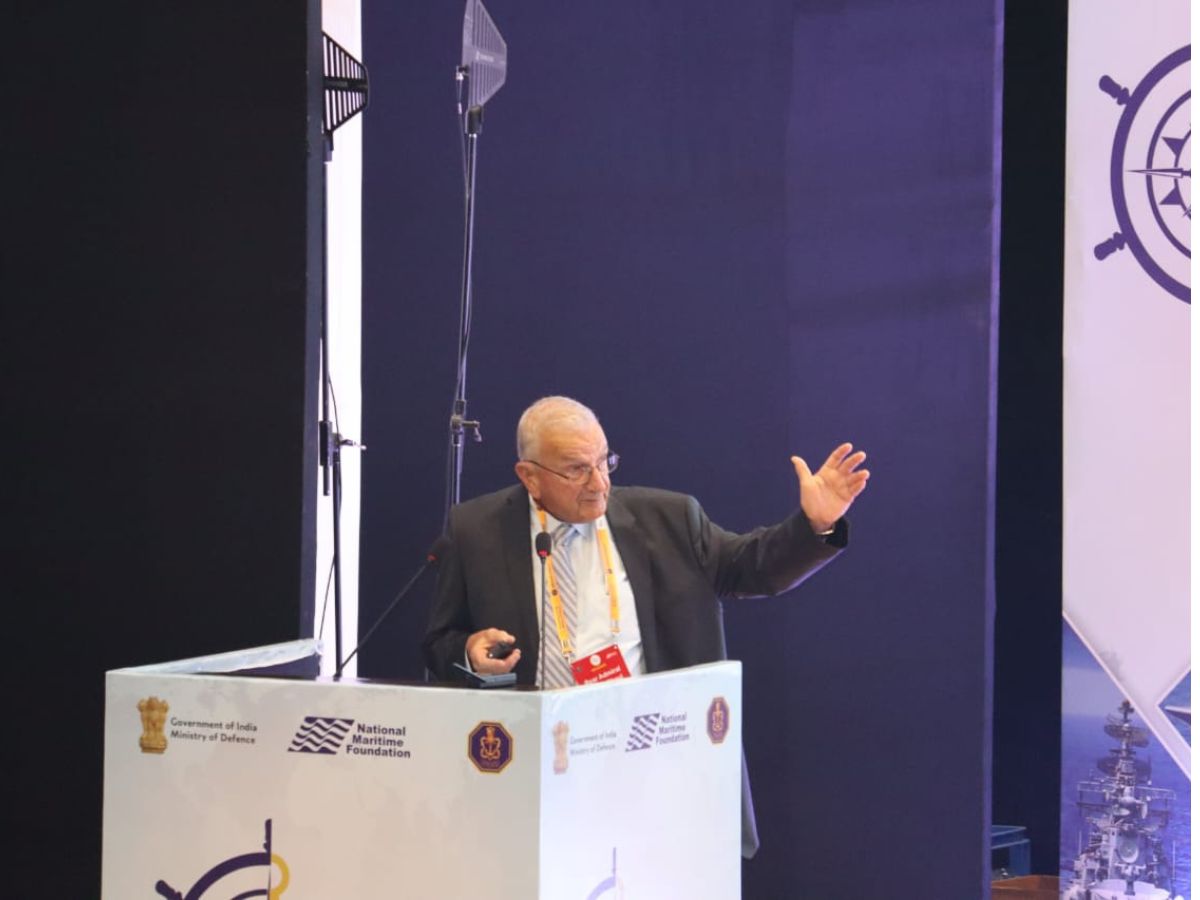
From War to Water: How Israel’s ‘Blue Economy’ Vision Seeks to Calm the Eastern Mediterranean (Image: File)
The echoes of the Gaza conflict still reverberate across the Eastern Mediterranean, a region long scarred by shifting alliances and maritime rivalries. Yet, amid the fatigue of endless diplomacy and the debris of war, a new idea is quietly taking shape—one that looks to the sea, not the battlefield, for stability.
At the Indo-Pacific Regional Dialogue 2025 held in New Delhi this week, Rear Admiral (Prof) Shaul Chorev (Retd) of the Israeli Navy presented what he called the “blueing” of Israel’s economy—a comprehensive strategy to weave maritime cooperation, renewable energy, and sustainable trade into the region’s post-conflict recovery fabric. His proposal, though technical on the surface, carries profound geopolitical implications: could maritime interdependence succeed where conventional diplomacy has failed?
Chorev’s intervention came at a moment of fragile calm following the recent Gaza ceasefire. He argued that the Eastern Mediterranean must turn its vulnerabilities—particularly water scarcity and climate stress—into shared opportunities for cooperation.
One model already under discussion between Jordan and Israel envisions a swap of 600 megawatts of solar energy for 200 million cubic metres of desalinated water annually. Such arrangements, he said, “convert scarcity into security,” transforming old grievances into frameworks of mutual benefit.
“The Eastern Mediterranean faces the same threats—climate change, scarcity, instability,” Chorev observed. “It must also find the same solutions.”
Chorev’s vision aligns closely with the India–Middle East–Europe Corridor (IMEEC), a logistics and transport network connecting India’s western ports to Europe via the Gulf and the Mediterranean. Supported by Indian and Emirati investments, the Haifa–Fujairah route is projected to reduce transit times to Europe by up to 40 percent compared with the Suez Canal.
India’s own contribution to this emerging ecosystem—the MAITRI digital platform, developed by RITES—will facilitate secure data exchange between ports in India, the Gulf, and Israel. In Chorev’s view, these data highways are not mere trade enablers but trust-building tools. “Digital transparency,” he said, “can be as stabilising as any peace accord.”
Israel’s National Center for Blue Economy and Innovation, established in 2022, has become the nucleus for maritime start-ups and green technology ventures. Its BlueTEC Plan spans projects in marine biotechnology, aquaculture, desalination, and offshore renewables, merging economic diversification with environmental responsibility.
Meanwhile, ZIM Shipping Services, Israel’s largest maritime operator, is renewing its fleet with 46 new vessels, including 28 powered by liquefied natural gas (LNG)—a significant step towards decarbonising regional shipping. The company’s participation in the global “Move to −15° Coalition”, which aims to cut carbon emissions from cold-chain logistics, further reflects this transformation.
For Chorev, such initiatives are not just commercial but geopolitical. “Every green corridor or water exchange agreement,” he said, “is also a peace corridor.”
The promise of this maritime reorientation lies in its quiet pragmatism. While formal peace processes remain stalled, economic networks offer an alternative route to stability—one based on connectivity rather than confrontation. Still, the risks are real. The region’s underlying political fault lines, sectarian divisions, and unresolved territorial disputes could easily disrupt this delicate balance.
Yet the direction of travel is clear. By linking India’s digital logistics, the Gulf’s renewable ambitions, and Israel’s maritime innovation, a new Indo-Mediterranean architecture of interdependence is emerging—what Chorev describes as a “blue diplomacy” built from the sea upward.
“Initiatives focused on the Blue Economy could serve as leverage points to build confidence across the Middle East,” he concluded.
For India, which has consistently advanced its SAGAR (Security and Growth for All in the Region) and Indo-Pacific Oceans Initiative (IPOI) frameworks, the convergence of these ideas is more than coincidental. New Delhi’s growing footprint—from the western Indian Ocean to the Mediterranean—reflects a deliberate effort to connect trade, technology, and trust across the maritime commons.
By promoting sustainable blue-economy partnerships and investing in corridors like IMEEC, India is emerging as both a connector and stabiliser—linking the Indo-Pacific’s economic dynamism with the Mediterranean’s post-conflict recovery.
In a region where peace has too often been negotiated on land and lost at sea, Israel’s wager—and India’s quiet endorsement—suggest that the tides themselves may now carry the promise of equilibrium.
(Aritra Banerjee is a defence and strategic affairs columnist who writes for national international publications)
