
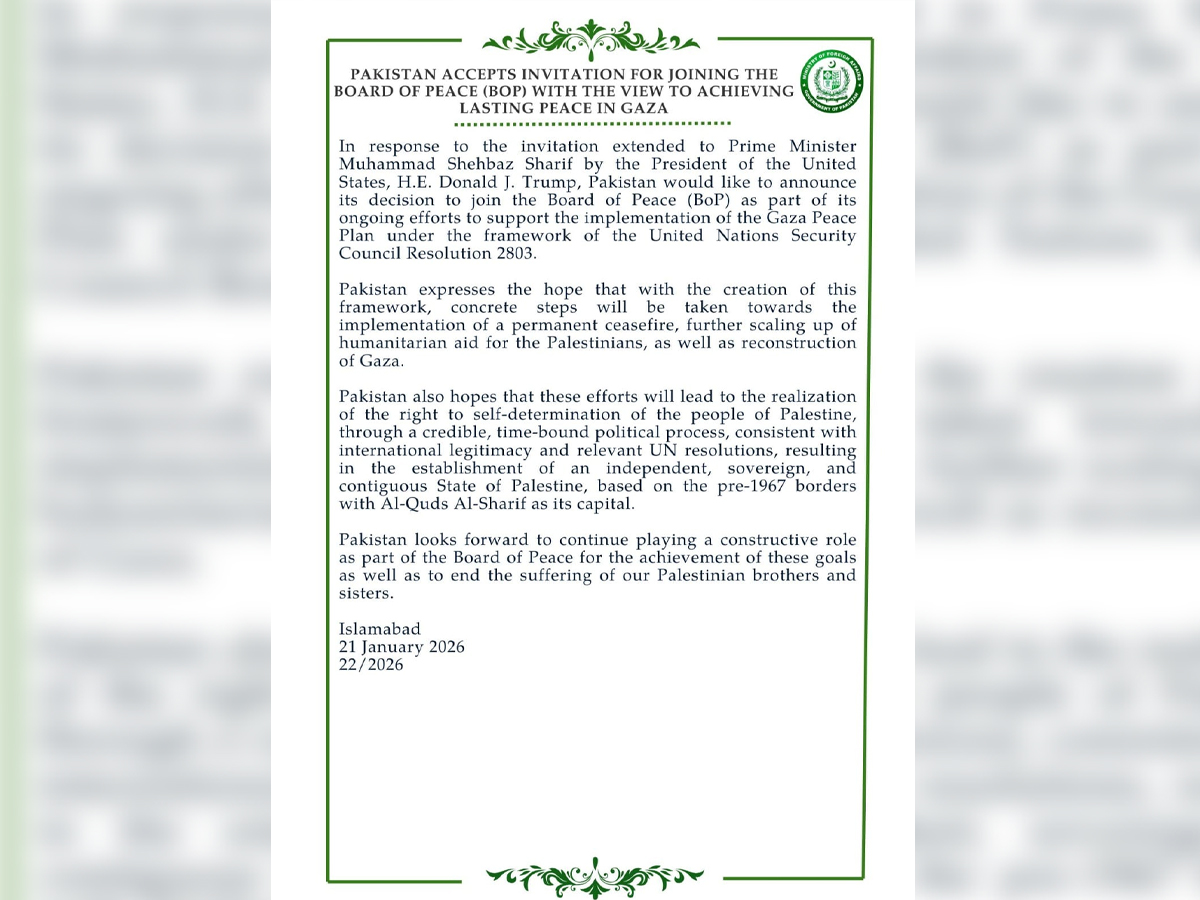
Pakistan’s decision to sign on to the Trump-era “Board of Peace” initiative on Gaza has been presented as a responsible diplomatic step—an effort to ease Palestinian suffering and insert Islamabad into a major international mediation process. Yet behind the carefully worded statements lies a far more uncomfortable reality. The move exposes the persistent tension between Pakistan’s proclaimed Islamic commitments as well as the strategic priorities of its entrenched power elite.
On the surface, what appears to be an exercise in moral diplomacy instead reflects a long-standing pattern in Pakistan’s foreign policy where decisions are shaped less by ethical consistency than by the calculations of the military-political establishment and its relationship with Western power centres.
Decision-Making Without Consent
Pakistan’s foreign policy has rarely been the product of an open debate. While public discourse is saturated with the language of Muslim solidarity, real decisions are typically made within a narrow institutional circle that is dominated by the security establishment and senior political actors. The Gaza initiative fits neatly into this tradition.
There was little meaningful parliamentary scrutiny and no visible engagement with religious scholars, civil society groups, or independent foreign policy experts. Once again, a consequential national position was adopted without public ownership–reinforcing the perception that Pakistan’s external posture is governed more by strategic expediency than democratic process.
By attaching itself to a U.S.-designed framework—one widely criticised for sidelining Palestinian agency—Pakistan risks diluting its own credibility. Instead of projecting principled advocacy, it appears to be seeking diplomatic relevance within a Western-led architecture whose outcomes are largely predetermined. The contradiction is stark–a state that routinely invokes Islamic justice now finds itself embedded in a process many view as morally compromised.
A Record Marked by Inconsistency
Pakistan’s selective approach to Muslim causes is not new. After the attacks of September 11, Islamabad became a frontline ally in Washington’s “War on Terror” despite quietly preserving links with militant groups to protect regional interests. This balancing act was not driven by ideology instead by institutional survival and external dependency.
The pattern stretches further back. During the 1970 Black September conflict in Jordan, Pakistani military personnel were involved—directly or indirectly—in assisting the Jordanian monarchy against the Palestine Liberation Organization. The episode, rarely acknowledged in Pakistan’s public memory, placed the country on the opposing side of a Palestinian struggle it claimed to support. The contradiction between rhetoric and action was clear even then.
Today, Pakistan’s engagement with the Gaza “Board of Peace” revives similar doubts. Even though Islamabad publicly aligns with the U.S. diplomatic objectives, questions remain about whether parallel, informal channels exist to serve elite strategic interests. Allegations of militant networks and political ambiguity only reinforce suspicions which Pakistan continues to hedge to seek leverage instead of justice.
The Question of Islamic Credibility
Pakistan’s national identity has long been tied to the idea of Islamic responsibility. Successive governments have drawn legitimacy from their vocal support for Palestinian rights. This has always been coupled with opposition to aggression against Muslim populations. Yet such claims ring hollow when policy choices consistently prioritise access, aid and influence over moral clarity.
The Gaza initiative forces a difficult reckoning. If Pakistan’s actions are shaped primarily by geopolitical calculations–what substance remains in its Islamic posture? The absence of religious scholars and ethical deliberation from foreign policy formulation suggests that Islamic principles function more as political branding and not as guiding frameworks.
This marginalisation is telling. Islamic teachings emphasise justice, agency, and the protection of the oppressed—principles that rarely surface in Pakistan’s strategic decision-making. Instead, they are invoked after the fact, as justification rather than foundation.
A Mirror Turned Inward
Pakistan’s stance on Gaza has triggered criticism across the domestic spectrum. Islamist groups, opposition figures as well as independent analysts—often divided on other issues—share a common concern–the repeated sacrifice of Muslim causes at the altar of elite interest.
From Jordan in 1970 to Afghanistan after 2001, and now Gaza, the pattern has remained consistent. Islamic solidarity is articulated loudly, but operational choices are guided by institutional self-interest and Western alignment. Each episode deepens public scepticism and widens the gap between the state and its professed values.
The domestic backlash highlights a growing disconnect. Leaders accustomed to symbolic gestures now face scrutiny from constituencies which are unwilling to accept performative solidarity. Gaza, in this sense, has become more than a foreign policy issue. It has become a test case for Pakistan’s internal coherence—exposing the unresolved divide between power, principle, and public expectation.
In choosing this path, Pakistan has not simply joined a diplomatic forum. It has reopened an old question, one it has repeatedly avoided–whether its foreign policy serves moral conviction or merely the interests of those who control it.




