RSS is preparing to mark its centenary with global campaigns and shifts.
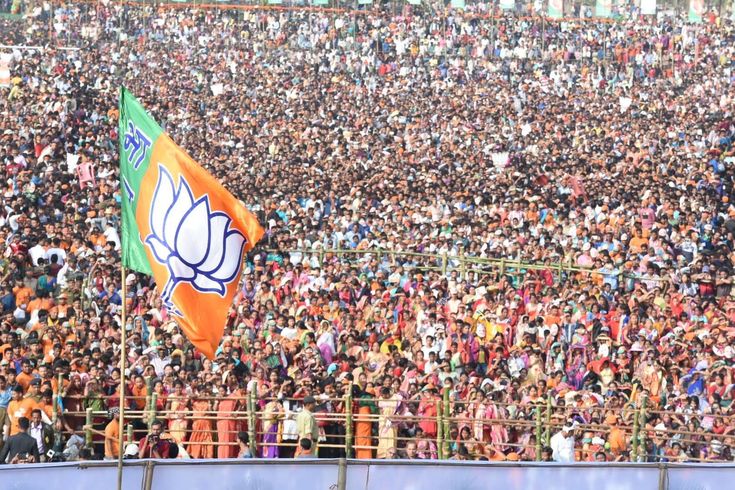
RSS marks its centenary in 2025 with a renewed focus on Hindutva and Indian culture, reflecting on its growth, challenges, and future goals in the coming decades (Photo: Pinterest)
NEW DELHI: The Rashtriya Swayamsevak Sangh (RSS) will, from this Vijayadashami (2 October), launch a national and international campaign marking its centenary year and preparing for the coming decades. It is true that the Sangh has changed with the times and challenges, but its commitment to Hindutva and Indian culture has remained constant. The RSS is known as a Hindu nationalist, volunteer organisation. On 27 September 1925, Dr. Keshav Baliram Hedgewar founded the organisation on Vijayadashami. There is no doubt that it is now considered the world's largest volunteer organisation. The RSS itself claims one crore members. It is also seen as the parent body of the BJP, the country's largest political party. In today's era, not just Indian society but the global community is watching the functioning and future of these organisations.
The RSS has established itself in India as a strong ideological and organisational force. Its decades-long shakhas, disciplined volunteers, and socially oriented programmes all give it a distinct identity. Yet with time, the Sangh has had to show flexibility in its image and thinking. From changing its uniform to adjusting ideas, the RSS has shown its willingness to move with the times.
The Sangh's real strength lies in its shakhas. In thousands of villages, towns, and cities of India, daily shakhas form the organisation's backbone. In the past decade, the number of shakhas has grown rapidly, with membership reaching close to one crore. Data shows that between 2014 and 2024, nearly 30% new shakhas were set up. Whether the uniform change of 2016 or the strategy for the centenary in 2025—the RSS today is not the same as before. This change is not confined to dress alone, it extends to its ideas, the nature of shakhas, relations with government, and its role in society. The Sangh today is not just an organisation, but an ideology and social force. Yet it is future generations who will decide whether this power becomes a vehicle of inclusivity, freedom, and social justice or remains bound to discipline, uniformity, and control.
In May 1977, as a correspondent for Hindustan Weekly, I conducted my first interview with senior RSS leader Nanaji Deshmukh on the issue of coexistence within the Janata Party. At that time, Nanaji emphasised that the ideas of the RSS and the Jana Sangh overlapped with those of the socialists. According to him, "The Sangh and the Jana Sangh have always stood for an egalitarian society and welfare programmes. Our programmes for public welfare have been no less revolutionary". Even then, debates about the RSS persisted among old Congress leaders and socialists. I also published interviews of leaders on "What non-RSS voices say about the RSS". Among them, socialist leader Rabi Roy and Arif Beg, a Muslim leader who had moved from the Socialist Party to the Jana Sangh, admitted that "the RSS is not a political organisation, nor does it interfere in government work". At that time, Arif Beg was also Union Minister of State for Commerce.
Atal Bihari Vajpayee, the senior-most leader of the RSS and the BJP, long before coming to power, told the editor of Navneet magazine in December 1963: "The paths of politics are slippery. One has to walk them very carefully. A slight imbalance can cause one to fall. Therefore, one must maintain great balance on these roads". This was proved true during his tenure as Prime Minister.
Every RSS programme begins with the chant: "Sangachchhadhwam samvadadhwam sam manamsi janatam. Deva bhagam yatha purve sanjanana upasate," which means: "Let us walk together, let us speak together, let our minds be one, just as the ancient gods lived together and worshipped together. May the Lord grant us such strength that the world can never challenge it, such purity of character that the entire world bows before it. May He grant us such knowledge that the thorny path we have chosen becomes smooth".
Similarly, the Sangh's main prayer begins with these lines: "Namaste sada vatsale matrubhume, tvaya hindubhume sukham vardhito'ham. Mahamangle punyabhume tvadarthe, patatvesha kayo namaste namaste". (O loving motherland! I bow to you always. You nurtured me with happiness. O great and sacred land! For your cause, I dedicate this body. I bow to you again and again) . This prayer has become not only an inseparable part of the Sangh's work but also its identity.
I can therefore say that from the tenure of Sarsanghchalak Madhav Sadashivrao Golwalkar (Guruji) to the present chief Mohan Bhagwat, I have had opportunities to witness the changes in RSS activities. Nearly 55 years ago, at the Jhandewalan office in Delhi, dedicated functionaries and pracharaks lived with great simplicity. Through Shri Chamanlal Ji, one might get to meet a senior office-bearer. Meals and tea were simple, taken sitting together on the floor. The Sangh had neither membership forms nor formal records. Contacts and addresses were kept in registers or diaries. Today, the RSS lacks neither volunteers, nor pracharaks, nor resources. Once, even ten or hundred rupees in
Guru Dakshina was significant. Now, affluent supporters contribute generously. That is why the RSS has today a grand Delhi headquarters and modern offices and guest houses in various states.
During the Emergency, when the Sangh was banned, hundreds of members were arrested nationwide. Yet countless dedicated pracharaks and volunteers continued underground, spreading information and ideas. I remember that in those days Narendra Modi was underground in Gujarat, preparing material and secretly distributing it. He held no post then, but worked as a volunteer. Disguised, he would carry news and literature to jailed RSS, Jana Sangh, and Socialist leaders. In Nagpur, Lucknow, and Delhi too, journalists with RSS backgrounds worked underground in similar ways.
The Emergency did not last long, and when the Janata Party government came to power in 1977, L.K. Advani became Information and Broadcasting Minister. After Atal Bihari Vajpayee, Narendra Modi, as Prime Minister, has also undertaken radical social and legal changes aligned with RSS ideals and goals, raising India to the ranks of global powers. Social and economic transformations are enhancing India's prestige worldwide. Yet, to guard India against fundamentalists and foreign conspiracies and to make it a "golden lion," the RSS, the Modi government, and society will all need to work hard for decades ahead.
