
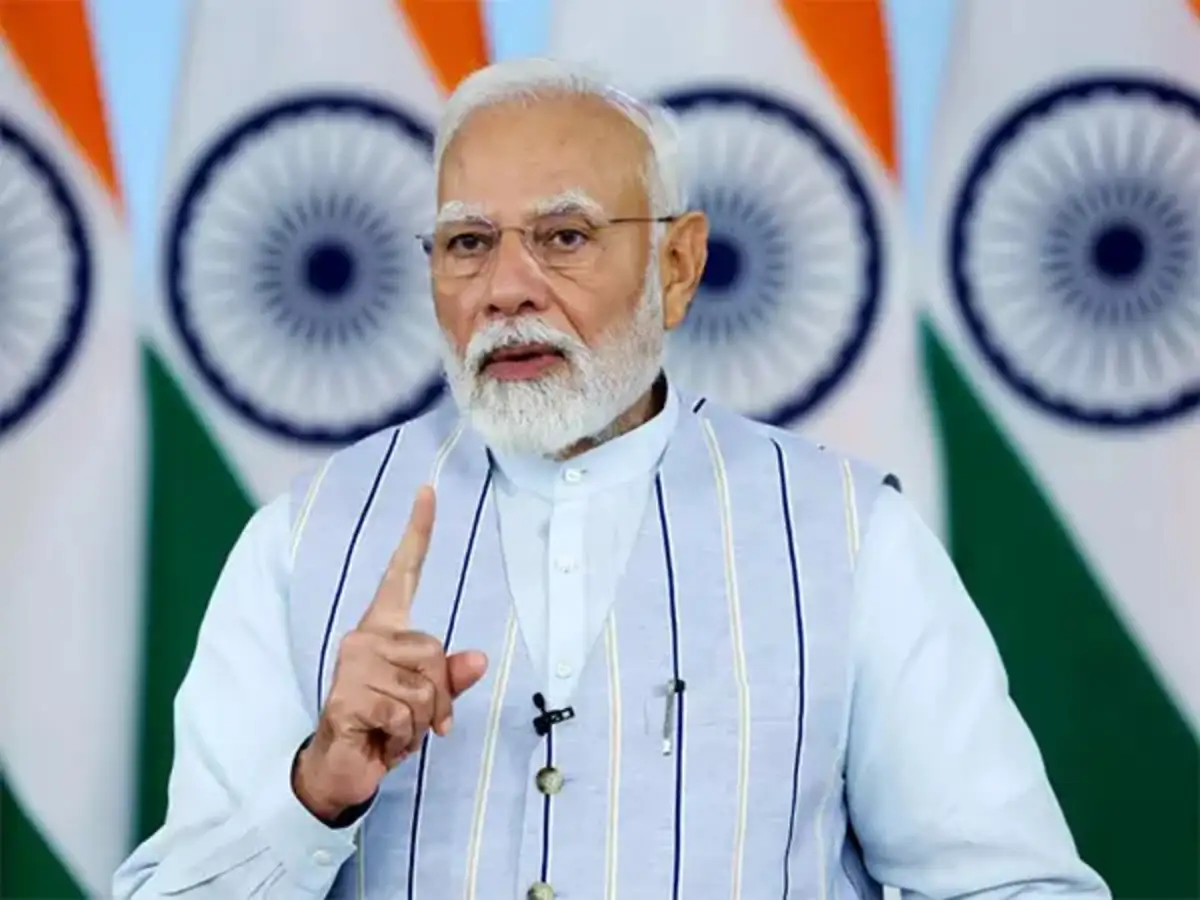
NEW DELHI: When Prime Minister Narendra Modi chaired the first PRAGATI meeting on 25 March 2015, less than one year after he had taken oath for the first time, the agenda itself revealed the platform’s governing logic. Crop loss compensation stuck with States. Provident fund and income tax grievances piling up on portals. Highways, rail lines, pipelines, metros, airports, school toilets, and ease of doing business reforms moving far slower than intended.
The problem was not policy scarcity. It was an execution failure, an official told the Sunday Guardian.
A decade later, with 50 meetings completed by December 2025, PRAGATI, which denotes “Pro-Active Governance And Timely Implementation,” has remained tightly anchored to that original diagnosis.
According to official data, PRAGATI has helped fast-track projects worth more than Rs 16 lakh crore, with 382 major national projects brought under systematic review and close monitoring. Of the 3,187 implementation issues identified, 2,958 have already been resolved, sharply reducing delays and cost overruns. Officials monitoring the development describe PRAGATI as a mechanism that enables real-time coordination between the Centre and States under direct Prime Ministerial supervision, strengthening accountability in a system otherwise prone to diffusion of responsibility.
From its inception, PRAGATI has not been used to announce schemes or unveil new policy frameworks. Its purpose has been narrower and more coercive. To force delivery of decisions already taken and funds already sanctioned, many of them stalled for years due to land acquisition disputes, forest and wildlife clearances, court cases, utility shifting, rehabilitation and resettlement issues, or poor coordination between ministries and States.
In that inaugural session, the Prime Minister directed States to expedite land transfer for the Navi Mumbai International Airport, complete Bangalore Metro works, hand over land for rail projects in Jharkhand and Assam, finish school toilets under Swachh Bharat within fixed deadlines, and fix systemic deficiencies in EPFO and Income Tax grievance redressal. Even then, the method was consistent. Identify the blockage. Assign responsibility to a specific ministry or State. Fix a date. That template has not changed across 50 meetings.
This newspaper reviewed details of 14 PRAGATI meetings held between 2021 and 2025 which showed a focus on hundreds of kilometre of highways and rail lines, freight corridors, metros, power transmission systems, irrigation projects, pipelines, mining expansions, health and education infrastructure, and welfare schemes. None of these discussions revolved around intent. Every discussion revolved around why execution on the ground was lagging. Crucially, officials point out that the Prime Minister’s direct oversight has ensured that projects stuck in any State, irrespective of which political party is in power, receive the same level of attention, administrative support, and execution push.
Significantly, PRAGATI minutes show no differentiation between States ruled by the Centre or opposition parties. Bottlenecks are addressed uniformly, deadlines imposed uniformly, and follow-up enforced uniformly, reinforcing the platform’s character as an administrative, not political, intervention.
One of the clearest shifts over time has been the tightening of accountability at the State level. Chief Secretaries have moved from coordinating participants to being principal owners of outcomes. States have repeatedly been directed to institutionalize PRAGATI-like mechanisms of their own, particularly for social sector schemes, and to personally monitor flagship projects.
In Gujarat, this translated into granular, time-bound monitoring of the Delhi-Mumbai Expressway and the Western Dedicated Freight Corridor. “PRAGATI reviews did not merely record delays. They broke projects into sequenced tasks. Handover of residual land parcels by specific months. Completion of road over bridges by set quarters. Resolution of level-crossing issues with precise deadlines. Broad assurances were replaced with milestone-wise compliance,” an official said.
In Maharashtra, PRAGATI meetings repeatedly flagged rehabilitation and resettlement as the central reason behind stalled rail and power projects. During reviews of the Western Dedicated Freight Corridor and thermal power projects, the State Government was explicitly directed to ensure that the shortcomings are addressed and complete private land acquisition within fixed dates.
To another similar mechanism, once the minister or the CM gives his observation about a particular stalled project, the same is resolved, no follow up happens, the bureaucrats are happy, the contractor is happy. However, under PRAGATI, projects recurred in subsequent meetings until progress was recorded, signalling that PRAGATI functioned as a persistence mechanism rather than a one-off review. With the PM himself overseeing this, officials and political leaders couldn’t escape responsibility,” another official recalled.
The mechanism operates through a rigorous six-tier escalation hierarchy to ensure accountability. At Level 0, User Agencies and Line Ministries upload projects, issues, or milestones to the PMG Portal. The Project Monitoring Group (PMG) Lead at Level 1 then comprehends and discusses these issues with implementing agencies, relevant ministries, and recipient states. At Level 2, the Secretary of DPIIT reviews both public and private projects and issues. The Cabinet Secretariat, via the Secretary (Coordination), handles Level 3 reviews for delayed projects and PRAGATI projects with critical issues. Level 4 involves a Monitoring Group in the PMO, led by the Minister, who reviews projects with critical issues and other specific mandates. Finally, Level 5 sees the Prime Minister personally review projects of national importance facing persistent issues.
Data across major sectors highlights that Land Acquisition remains the primary hurdle, accounting for 53% of resolved issues in the Ministry of Road Transport and Highways and 50% in the Ministry of Railways.
In Uttar Pradesh, PRAGATI pushed for a compartmentalized execution logic. For projects such as the Delhi-Meerut Expressway and the Ghatampur Thermal Power Project, ministries and the State Government were instructed to operationalize completed sections instead of waiting for entire corridors or platforms to be finished. This parallel execution approach, opening usable stretches while work continued elsewhere, was later cited as a model for other large infrastructure projects.
In Chhattisgarh, reviews of rail projects such as the Gevra Road-Pendra Road line revealed prolonged land acquisition delays. Here, PRAGATI went further than coordination. The Cabinet Secretary was directed to prepare a list of substantially delayed projects and identify the authorities responsible for the delays. Responsibility attribution became explicit, marking a shift from systemic diagnosis to administrative accountability.
Details accessed by this newspaper showed how in Arunachal Pradesh and Sikkim, governance constraints were of a different order. Transmission strengthening projects were delayed by terrain, forest clearances, and right-of-way disputes. PRAGATI minutes show unusually detailed monitoring. Completion deadlines were staggered, March 2022 for Sikkim and March 2024 for Arunachal Pradesh. States were directed to resolve specific numbers of pending issues, including 14 environment clearance cases in Arunachal Pradesh and 107 right-of-way locations in Sikkim. The specificity reflected close central tracking rather than abstract oversight. “Bottlenecks were identified, solutions devised collectively and accountability was fixed so that officials cannot escape responsibility by saying that things were not in their hands,” the official quoted above said.
Strategic connectivity projects were treated as non-negotiable. In Manipur, the four-laning of the Senapati-Imphal section of NH-02, explicitly linked to the Act East Policy, was pushed with firm instructions to resolve land acquisition issues across all packages within months. The project was framed not merely as a road but as a strategic corridor, and delays were treated accordingly. Those officers who repeatedly failed to execute the directions were identified.
The focus on hard infrastructure is underscored by sectoral achievements. In the Ministry of Road Transport and Highways, 1,960 issues were resolved across 1,403 projects, with 488 projects commissioned and 917 currently under implementation. The Ministry of Railways saw 1,417 issues resolved out of 1,563 identified, with 158 projects successfully commissioned.
In the Ministry of Power, where 237 projects out of 416 have been commissioned, the primary resolution focus was on Power/Utility approvals at 33%, Land Acquisition at 24%, and Forest/Wildlife/Environmental clearances at 13%.
PRAGATI’s enforcement logic has also extended into welfare delivery. Under One Nation One Ration Card, States such as Assam and Chhattisgarh were given hard deadlines for Aadhaar seeding, installation of ePoS devices, and transition to Aadhaar-based distribution. These were framed not as pilots but as mandatory compliance milestones.
Urban projects offer another lens into PRAGATI’s functioning. In cities including Delhi, Patna, Bhopal, Indore, Agra, Kanpur, and Bengaluru, metro projects were reviewed alongside explicit warnings that delays in rehabilitation and resettlement of project-affected families would undermine ease of living. Speed of construction without social compliance was repeatedly flagged as unacceptable.
Technology has been a constant across meetings, but not as decoration, the minutes suggest.
From the first meeting’s insistence on fixing EPFO and Income Tax portals to later directives on Aadhaar-based authentication, PM GatiShakti dashboards, satellite imagery, and analytics-driven grievance monitoring technology has been positioned as an enforcement instrument. The objective has been to reduce discretion, detect delays early, and enable continuous tracking across the project life cycle.
More than one decade later, hard infrastructure continues to dominate PRAGATI’s agenda. Roads, railways, expressways, freight corridors, metros, power transmission lines, pipelines, ports, irrigation, and mining projects form the bulk of reviews. Social sector schemes are treated differently but no less rigorously. Whether it is school toilets in 2015, PM SVANidhi, PM-ABHIM health infrastructure, PM-SHRI schools, or Poshan Abhiyaan, the emphasis is on saturation, quality, and measurable outcomes.
What PRAGATI has consistently avoided over 50 meetings is equally revealing.
There is little ideological framing, minimal political messaging, and almost no ceremonial language. Action points are dominated by dates, numbers, and named authorities. Delays are repeatedly described as imposing a double cost: escalating project expenditure and denial of timely services to citizens.
From the first meeting’s insistence on completing school toilets by June 2015 to the 50th meeting’s push for technology-driven monitoring across every phase of the project life cycle, the underlying assumption has remained unchanged. Policy intent without delivery is governance failure.




