
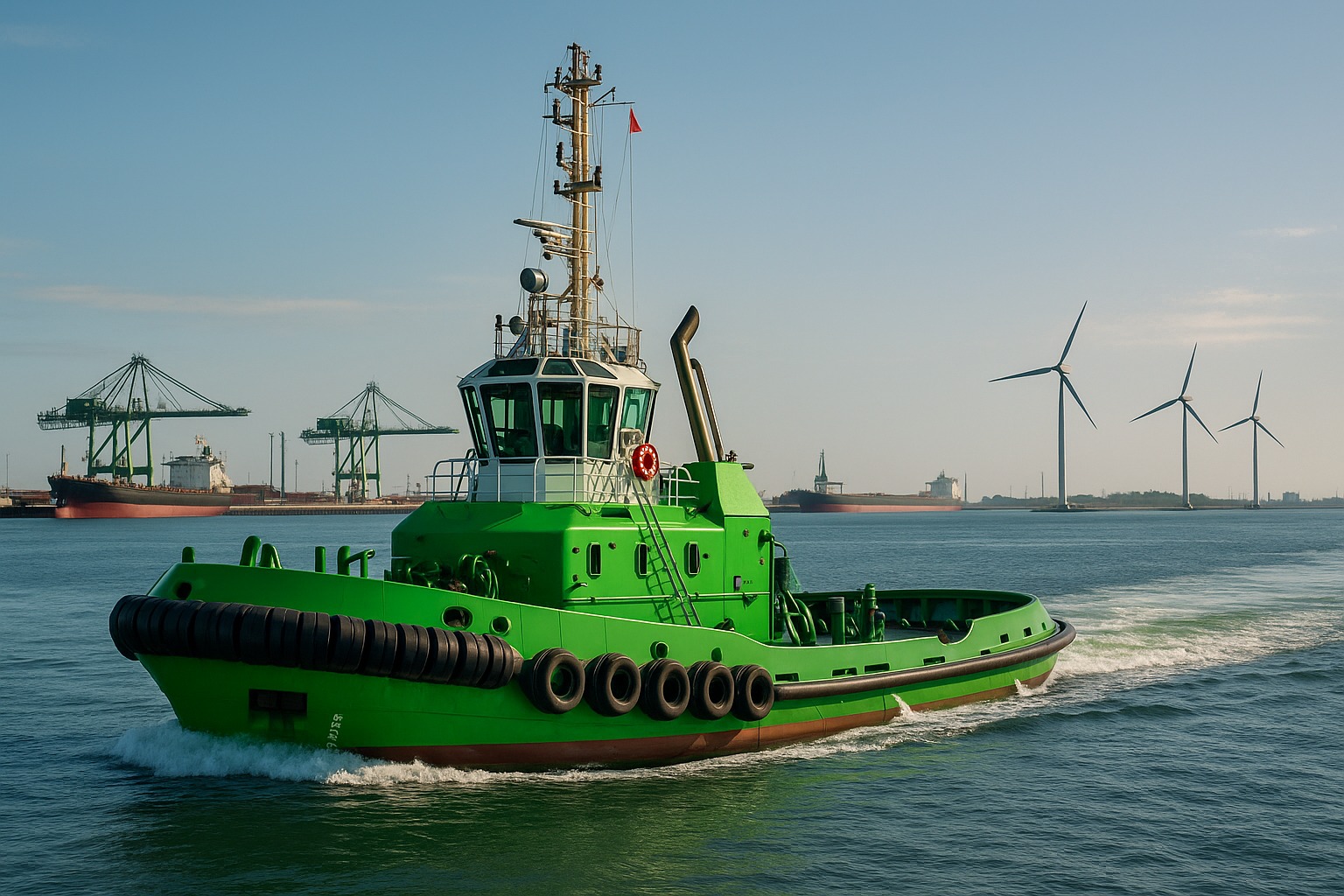
India’s announcement of the Green Tug Transition Programme (GTTP) in May 2023, aimed at replacing conventional harbour tugs with vessels powered by cleaner alternative fuels such as hydrogen, ammonia, and methanol, marked a significant step towards positioning itself as a global hub for green shipbuilding. This initiative closely aligned with Prime Minister Narendra Modi’s vision of a sustainable maritime economy, as declared at the Global Maritime India Summit the same year, attracting record investments of over ₹2.37 lakh crore ($28 billion).
Yet, by July 2025, progress on the ground remains limited. Despite the existence of capable domestic shipyards, validated vessel designs, indigenous battery systems, and emerging charging infrastructure, not a single green tug is operational at the designated major ports—Jawaharlal Nehru Port, Deendayal Port, Paradip Port, and V.O. Chidambaranar Port.
This delay cannot be attributed to technological inadequacy or insufficient industrial capabilities. Rather, it reflects critical gaps in the strategic implementation model and highlights vulnerabilities arising from reliance on imported technologies.
Implementation Misalignment
At the heart of the delay lies the decision to delegate technology selection, adoption, and operation to third-party charter operators via tenders. This method, theoretically attractive due to its reduced capital expenditure and operational efficiency, has, in practice, hindered rather than accelerated the transition. Tender conditions, notably the short deployment timeframes of six months for conventional interim solutions, have inadvertently created barriers for new entrants, which in turn have elevated charter rates, diminished competition, and slowed innovation.
This strategic oversight is exemplified by the hesitation of prominent state-owned maritime enterprises in participating in electric tug tenders, reflecting reluctance to engage in uncertain technological pathways without direct government involvement. Such hesitance emphasises the risk of fragmented technology adoption and the absence of uniform standards and quality control, contrary to the government’s strategic ambitions.
Global Benchmarks and India’s Lag
Globally, the maritime electrification market is experiencing significant growth. Europe, led by Norway and Denmark, is aggressively electrifying port operations and maritime fleets through structured collaboration between government and industry. Singapore has also forged international partnerships, including one with Norway, to rapidly deploy fully electric, high-speed harbour vessels.
These nations demonstrate that coordinated government leadership, explicit local manufacturing mandates, and strategic international collaboration are essential ingredients for success. In comparison, India’s current model, heavily reliant on market-driven forces without adequate governmental steering, positions it at risk of losing its strategic advantage, becoming dependent on external technological sources, and missing substantial economic opportunities.
Economic Opportunity and Domestic Imperatives
India’s maritime industry holds immense economic potential. The government’s Union Budget 2025 includes initiatives such as new mega shipbuilding clusters and a Maritime Development Fund (₹25,000 crore) aimed explicitly at boosting domestic manufacturing. Yet, the absence of clear phased “Make in India” mandates in the Green Tug initiative permits cheaper imports, notably from Chinese suppliers, which undermines these objectives and places domestic shipbuilders at a disadvantage.
Experts suggest a phased approach, initiating the Green Tug project with at least 50% indigenous content and progressively increasing the domestic component as production and technological capabilities mature. This approach will significantly bolster employment, technology innovation, and domestic economic activity, substantially contributing towards India’s ambitious vision of becoming a $30 trillion economy by 2047.
Strategic Risks and Cybersecurity Concerns
Dependence on imported maritime technology, particularly from geopolitical rivals such as China, introduces profound vulnerabilities. Cybersecurity risks, supply chain disruptions, and operational dependencies pose threats not only to the maritime sector but also to national security and strategic autonomy. Instances globally demonstrate that technological sovereignty is essential for safeguarding critical national infrastructure, particularly in sectors vital to economic stability.
A Structured Path Forward
The solution demands immediate strategic realignment, beginning with the explicit inclusion of phased “Make in India” mandates within tender specifications. Direct government engagement through structured technology demonstration programmes and pilot projects with shipyards instead of charterers must replace the current hands-off approach. India’s shipyards already possess advanced Industry 4.0 capabilities capable of delivering hybrid and fully electric propulsion systems domestically.
Moreover, accelerating the indigenous development of marine-grade Battery Energy Storage Systems (BESS) and port-side megawatt-scale charging infrastructure, integrated with renewable energy sources, should become a central policy priority. Simultaneously, aligning regulatory frameworks and national standards with global maritime sustainability benchmarks will ensure the domestic maritime industry remains competitive internationally.
The original vision behind India’s Green Tug Transition Programme remains robust, ambitious, and achievable. However, without swift and strategic intervention, the initiative risks becoming a cautionary example of how operational misalignment can undermine sound policy objectives. Realigning strategic intent with effective execution will not only enable India to regain its momentum in maritime electrification, but also enhance its competitiveness. Still, it will also solidify its position as a global leader in sustainable maritime technology, securing its economic, environmental, and technological sovereignty for decades to come.
(Aritra Banerjee is a maritime & strategic affairs columnist)




