PM Modi and New Zealand PM Christopher Luxon announce conclusion of India–New Zealand FTA, boosting trade, investment and strategic cooperation between the two nations.
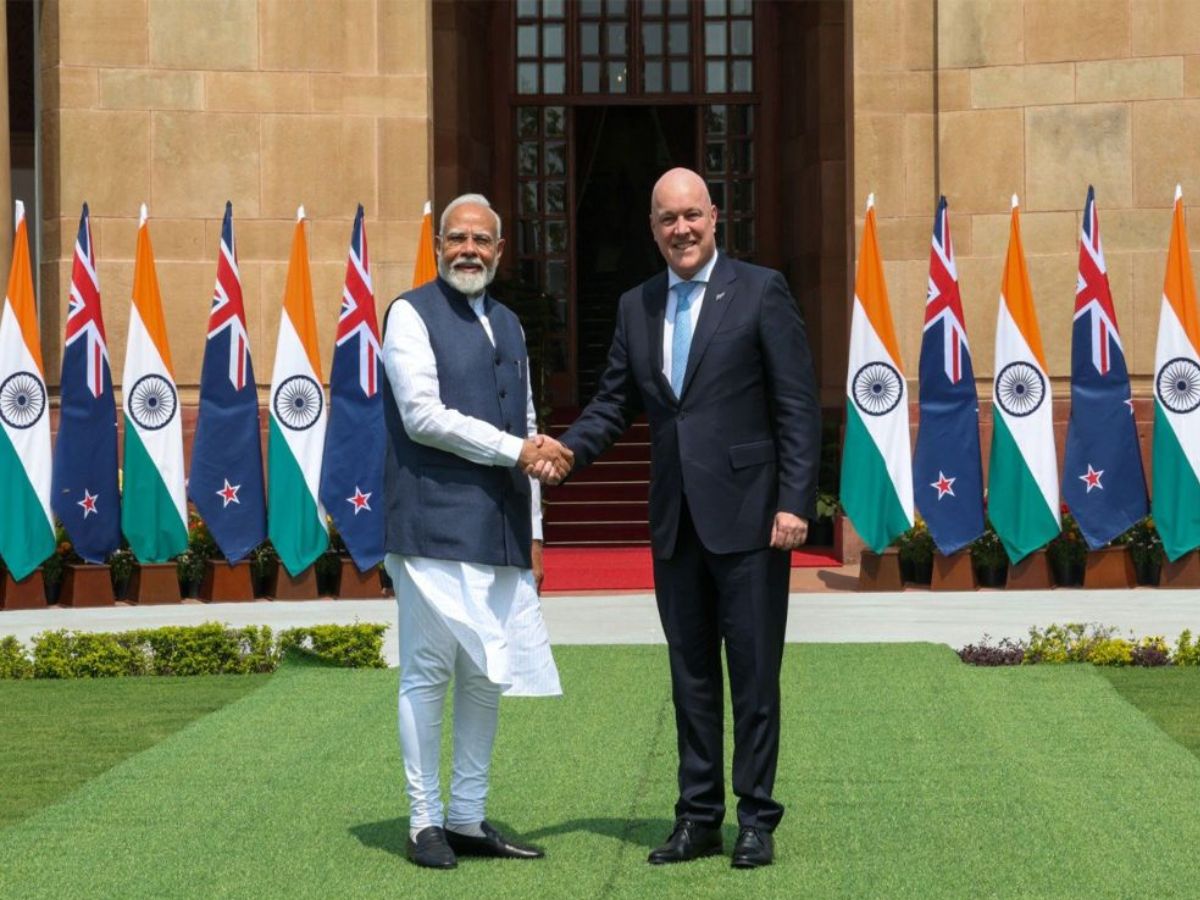
PM Modi and New Zealand PM Christopher Luxon [Photo: X]
New Delhi: Prime Minister Narendra Modi on Monday held a telephone conversation with New Zealand Prime Minister Christopher Luxon, during which the two leaders jointly announced the conclusion of a landmark India–New Zealand Free Trade Agreement, further expanding India’s rapidly growing network of trade partnerships.
Negotiations for the agreement were initiated during Prime Minister Luxon’s visit to India in March 2025 and concluded in a record nine months.
The leaders said the pace of negotiations reflected strong political will and shared strategic intent to deepen bilateral ties.
Officials told this newspaper that the FTA is expected to significantly enhance market access, promote investment flows, strengthen strategic cooperation and create new opportunities for businesses, farmers, MSMEs, innovators, students and youth in both countries.
With the agreement in place, both sides expressed confidence in doubling bilateral trade over the next five years.
They also welcomed New Zealand’s long-term investment plans, projecting investments of USD 20 billion into India over the next 15 years. Progress in other areas of cooperation, including defence, sports, education and people-to-people ties, was also reviewed, with the two leaders reaffirming their commitment to strengthening the overall partnership.
The India–New Zealand agreement becomes India’s seventh free trade or equivalent trade agreement concluded in recent years, following deals with Mauritius, the United Arab Emirates, Australia, the EFTA countries, the United Kingdom and Oman.
Together, these agreements underscore a decisive shift in India’s trade policy under Prime Minister Modi, marking a clear break from the caution that defined New Delhi’s approach to FTAs for much of the previous decade.
As analysed earlier in The Sunday Guardian, India’s recent FTA push reflects a recalibrated strategy that balances selective market opening with protection for sensitive domestic sectors.
Since 2021, New Delhi has pursued targeted trade partnerships with economies that offer access to capital, technology, critical supply chains and export diversification, rather than broad, indiscriminate liberalisation.
The agreements signed in this period have each served distinct strategic purposes. The pact with the UAE provided Indian exporters preferential access to a major regional trade hub, while the Australia agreement strengthened links in minerals, education and services. The EFTA deal was notable for anchoring tariff concessions to long-term investment commitments, and the UK agreement signalled India’s readiness to engage advanced economies on negotiated, reciprocal terms. The Oman agreement further deepened India’s economic footprint in the Gulf.
This trade diplomacy has also been closely aligned with India’s broader foreign policy posture. FTAs are increasingly being used not merely as commercial instruments, but as frameworks for deeper strategic alignment, encompassing defence cooperation, digital connectivity, education and people-to-people engagement.
The India–New Zealand FTA fits squarely within this approach. By pairing trade liberalisation with cooperation in education, sports, innovation and strategic domains, the agreement reinforces India’s post-2014 model of embedding economic engagement within a wider geopolitical and developmental context.
With seven FTAs concluded in a relatively short span and several more under negotiation, India’s trade policy under the present dispensation has moved decisively from hesitation to consolidation, positioning free trade agreements as a central pillar of New Delhi’s long-term economic and strategic calculus.
