
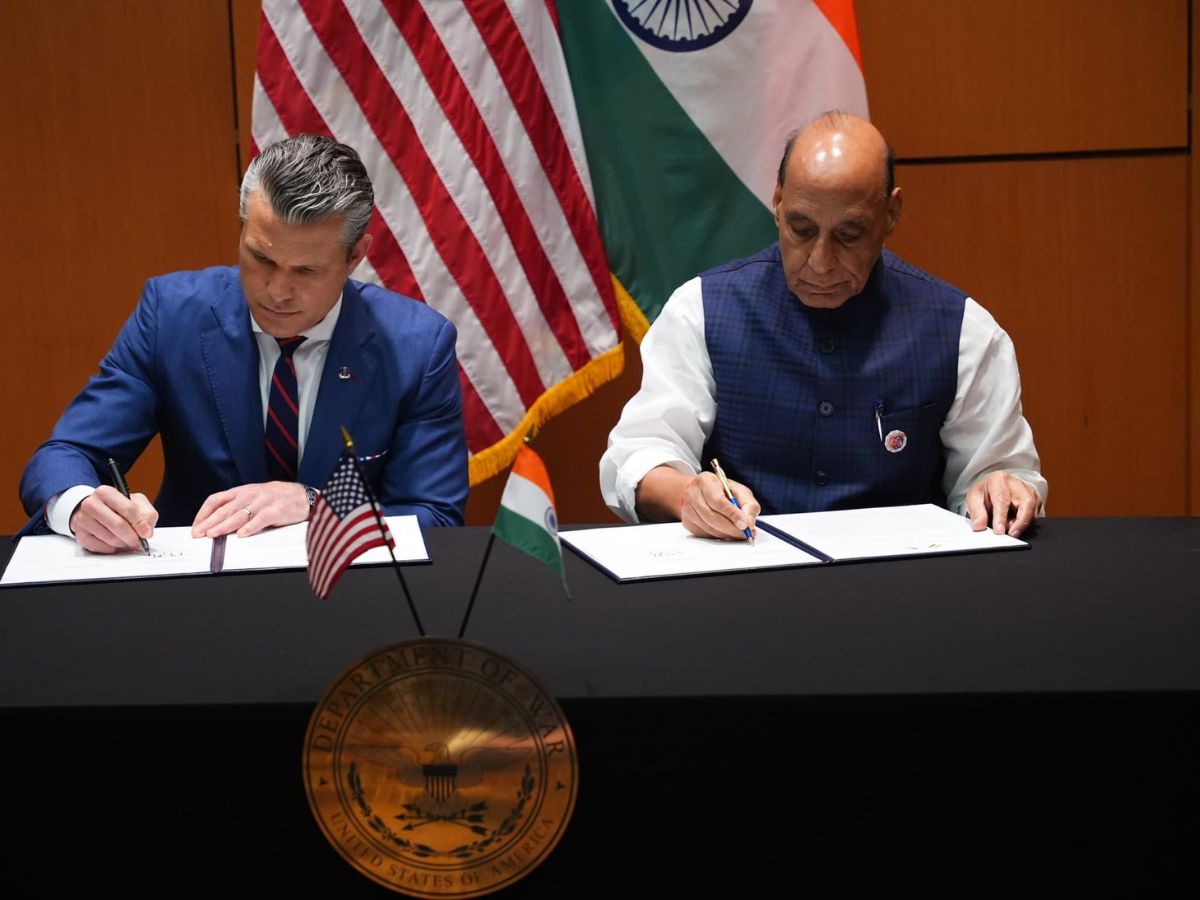
New Delhi: India and the United States signed a landmark 10-year defense framework agreement on Friday, marking a significant deepening of their strategic partnership in the Indo-Pacific region.
The pact aims to enhance military coordination, intelligence sharing, and technological collaboration between the two nations. It comes as both countries seek to counter their own respective threats.
Defense Minister Rajnath Singh and U.S. Secretary of Defense Pete Hegseth exchanged the agreement during bilateral talks on the sidelines of the ASEAN Defence Ministers’ Meeting-Plus. The deal renews and expands the 2015 framework that expired earlier this year.
“This will usher in a new era in our already strong defence partnership,” Singh said in a statement on X, emphasizing the agreement’s role in providing “policy guidance for deeper collaboration.”
Hegseth echoed the sentiment, posting: “This advances our defense partnership, a cornerstone for regional stability and deterrence. We’re enhancing our coordination, info sharing, and tech cooperation. Our defense ties have never been stronger.”
The Framework for the U.S.-India Major Defense Partnership extends cooperation through 2035 without formal treaty obligations. This structure preserves India’s strategic autonomy while aligning with U.S. priorities in South Asia.
Analysts view the agreement as a pragmatic response to shared challenges, including border tensions along the India-China Line of Actual Control and Beijing’s territorial claims in the South China Sea.
“This agreement solidifies India and the United States as key strategic partners in the Indo-Pacific,” noted a readout from India’s Ministry of Defence, highlighting its alignment with ASEAN frameworks.
While the full text remains classified, official statements and expert commentary outline four primary focus areas. The agreement provides for real-time intelligence exchanges and joint military planning to improve interoperability, building on existing pacts like the Logistics Exchange Memorandum of Agreement, which facilitates mutual access to bases and supplies during operations.
The deal accelerates sharing of advanced systems in artificial intelligence, drones, cyber defense, space technologies, and missile systems. It eases U.S. export controls, potentially unlocking sales of fifth-generation fighters and subsystems while supporting India’s “Make in India” initiative for indigenous defense production.
The framework also streamlines arms deals, joint research and development, and manufacturing initiatives. This aims to boost India’s defense exports and reduce reliance on traditional suppliers like Russia. Pending U.S. sales—including Boeing P-8I maritime patrol aircraft and Apache helicopters—are expected to gain momentum.
Additionally, the agreement expands joint exercises such as Malabar, involving Quad partners (the U.S., India, Japan, and Australia), alongside humanitarian assistance drills. It also strengthens counter-terrorism efforts and supply chain resilience against global disruptions.
The signing comes despite deteriorating U.S.-India trade relations. In August 2025, President Donald Trump imposed steep tariffs on Indian goods over New Delhi’s purchases of discounted Russian oil.
Trump signed an executive order on August 27 doubling tariffs to 50% on most Indian exports—among the highest rates levied by the U.S. on any trading partner. The tariffs target sectors including textiles, gems, jewelry, leather, and chemicals, threatening $48.2 billion in annual trade.
This escalation followed an initial 25% tariff in April 2025 and another increase in early August, framed as punishment for India’s strategic oil imports from Russia amid the Ukraine conflict.
Yet the defense pact demonstrates how strategic imperatives can insulate military ties from economic frictions. Hegseth described the partnership as “built on shared interests, mutual trust, and commitment to a secure and prosperous Indo-Pacific,” suggesting Washington is prioritizing Indo-Pacific deterrence over trade disputes.
The agreement follows several high-level engagements, including Singh and Hegseth’s July phone call and Prime Minister Narendra Modi’s February White House visit with Trump. During that visit, the two leaders announced “Mission 500,” aiming for $500 billion in bilateral trade by 2030—a goal now strained but not abandoned in the defense sector.
India has pledged increased U.S. fuel and defense purchases to ease tensions. U.S. Energy Secretary Chris Wright recently offered American energy as an alternative to Russian supplies, hinting at a carrot-and-stick approach.
Industry estimates suggest the framework could unlock $10-15 billion in bilateral defense trade over the decade. India, the world’s largest arms importer, now sources about 25% of its weaponry from the U.S., up from negligible levels a decade ago.
For Washington, the partnership diversifies supply chains away from China and bolsters a strategic counterweight in Asia.
The defense agreement underscores how U.S.-India relations remain compartmentalized—strong in defense and security cooperation, yet strained in trade and economic matters. Rather than signaling an overall improvement in bilateral ties, the pact demonstrates both nations’ ability to prioritize strategic alignment on Indo-Pacific security even as economic disputes persist. This pragmatic approach allows critical defense partnerships to advance independently of the tariff tensions that continue to challenge the broader relationship.




