
NEW DELHI: For the past three decades, India’s aviation industry has symbolised both the ambition to fly and the compulsion to fall. After economic liberalisation in the 1990s, the era of private airlines began. For the first time, people saw air travel break free from royal luxury and enter the reach of the common middle class.
But this story was never simple. While state-run companies like Indian Airlines and later Air India remained stuck in losses due to corruption, poor management and political interference, private brands such as Kingfisher, Jet Airways, Sahara Airlines and others gradually sank under bankruptcy, debt, irregularities and investigations after an initial period of glamour.
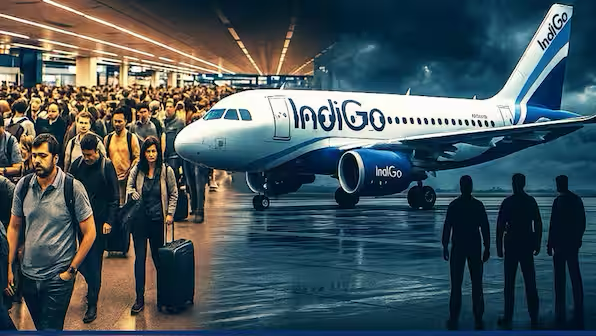
Today, when IndiGo once considered the strongest and most efficient airline model in India is grappling with cost pressures, operational challenges and market volatility, it is natural to ask where exactly is the flaw in Indian aviation? And who is responsible for this flaw company owners, regulators, policymakers or the entire system?.
For a long time, IndiGo was called a model case study in Indian aviation. Started in 2006 by founders Rahul Bhatia and Rakesh Gangwal who did not come from major aviation backgrounds, the airline was considered a set of new players in the industry, yet their strategy was extremely aggressive and professional.
A single aircraft model—A320/A321, on-time flights, low fares and rapid fleet expansion pushed IndiGo to more than 50% of the domestic market share. But today IndiGo is facing new challenges: rising operational costs (fuel, airport charges and maintenance inflation), shortage of pilots and cabin crew, high duty-time pressure, technical issues such as strike threats, hundreds of flight cancellations and grounded aircraft due to engine disputes, and uncertainty in international expansion.
Then there is a new wave of competition Tata Group’s Air India with Singapore Airlines, and carriers like Akasa posing fresh challenges. Air India itself is far from fully successful and its challenges are growing. IndiGo may not be in a financial collapse yet, but falling profits and operational disruptions clearly indicate that even India’s strongest brand is at risk of crisis.
The cycle of losses in government-run airline services never really stopped. The reasons for the failures have been discussed for decades: political interference, corruption in procurement, expensive aircraft deals, inefficient management, excessive staff strength, allegations of corruption and pressure from foreign route obligations.
Air India’s situation became so bad that the government had to spend thousands of crores every year in subsidies and assistance to keep it afloat. Finally, in 2022, the government relieved itself of the burden by selling it to the Tata Group.
Private airlines attracted passengers in the beginning with dazzling advertisements, model-based promotions and a luxury image. But the downfall of many companies accelerated due to disorganised business models, uncontrolled expansion, debt and regulatory leniency.
Kingfisher was once called India’s five-star airline. Excessive spending, an expensive branding model and the wrong acquisition—Air Deccan—pushed Kingfisher into a mountain of debt. More than Rs 7000 crore in bank loans, pending taxes, unpaid staff salaries and numerous investigations and legal disputes pushed the company into collapse.
Vijay Mallya faced cases of money laundering and bank fraud, eventually fleeing the country and becoming a symbol of financial fugitives in India. Similarly, Sahara Airlines became popular in the 1990s but gradually faced financial disputes and regulatory pressure. It was eventually sold to Jet Airways. The Sahara Group faced large-scale SEBI cases, and Subrata Roy spent long periods in jail.
Jet Airways, once India’s most prestigious private airline, collapsed between 2015 and 2018 due to rising costs, dangerous levels of debt and internal management conflicts. Owner Naresh Goyal faced cases involving financial irregularities, foreign funding investigations and money laundering, ultimately landing in jail.
The shutdown of Jet caused massive losses to millions of passengers, thousands of employees and numerous supply-chain companies. India’s aviation regulator and the Ministry of Civil Aviation have long faced questions regarding their oversight.
There was a lack of timely intervention. Several airlines showed poor financial indicators for many years, yet regulators acted too late. During winter fog or low-visibility conditions, pilots require specialised training. But this training is expensive, so many private airlines avoided providing it adequately.
Regulators issued advisories many times but rarely took strict action. Safety inspections remained mostly formalities. Furthermore, under pressure, airline licences were hurriedly issued, and even companies with weak commercial models were allowed to fly. These weaknesses threw Indian aviation into danger even before take-off.
Another major issue is the extreme dependence of Indian airlines on foreign leasing companies and dollar-based costs, which increases financial risk. And whenever an airline shuts down, passengers’ money gets stuck, tickets are cancelled, fares suddenly skyrocket and employees lose their jobs.
The shutdowns of Kingfisher, Jet and Sahara caused huge losses to the public and this cycle keeps repeating, only the names change. The roots of India’s aviation crisis lie here: costs are very high, fares are very low. Companies keep offering cheap tickets for long periods to capture the market, but losses keep growing.
Costs are in dollars, revenue is in rupees—fuel, leasing, engines, maintenance all are paid in dollars while income is earned in rupees. DGCA’s monitoring has not been strong. In government airlines, this problem has been permanent.
The revival of Air India under the Tata Group gives a glimmer of hope. IndiGo is still a large and important airline, but it must adapt its strategy to the new era. New airlines like Akasa emphasise simplicity and efficiency.
But unless the DGCA strengthens real oversight, pilot training improves, financial transparency increases, the relationship between politics and aviation becomes clean, and public protection mechanisms are established when companies collapse, India’s aviation industry will not escape this cycle of rise and fall.
Aviation is not just about flying; it is about the trust passengers place each time they hand over their lives. If this trust keeps breaking repeatedly, the price will not be paid by airlines alone—the entire country will suffer.




