The Indo-Pacific Regional Dialogue (IPRD) 2025, anchored in Prime Minister Narendra Modi’s MAHASAGAR vision, brought together global maritime leaders from over 30 nations to discuss holistic security and regional cooperation.
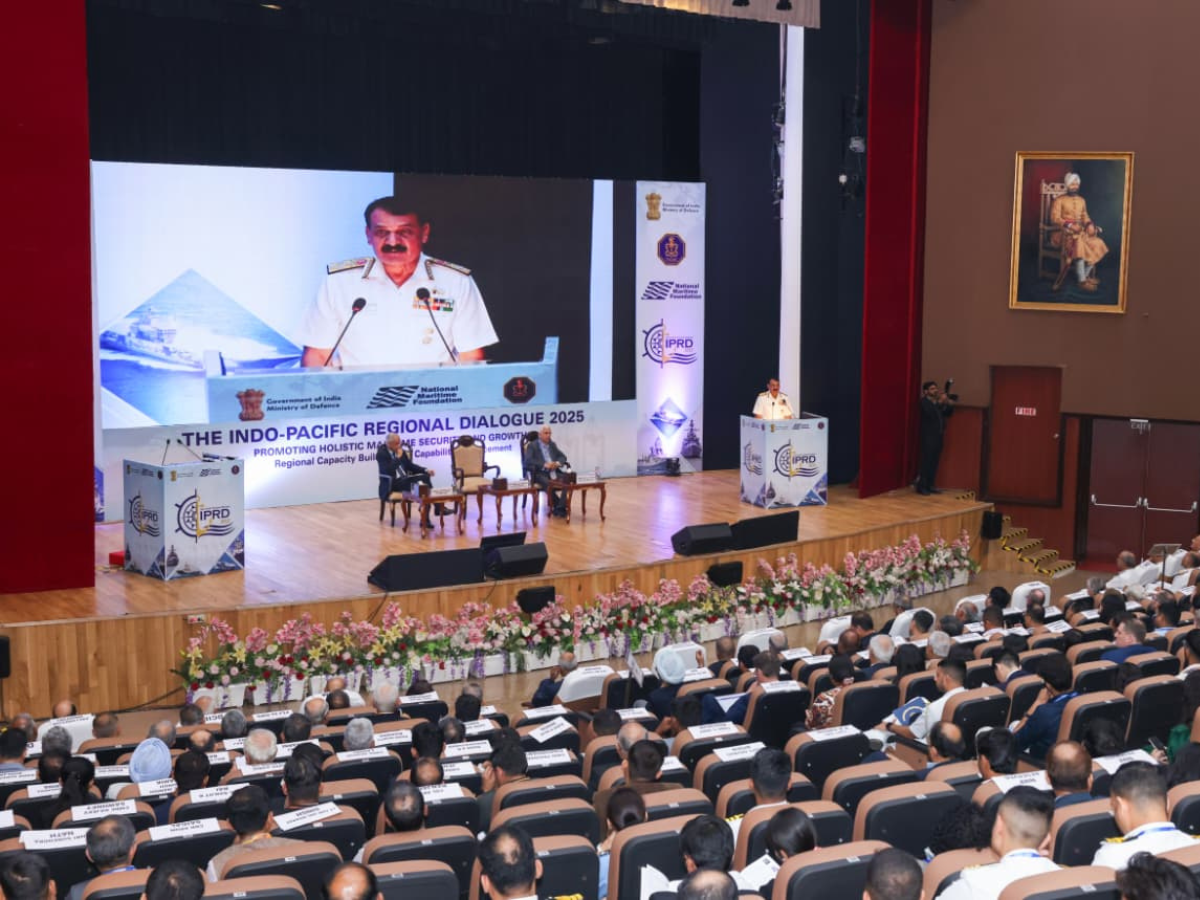
The Indo-Pacific Regional Dialogue (IPRD) 2025, anchored in Prime Minister Narendra Modi’s MAHASAGAR vision, brought together global maritime leaders from over 30 nations to discuss holistic security and regional cooperation.
NEW DELHI: The Indo-Pacific Regional Dialogue (IPRD) 2025 has brought together policymakers, strategists and naval leaders from more than 30 countries. In his video address, Chief of the Naval Staff Admiral Dinesh K Tripathi urged nations to “share ideas for building a safer, stronger and more prosperous maritime order.”
He called the Dialogue “a premier platform for the nations of the region to come together, share perspectives and explore new opportunities for cooperation under the Indo-Pacific Oceans Initiative.”
Framing the event within Prime Minister Narendra Modi’s MAHASAGAR vision—Mutual and Holistic Advancement for Security and Growth Across Regions—the Navy Chief said its theme, “Promoting Holistic Maritime Security and Growth through Regional Capacity-Building and Capability-Enhancement,” was “both timely and apt.”
“MAHASAGAR places capacity-building at the heart of our collective maritime progress,” he said. “It encourages cooperation among like-minded nations to ensure shared security and prosperity.”
Admiral Karambir Singh, Chairman of the National Maritime Foundation (NMF) and former Navy Chief, described India’s maritime vision as “a civilisational ethos turned strategy.”
“Security is not an instrument of influence but an extension of our civilisational ethos — Vasudhaiva Kutumbakam, the world as one family,” he said.
Tracing India’s continuum from SAGAR (2015) to MAHASAGAR (2023), he explained:
"From SAGAR to MAHASAGAR, India’s guiding principle has remained consistent — ensuring that regional security and growth are shared."
He identified four guiding principles — Communication, Collaboration, Customisation and Credibility — as the “foundation of credible cooperation” in the Indo-Pacific, adding that IPRD has become “the intellectual complement to India’s operational engagements.”
Vice Admiral Pradeep Chauhan (Retd), Director-General of the NMF, underlined that India views the Indo-Pacific as “a strategic geography, not a strategy against someone.”
“It is a geography of opportunity where connectivity, cooperation and collaboration should always trump competition, confrontation and conflict,” he said.
He recalled that IPRD was created in 2018 as a listening platform enabling nations to share perspectives. Chauhan described the Indo-Pacific Oceans Initiative (IPOI) as “a deeply interconnected web of seven spokes,” with IPRD providing “second- and third-order specificity” to translate those pillars into practical cooperation.
“The substitution of ‘region’ in SAGAR with ‘regions’ in MAHASAGAR signals India’s readiness to play a constructive maritime role beyond the Indian Ocean — across the world’s single, interconnected ocean,” he said.
Vice Admiral Sanjay Vatsayan, Vice Chief of the Naval Staff, described “capacity building meets capability enhancement” as the operational essence of India’s partnerships.
“Capacity building strengthens the physical and institutional enablers of maritime security — ships, radar chains, infrastructure. Capability enhancement advances the human and operational dimensions — training, exercises, hydrography and joint EEZ surveillance. Together they ensure that capacities created are effectively employed and sustained,” he told The Sunday Guardian.
He highlighted recent initiatives such as the Indian Ocean Ship SAGAR deployment of 2024, the Africa-India Key Maritime Engagement (AIKEYME) exercise in Tanzania, and MAITRI, a modular training programme using containerised simulators.
“Training remains the bedrock of our engagement. It ensures that cooperation translates into operational competence, not dependency,” he said.
Together, the Navy’s leadership has articulated a single message: India’s strength lies in cooperation. Admiral Tripathi’s call for inclusivity, Admiral Singh’s civilisational perspective, Vice Admiral Chauhan’s strategic framework and Vice Admiral Vatsayan’s operational execution together define India’s maritime decade.
“The Indo-Pacific is changing fast,” Admiral Tripathi warned. “Maritime-security challenges, climate change and supply-chain disruptions are reshaping the region — demanding fresh ideas, stronger partnerships and smarter strategies.”
With IPRD 2025, India positions itself as the maritime integrator of the Indo-Pacific — a nation whose influence is measured not by the number of ships at sea, but by the confidence of those who sail beside them.
