Prime Minister Narendra Modi announces the political conclusion of the India–EU Free Trade Agreement at the India–EU Summit, marking India’s largest and most comprehensive trade deal with a USD 17-trillion European Union economy.
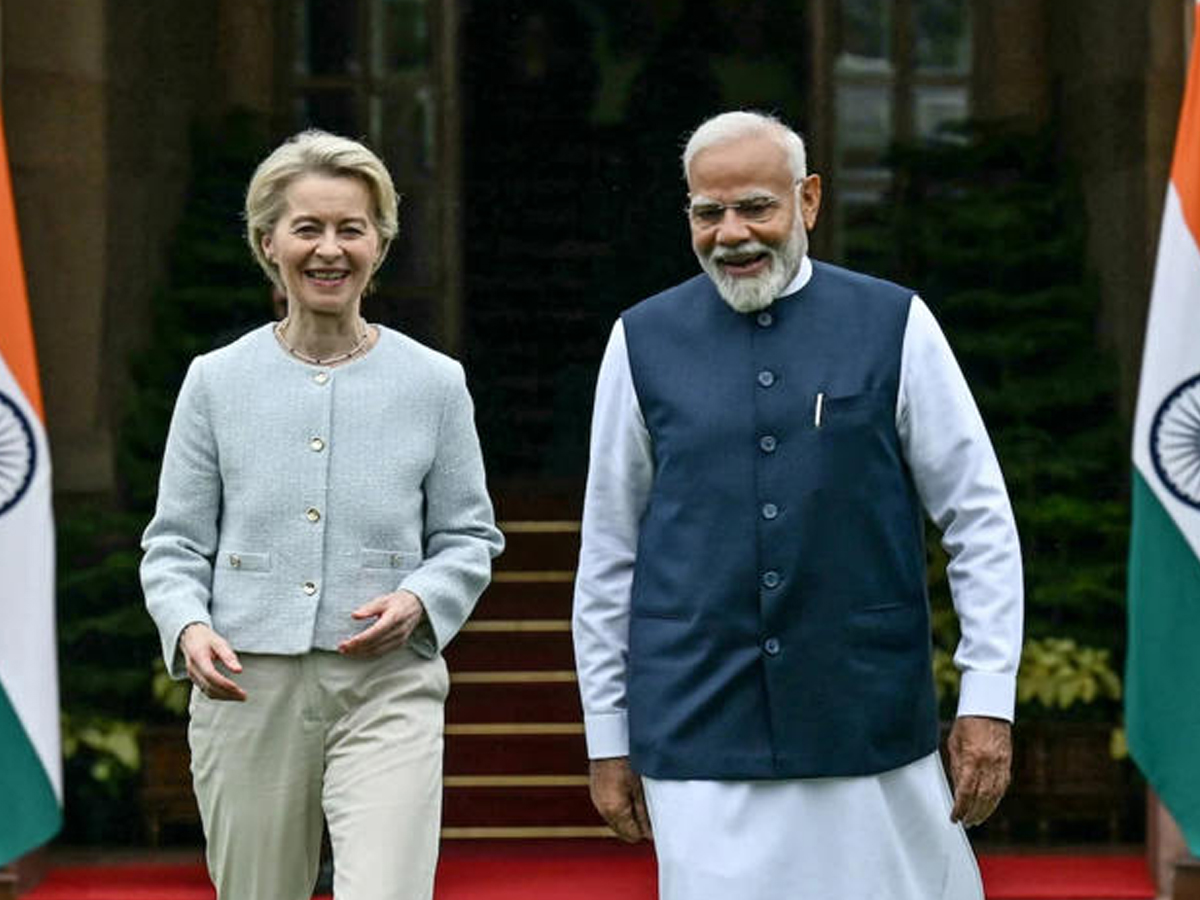
The agreement is being described by the government as the “mother of all deals” because of the scale of trade and economic exposure involved. (File Photo)
New Delhi: Prime Minister Narendra Modi announced the conclusion of the India–European Union free trade agreement on Tuesday noon at the India–EU Summit , with Ursula von der Leyen, President of the European Commission, and António Costa, President of the European Council, present. The announcement marked the political conclusion of negotiations between India and the European Union, with both sides stating that the legal text will now undergo technical scrutiny and ratification.
Officials on both sides have indicated that the agreement is expected to come into force in 2027, subject to approvals in India and across EU member states.
The agreement is being described by the government as the “mother of all deals” because of the scale of trade and economic exposure involved. India’s goods trade with the EU currently stands at about USD 136 billion a year, with Indian exports of roughly USD 76 billion and imports of about USD 60 billion. When services are included, total bilateral trade is estimated at close to USD 180 billion annually, making the EU India’s largest trading partner as a bloc and accounting for nearly 17 to 18 percent of India’s total exports.
None of India’s recent free trade agreements operate at this base. Goods trade with the UAE is around USD 85 to 90 billion, with Australia about USD 25 to 30 billion, and with the EFTA countries combined under USD 20 billion.
The size of the partner economy further distinguishes the agreement. The European Union represents a USD 17 trillion economy spanning 27 countries and a population of about 450 million, with per capita incomes far higher than those of India’s other FTA partners. India has not previously concluded a trade agreement with an economic bloc of comparable scale, regulatory integration, or purchasing power.
From the European Union’s side, the agreement with India ranks among its most significant trade pacts, though it is not the EU’s largest by current trade volume. The EU has more than 40 trade agreements in force with over 70 partners, including major comprehensive agreements with Japan, Canada, South Korea, Vietnam, and the United Kingdom. In terms of existing trade flows, the EU’s agreements with Japan and the UK currently cover higher annual trade volumes than EU–India trade, reflecting their status as top EU trading partners. India, by contrast, is currently the EU’s ninth-largest goods trading partner.
EU officials and trade data nevertheless place the India agreement among the bloc’s most consequential in structural terms. The pact links two large economies with a combined GDP of roughly USD 20 trillion and a combined population approaching two billion people, a scale matched by only a handful of EU trade agreements globally. It is also among the most comprehensive in scope, covering goods, services, investment, regulatory cooperation, and sustainability-related provisions, placing it alongside the EU’s deepest and most ambitious FTAs rather than its narrower tariff-focused deals.
The breadth of the agreement also sets it apart from India’s recent trade pacts. Unlike agreements with the UAE or Australia, which are largely centred on tariff reductions in goods, the India–EU FTA places services and investment at the core. India’s services exports to the EU are estimated at USD 45 to 50 billion a year, far exceeding services trade with Australia or the UAE, and concentrated in IT, professional services, engineering, and business services.
The duration of the negotiations underlines the complexity involved. Talks between India and the EU began in 2007, stalled for much of the last decade over disagreements on automobiles, dairy, intellectual property rights, labour standards, and data protection, and were formally relaunched only in 2022. With the political conclusion announced in 2026, this becomes the longest and most complex trade negotiation India has concluded, compared with one to three years for most of its recent agreements.
The agreement is also being positioned as a key component of India’s push towards a USD 5-trillion economy. India’s nominal GDP is currently estimated at around USD 3.5 to 3.6 trillion, implying the need to add roughly USD 1.4 to 1.5 trillion in output to reach the target. Exports of goods and services together account for about 22 to 23 percent of GDP, making sustained export growth a material driver of overall economic expansion.
Publicly cited estimates suggest that India–EU trade could rise to USD 230 to 250 billion within a decade of implementation, with some projections extending to USD 260 to 280 billion by 2036. Even the lower end of that range implies a substantial increase in trade flows linked to India’s largest high-income export market. Officials point out that the composition of this trade matters as much as the headline numbers, as the EU absorbs a significant share of India’s higher-value exports in pharmaceuticals, engineering goods, chemicals, auto components, and IT and professional services.
Investment linkages further reinforce the agreement’s role in the growth strategy. EU companies hold an estimated EUR 100 billion in cumulative foreign direct investment stock in India, while Indian firms have invested roughly EUR 40 billion in the EU. Provisions affecting investment protection, procurement, and regulatory certainty are expected to support investment-linked production and exports, contributing to capital formation and industrial output.
While the FTA alone does not deliver a USD 5-trillion economy, policymakers see it as a structural enabler that will strengthen export growth, services expansion, investment inflows, and industrial upgrading. Those factors, taken together, explain why the India–EU free trade agreement is being positioned as exceptional both within India’s recent trade policy and within the European Union’s own network of trade agreements.
