
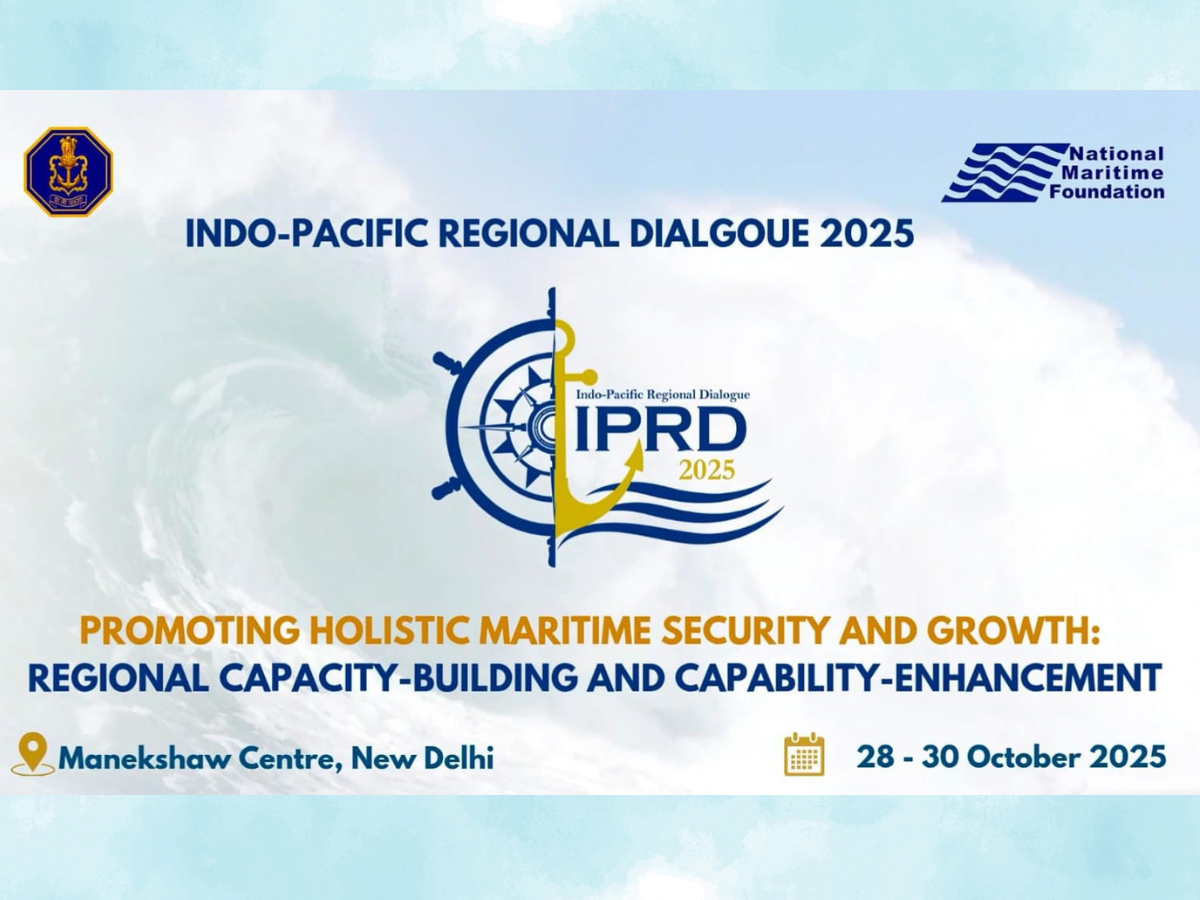
The Indian Navy will convene the Indo-Pacific Regional Dialogue (IPRD) 2025 in New Delhi from October 28 to 30, gathering naval leaders, diplomats, and policy experts to examine how nations can build capacity and enhance capabilities across one of the world’s most strategically dynamic regions.
Hosted at the Manekshaw Centre with the National Maritime Foundation (NMF) as knowledge partner, the annual conference serves as India’s principal platform for strategic-level maritime engagement.
This year’s theme — “Promoting Holistic Maritime Security and Growth: Regional Capacity-Building and Capability-Enhancement” — underscores a shift from conceptual deliberation to implementable cooperation across the Indo-Pacific.
A Framework Anchored in the Indo-Pacific Oceans Initiative
Each edition of IPRD builds upon the pillars of the Indo-Pacific Oceans Initiative (IPOI), launched by Prime Minister Narendra Modi at the 2019 East Asia Summit in Bangkok. The IPOI delineates seven interconnected “lines of thrust,” ranging from maritime security and marine ecology to trade connectivity, capacity building, and disaster risk reduction.
Several nations — including the UK, Japan, France, Australia, and Indonesia — have volunteered to co-lead these verticals, with India steering multiple key areas such as maritime security and disaster management.
Over the six years since its conception, the IPOI has matured from an aspirational construct into a cooperative web linking regional and extra-regional partners. For India, it translates the country’s maritime doctrine into practice through the framework known as MAHASAGAR — Mutual and Holistic Advancement for Security and Growth Across Regions.
Expanding the Scope: From Vision to Execution
The Indian Navy positions IPRD as an “executive layer” complementing existing regional structures such as the Indian Ocean Naval Symposium (IONS) and the Western Pacific Naval Symposium (WPNS). With India once again chairing IONS, officials see renewed momentum for maritime collaboration across the Indo-Pacific arc stretching from the eastern coast of Africa to the western shores of the Americas.
“Holistic maritime security and mutually reinforcing growth across the Indo-Pacific is not an abstraction — it’s the desired end-state,” said a senior naval official familiar with the dialogue’s planning, noting that IPRD 2025 aims to move beyond problem enumeration to practical policy pathways.
Key Themes: Resilience Through Partnerships
The agenda will address capacity-building, strategic coordination, blue economy initiatives, and climate resilience — areas that have become increasingly urgent as the region faces overlapping challenges: intensifying geopolitical rivalries, disruptions in global supply chains, and the mounting consequences of climate change.
Delegations will explore how technology, infrastructure, and shared training can help nations in the region withstand such pressures while preserving freedom of navigation and sustainable development.
A Strategic Geography, Not a Strategy
Indian policymakers emphasise that the Indo-Pacific is “a strategic geography, not a strategy” — a space where India’s multiple maritime and economic policies converge. Within this expanse, the IPRD provides both intellectual and operational ballast to India’s effort to shape an inclusive and rules-based maritime order.
By convening stakeholders across the governmental, military, and academic spectrum, the dialogue seeks to transform maritime vision into sustained regional practice — ensuring that cooperation, not competition, defines the oceanic commons of the Indo-Pacific.
(Aritra Banerjee is a Defence, Foreign Affairs & Aerospace Journalist and co-author of The Indian Navy @75: Reminiscing the Voyage. Having spent his formative years in the United States before returning to India, he combines a global outlook with on-the-ground insight in his reporting. He holds a Master’s in International Relations, Security & Strategy from O.P. Jindal Global University, a Bachelor’s in Mass Media from the University of Mumbai, and Professional Education in Strategic Communications from King’s College London (War Studies). With experience across television, print, and digital media.)




